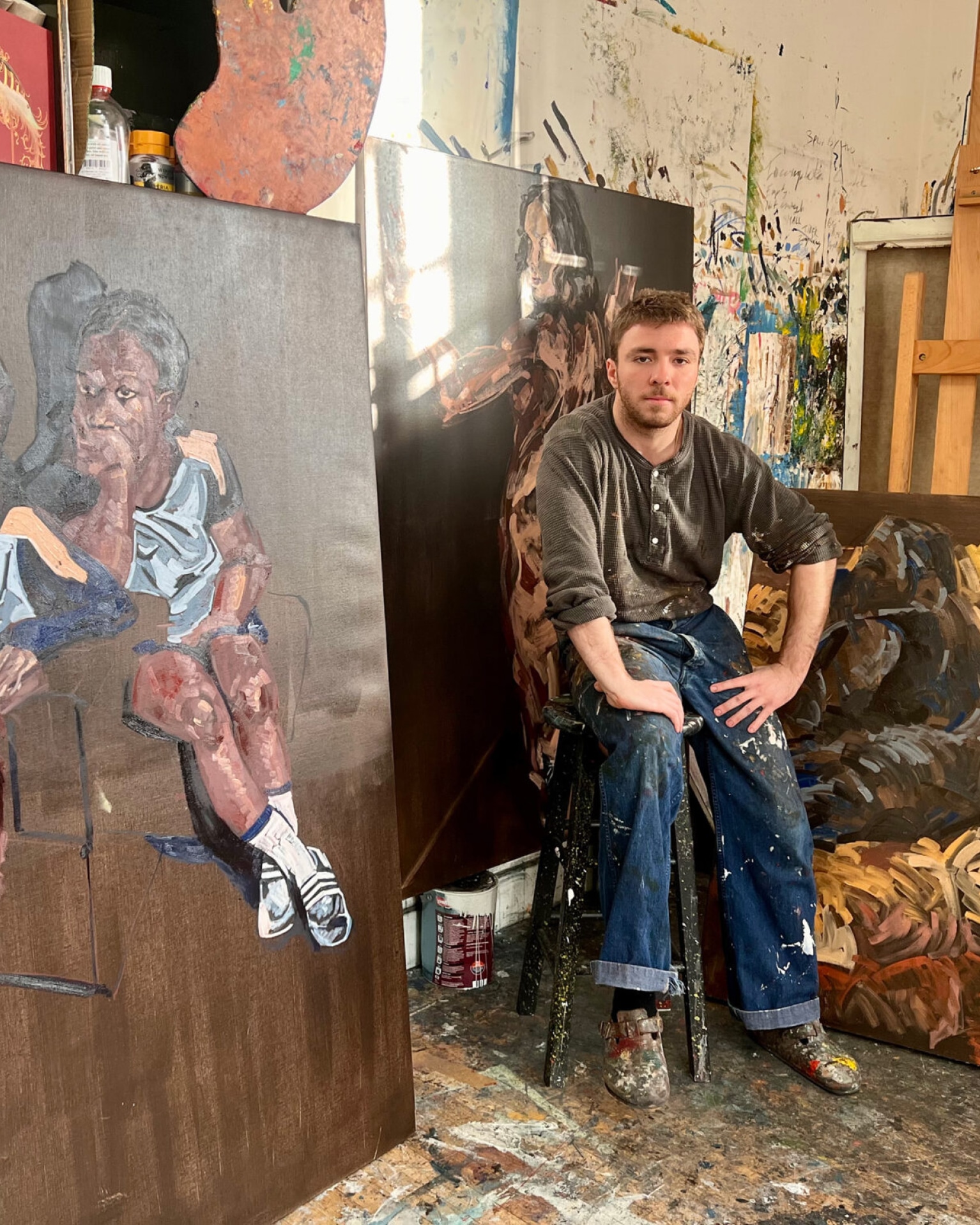
On the eve of his new exhibition Talk is Cheap, Rocco Ritchie opens the doors to his Chelsea studio
Photography Alec Maxwell
Rocco Ritchie is fast establishing himself as a rising force in contemporary art. With his latest exhibition opening in London this week, we meet the artist.
It’s a bright December afternoon in Chelsea. As Londoners make the most of an unexpected wash of winter sun, Rocco Ritchie is holed up in his studio – with good reason. In less than 24 hours, he will open Talk is Cheap, his latest exhibition.
Born in Los Angeles to Madonna and Guy Ritchie, the 25-year-old artist has spent the past few years quietly honing his practice. After studying fine art at Central Saint Martins and the Royal Drawing School, Ritchie has been steadily carving out a reputation of his own. His major solo debut arrived in Miami’s Design District with Pack a Punch (2024), a series of charcoal portraits of Muay Thai fighters; later that year, a collaboration with Giorgio Armani explored the isolations of fame through paparazzi-inspired paintings in Paris. For this latest body of work, his search for inspiration took him to Italy’s west coast.
Following a summer spent in the Tuscan village of Carrara – the historic heart of marble sculpture – Ritchie returned to London with new technical fluency and fresh intent. Influenced by figures ranging from Leonardo da Vinci and Lee Miller to Michelangelo, Caravaggio and his mentor, Tony Cassanelli, the evolution is evident.
Talk is Cheap brings together recent sculptural works, a 500-kilo slab of Spanish marble and a painted portrait of his twin sisters, Stella and Estere. Ritchie describes the exhibition simply as “just a little bit of me”. On the morning of the opening at The Painting Rooms, he opens the doors of his studio to EE72 to discuss process, discipline and his new chapter.
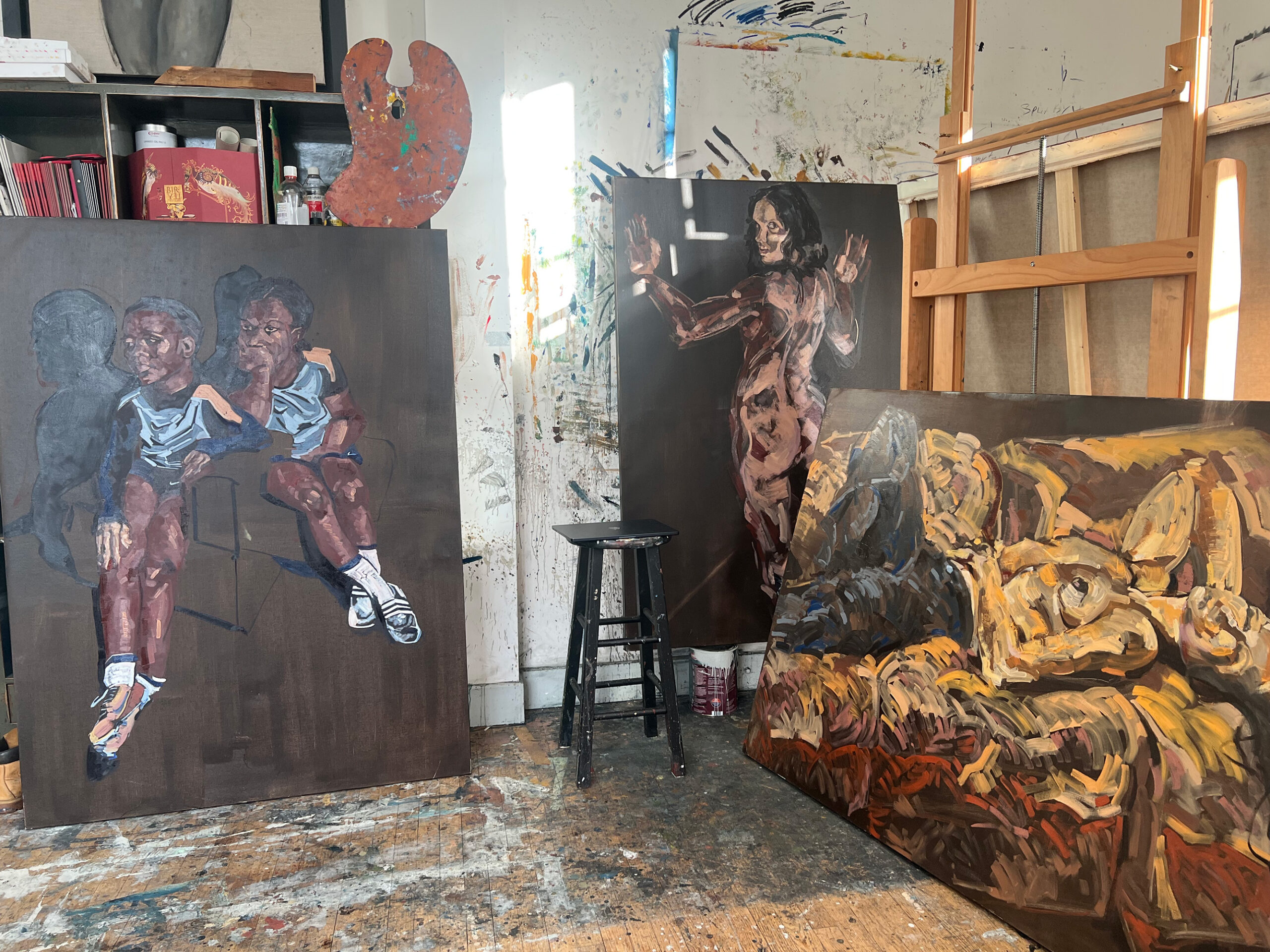
Your upcoming show is called Talk is Cheap, tell us about your choice of name?
There are a few reasons. The main reason being that you will always have reasons why you should or shouldn’t have an exhibition. I spent so much time thinking, ‘I need a concept or an idea. I need a certain amount of paintings. I need a space.’ I felt like I got so lost in the preparation of the work and because of that, I lost track of actually making the work. Talk is Cheap says, it doesn’t matter how well-prepared you are or how perfectly you line up the practical side of the exhibition – it comes down to what you actually do. Also, I don’t think you need a degree or to have a real understanding of art; I think the work has to speak to you. I know it sounds simple, but I think the whole point of a painting is to look at it, not necessarily knowing anything about it, and to feel something.
The work has to speak to you. The whole point of a painting is to look at it, not necessarily knowing anything about it, and to feel something.
ROCCO RITCHIE
You’ve said you want this show to create “conversation that goes beyond words”. Are there any particular ideas or emotions you are hoping to relay?
It’s personal. These are my friends and my family. This is in my space where I spend most of my time. I feel like this show is just a little bit of me. Whether the world needs it or not is a separate question. I think it’s just a little look into my mind and life.
You’ve chosen to focus on raw materials such as wood and marble in the show. Why was it important for you to have these materials at the show’s nucleus?
This is a show I’ve put on with my friend, Tony Cassanelli. He’s also a teacher to me because I spent my summer with him in Carrara, Tuscany, doing a sculpture workshop. I learnt how to mix pigment and to work with everything from its rawest form. I learnt how to make my own stretches and do everything with material rather than having to rely on outsourcing. If you have some form of technical ability, I think the work is much more intense and powerful.
How did that trip come about?
I’ve known Tony for years, and he’s always said that I should come to Carrara. I was kind of fed up with dossing around. I was doing some heavy dossing, as most people do at the beginning of summer. I was like, ‘Alright, I need to get my act together and put some hours in.’ I flew there with no real plan of how long I was going to stay. I committed to being in the mountains and just grafting. He taught me so much, and not just about the work. I studied Michelangelo and Caravaggio. I studied the masters and learnt about the world of art, painting and sculpture.
Do you have a main takeaway from that experience?
I think it humbled me a lot because I realised how much I didn’t know. Even though my technical ability to paint became slightly better, I was like, ‘Wow, I’m so far from where I want to be.’ In a way, it excited me because I was like, ‘Alright, there’s so much more work to be done. There’s so much more to be learnt.’ I could see the longer vision.
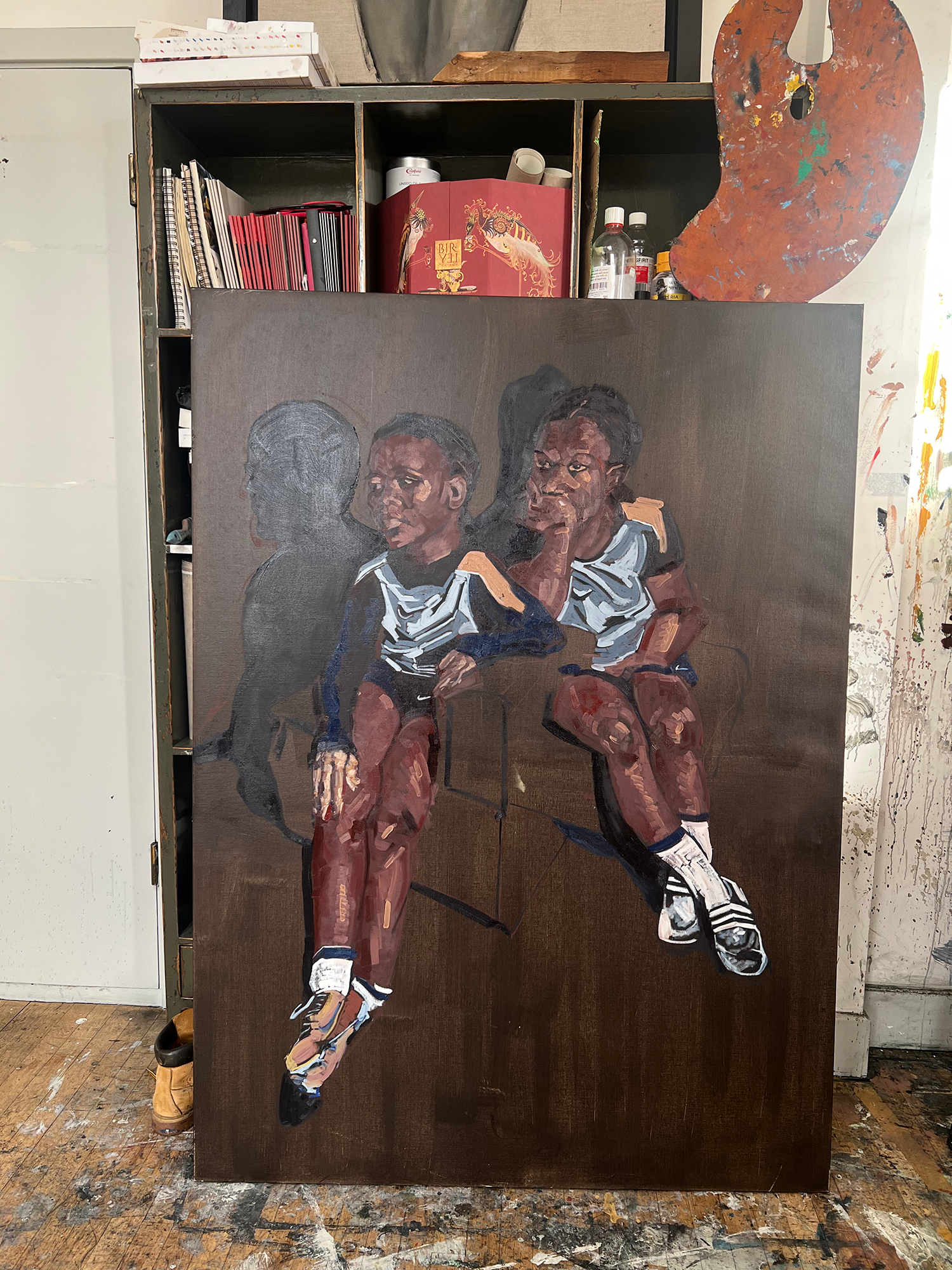
We’re currently in your studio. Do you have any studio-based rituals that help you get into a creative headspace?
I’ve got many! I drink a lot of coffee. I think it’s also good to leave the studio and come in with a fresh view, especially if you’ve been working away for hours. Otherwise, everything blends into one, and you lose that vision of what’s right and what’s wrong. I also do a lot of reading, and not just books. I like to look at pictures of other artists, paintings, inspiration, and endless amounts of references. That’s what drives me in the right direction.
I do a lot of reading, and not just books. I like to look at pictures of other artists, paintings, inspiration, and endless amounts of references. That’s what drives me in the right direction.
ROCCO RITCHIE
Were there any particular references that informed the collection?
My favourite current reference is Sorolla, who’s an old Spanish painter. I’m obsessed with impressionism because it’s not about the picture you’re looking at – it’s about your take on it. You need to have skill and ability to paint impressionist art, but I like the idea of asking, ‘What does your brain think of this art?’ Da Vinci and Caravaggio are always great to look at for technical inspiration. There was also a Lee Miller show at Tate Britain that made me think of London and the idea of capturing your environment.
Looking towards 2026, both professionally and personally, what are you most looking forward to?
I’m actually doing a residency in a different country. I need a fresh outlook and to end my 20s in more of an uncomfortable environment. It’s very exciting. Professionally, I’m already working on a few other shows, but I’ve got to get tomorrow’s exhibition out of the way first.
This is the last 24 hours before your show’s opening. What does the rest of your day look like?
I’m debating whether to accept what my last few paintings look like. Realistically, I probably won’t. I’ve done enough work and, at some point, you have to accept that this is the work. You also run the risk of making the painting worse, which I’m slightly in the territory of doing.
Is there anything else you wanted to let us know?
The support group around me has really stepped up and shown its generosity. I wouldn’t be here without my family and friends, and I really want to thank them for putting in the effort, being there for me, and pushing me when I needed it.
Talk is Cheap is open now at The Painting Rooms in London
The art of understatement: Jacqueline Rabun and the enduring appeal of minimalism The art of understatement: Jacqueline Rabun and the enduring appeal of minimalism
The art of understatement: Jacqueline Rabun and the enduring appeal of minimalism
A photographer’s love/hate relationship with Seoul A photographer’s love/hate relationship with Seoul
A photographer’s love/hate relationship with Seoul
Tems on why protecting her peace has become her greatest success Tems on why protecting her peace has become her greatest success
Tems on why protecting her peace has become her greatest success
“I’m obsessed with pop music and think I will be forever”: Troye Sivan on new album She’s the Best “I’m obsessed with pop music and think I will be forever”: Troye Sivan on new album She’s the Best
“I’m obsessed with pop music and think I will be forever”: Troye Sivan on new album She’s the Best
Edward Enninful on the enduring impact of the 90s Edward Enninful on the enduring impact of the 90s
Edward Enninful on the enduring impact of the 90s
Topjaw’s Jesse Burgess on Gordon Ramsay, Michelin stars and building a food empire online Topjaw’s Jesse Burgess on Gordon Ramsay, Michelin stars and building a food empire online
Topjaw’s Jesse Burgess on Gordon Ramsay, Michelin stars and building a food empire online
How Lima’s young creatives are using fashion as an act of resistance How Lima’s young creatives are using fashion as an act of resistance
How Lima’s young creatives are using fashion as an act of resistance
Glen Luchford revisits his photographs that captured the spirit of the 90s Glen Luchford revisits his photographs that captured the spirit of the 90s
Glen Luchford revisits his photographs that captured the spirit of the 90s
How Lima’s young creatives are using fashion as an act of resistance How Lima’s young creatives are using fashion as an act of resistance
How Lima’s young creatives are using fashion as an act of resistance
Pat McGrath on the fearless experimentation of the 90s Pat McGrath on the fearless experimentation of the 90s
Pat McGrath on the fearless experimentation of the 90s
Hair stylist Julien d’Ys on creating Linda Evangelista’s defining pixie cut Hair stylist Julien d’Ys on creating Linda Evangelista’s defining pixie cut
Hair stylist Julien d’Ys on creating Linda Evangelista’s defining pixie cut
Backstage is where the magic happens Backstage is where the magic happens
Backstage is where the magic happens
Glen Luchford revisits his photographs that captured the spirit of the 90s Glen Luchford revisits his photographs that captured the spirit of the 90s
Glen Luchford revisits his photographs that captured the spirit of the 90s
“Messy, imperfect and full of possibility”: Reni Eddo-Lodge reflects on the early internet of the 90s “Messy, imperfect and full of possibility”: Reni Eddo-Lodge reflects on the early internet of the 90s
“Messy, imperfect and full of possibility”: Reni Eddo-Lodge reflects on the early internet of the 90s
How Chennai’s youth are reclaiming identity through radical hair How Chennai’s youth are reclaiming identity through radical hair
How Chennai’s youth are reclaiming identity through radical hair
Dressed with intent: Fashion in the 90s Dressed with intent: Fashion in the 90s