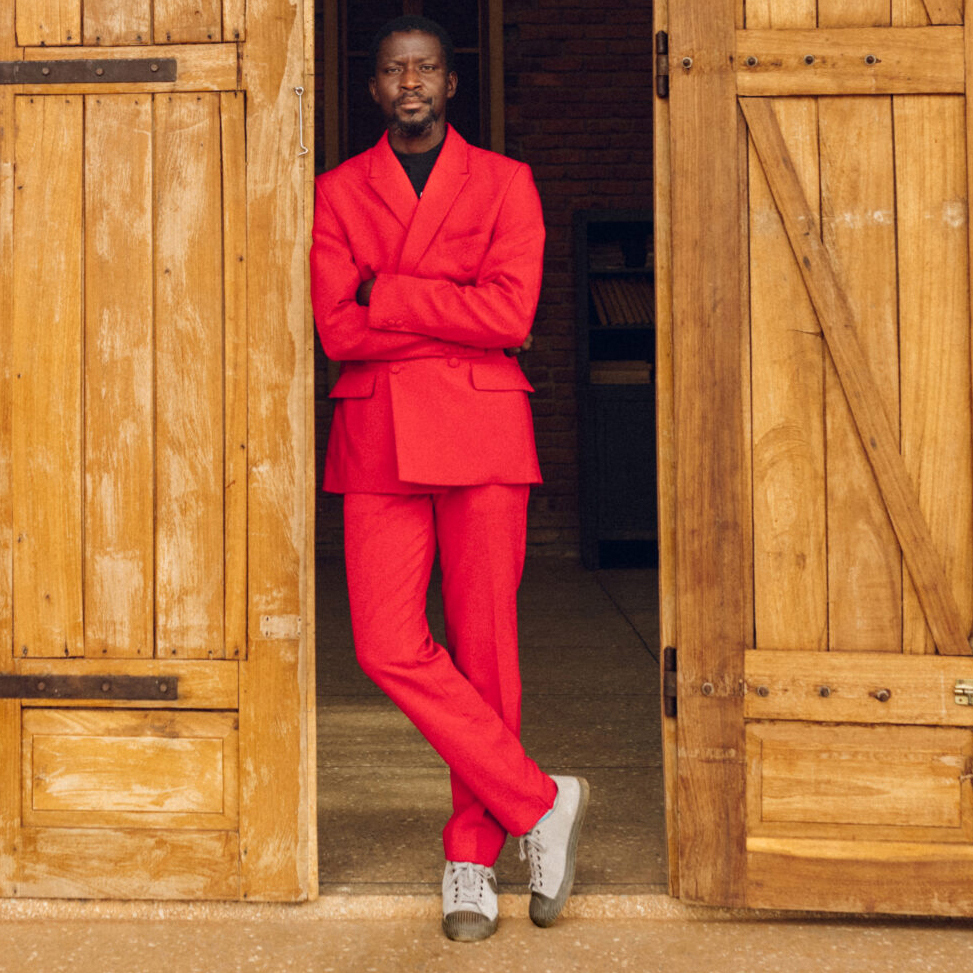
Ghanaian artist Ibrahim Mahama’s Parliament of Ghosts comes to London
As the first exhibition in Ibraaz, a new cultural space, it is an invitation to dialogue and repair. EE72 Contributing Art Editor Dominique Heyse-Moore revisits the collection.
“I am mostly interested in how we fix things that are broken.” Ibrahim Mahama.
In 2018, artist Ibrahim Mahama took me to places tourists do not think to visit in Ghana. The vast and infamous Agbogbloshie market and settlement in Accra and overgrown former industrial sites across the country. We walked lush disused train tracks and on deep layers of detritus from the Global North.
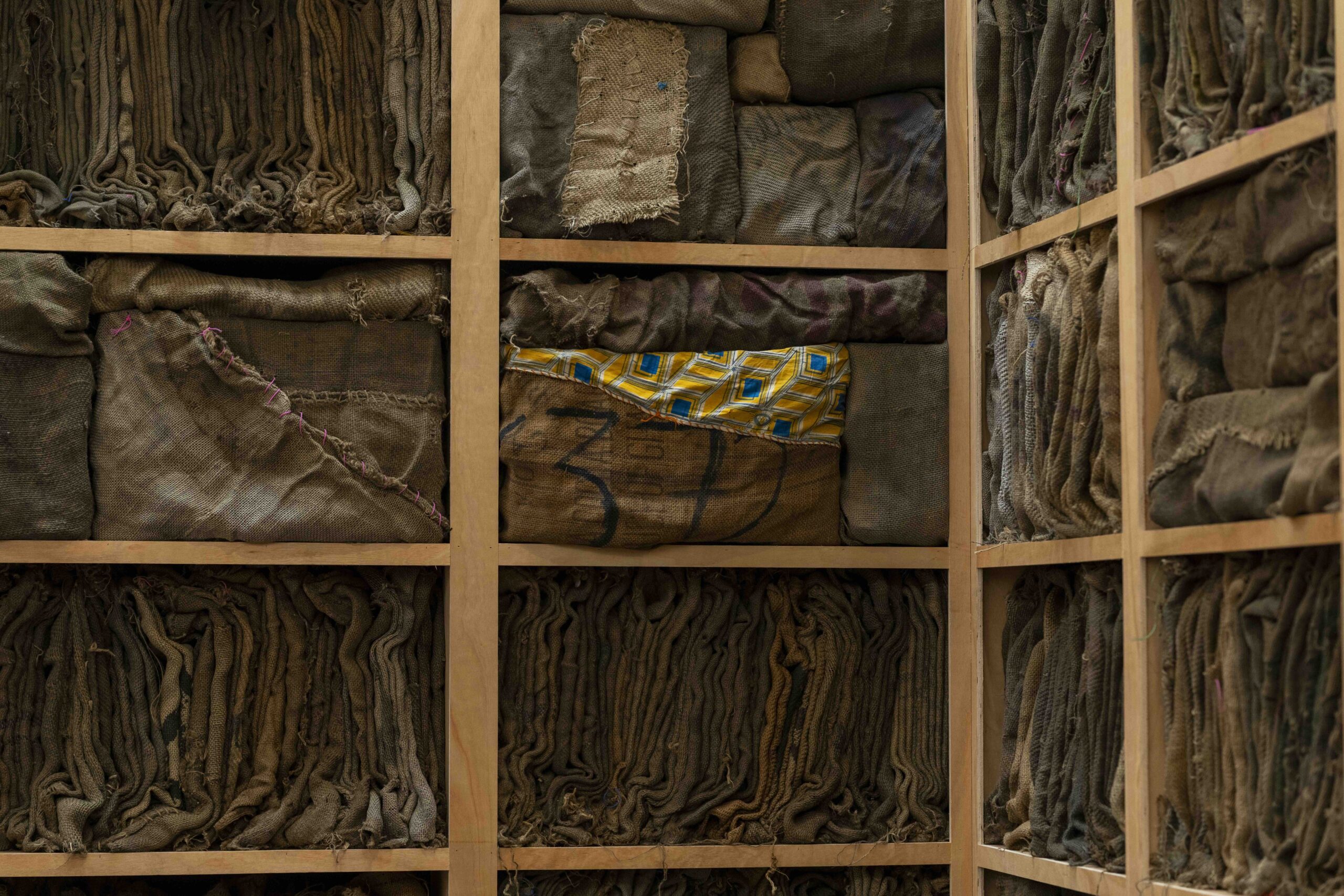
These places are where he seeks objects that are beyond the point of repair: he collects enormous quantities of fossil fuel impregnated sacks, old industrial sewing machines, splintered furniture and other timber, rusted pots, rotten boxes, defunct textbooks, out-of-date maps. They speak of colonial extraction by the British, the new hope of independence and the skilful resourcefulness of people. Rather than at the end of their life, he sees these things as encrusted with soul, history and potential, the perfect materials for an art practice about recognising strength and resourcefulness within Ghana.
A shipping container crammed with these exhausted items set off from the port in Takoradi — where Edward Enninful was born — to Manchester to create the first Parliament of Ghosts (co-commissioned by the Whitworth Art Gallery, The University of Manchester and Manchester International Festival 2019, a biennial festival of ambitious new work). We built a gloriously rough and ready parliament, with its own archive of twentieth-century Ghanaian material.
Visitors could look through discarded textbooks, old colonial maps and plans. Third class train seats, worn to a shine by innumerable journeys, were attached to monumental tiered structures. The parliament was brought to life by events, some programmed by the gallery, but we accepted requests to use it for open mike nights, Extinction Rebellion gatherings, poetry slams and more.
Courtesy of Ibraaz and Ibrahim Mahama
The architectural plans and materials for this first iteration travelled back to the north of Ghana to the city of Tamale, where Mahama is from and is continually building a vast infrastructure for art, including the Red Clay Studio complex, which houses at least two out-of-use aeroplanes. The ambition to create art spaces where there were none for many hundreds of miles is breathtaking; thousands of school children have already visited.
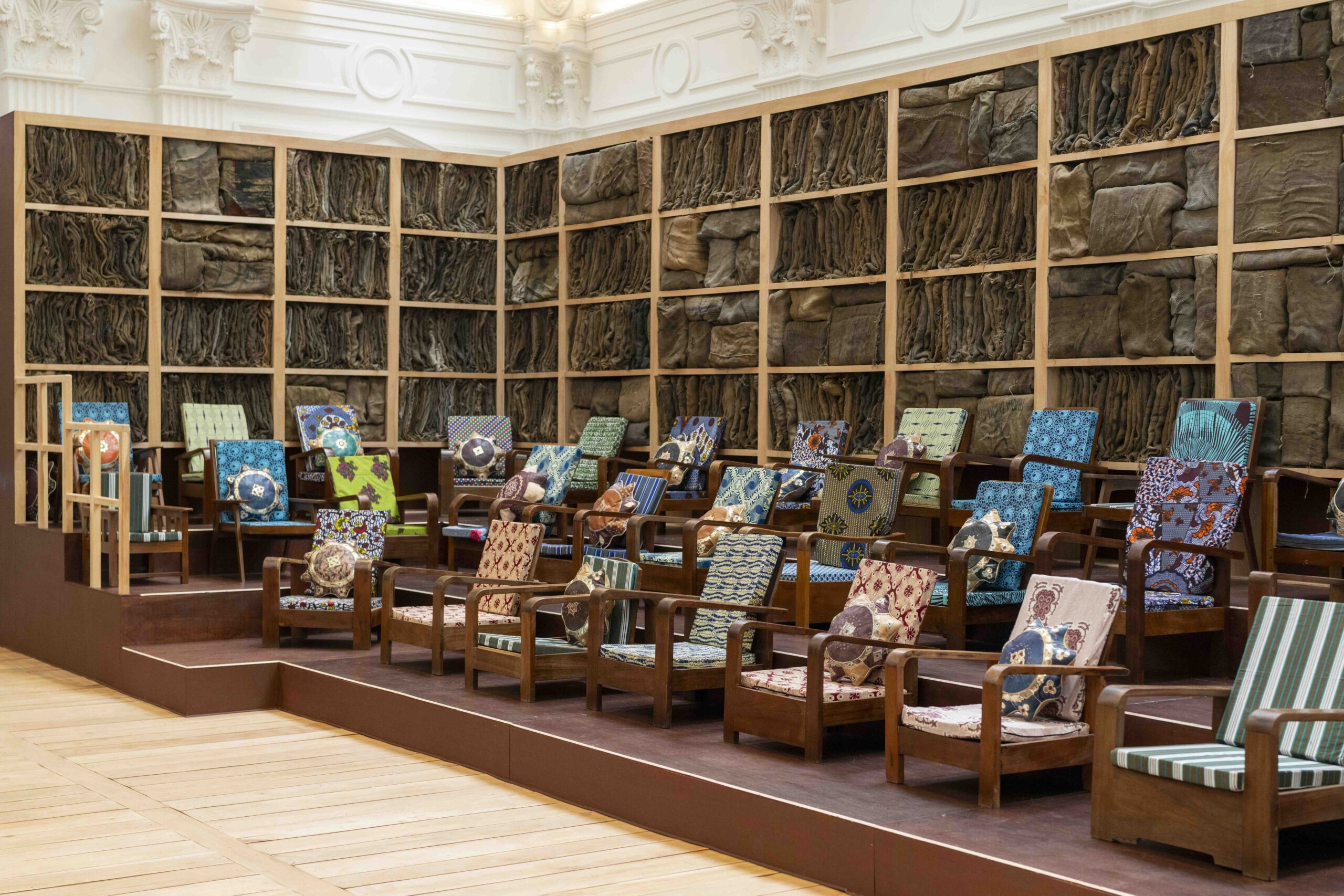
He wants them to remember that they were there when it was first made. It is the antithesis of a London heavy with art institutions. The Parliament of Ghosts continues to travel the world and has now found its closest resting place to the original Parliament in the Palace of Westminster. These remnants of Ghanaian history return to the heart of the British Empire. As the first exhibition in Ibraaz, a new cultural space in central London, it is an invitation to dialogue and repair.
The new parliament is a little more comfortable than our Manchester version. A women’s collective in Tamale upholstered the seats of salvaged chairs with African wax print cloth they selected from the market. There is also a reversal. Ibrahim Mahama’s understanding of the ‘remnants’ he gathers in Europe is a wonderful one. He is an internationally lauded and award-winning artist represented by White Cube; he understands the capital from this success as an artist’s material, which he feeds back into the labour and creativity of his collaborators in Ghana. He taught me that even the very brokenness of the art world can be used as a material with which to fix it.
Courtesy of Ibraaz and Ibrahim Mahama
Read more:
— Inside Ibraaz: A New Cultural Space Celebrating the Global Majority
— Past and Present Intertwine at Uzbekistan’s Bukhara Biennial
— View Finder: Photographer Jude Lartey and the Case for Slowness
How Lima’s young creatives are using fashion as an act of resistance How Lima’s young creatives are using fashion as an act of resistance

How Lima’s young creatives are using fashion as an act of resistance
Pat McGrath on the fearless experimentation of the 90s Pat McGrath on the fearless experimentation of the 90s
Pat McGrath on the fearless experimentation of the 90s
Hair stylist Julien d’Ys on creating Linda Evangelista’s defining pixie cut Hair stylist Julien d’Ys on creating Linda Evangelista’s defining pixie cut
Hair stylist Julien d’Ys on creating Linda Evangelista’s defining pixie cut
Backstage is where the magic happens Backstage is where the magic happens
Backstage is where the magic happens
Glen Luchford revisits his photographs that captured the spirit of the 90s Glen Luchford revisits his photographs that captured the spirit of the 90s
Glen Luchford revisits his photographs that captured the spirit of the 90s
“Messy, imperfect and full of possibility”: Reni Eddo-Lodge reflects on the early internet of the 90s “Messy, imperfect and full of possibility”: Reni Eddo-Lodge reflects on the early internet of the 90s
“Messy, imperfect and full of possibility”: Reni Eddo-Lodge reflects on the early internet of the 90s
How Chennai’s youth are reclaiming identity through radical hair How Chennai’s youth are reclaiming identity through radical hair
How Chennai’s youth are reclaiming identity through radical hair
Dressed with intent: Fashion in the 90s Dressed with intent: Fashion in the 90s