Perfume’s first provocateur: how Elsa Schiaparelli still shapes fragrance culture today
From gender-fluid perfume to surreal packaging and scandalous campaigns, Elsa Schiaparelli transformed beauty into theatre decades before the industry caught up. Anita Bhagwandas explores the designer’s radical perfume legacy and its lasting influence on modern fragrance
Walking into the perfume room at the V&A’s Schiaparelli exhibition feels a little like stepping into a beauty fever dream.
Whimsical illustrated adverts line the faux fur walls, nestled next to fragrance bottles shaped like smoking pipes, burning candles and women’s torsos. Looking around at Schiaparelli’s perfume universe, it feels like seeing the past, present and future of fragrance collapsing into one single trippy frame. It also offers a glimpse into what it might have felt like to step inside her famous birdcage-style perfume aviary, installed in her Paris perfume boutique back in the 1930s.
We know Italian designer Elsa Schiaparelli as fashion’s original disruptor: the woman behind lobster dresses, skeleton gowns and the electric audacity of the colour Shocking Pink. But the strongest proof of Schiaparelli’s influence on our modern world isn’t in her fashion archives. It’s sitting on vanity tables across the globe to this day.
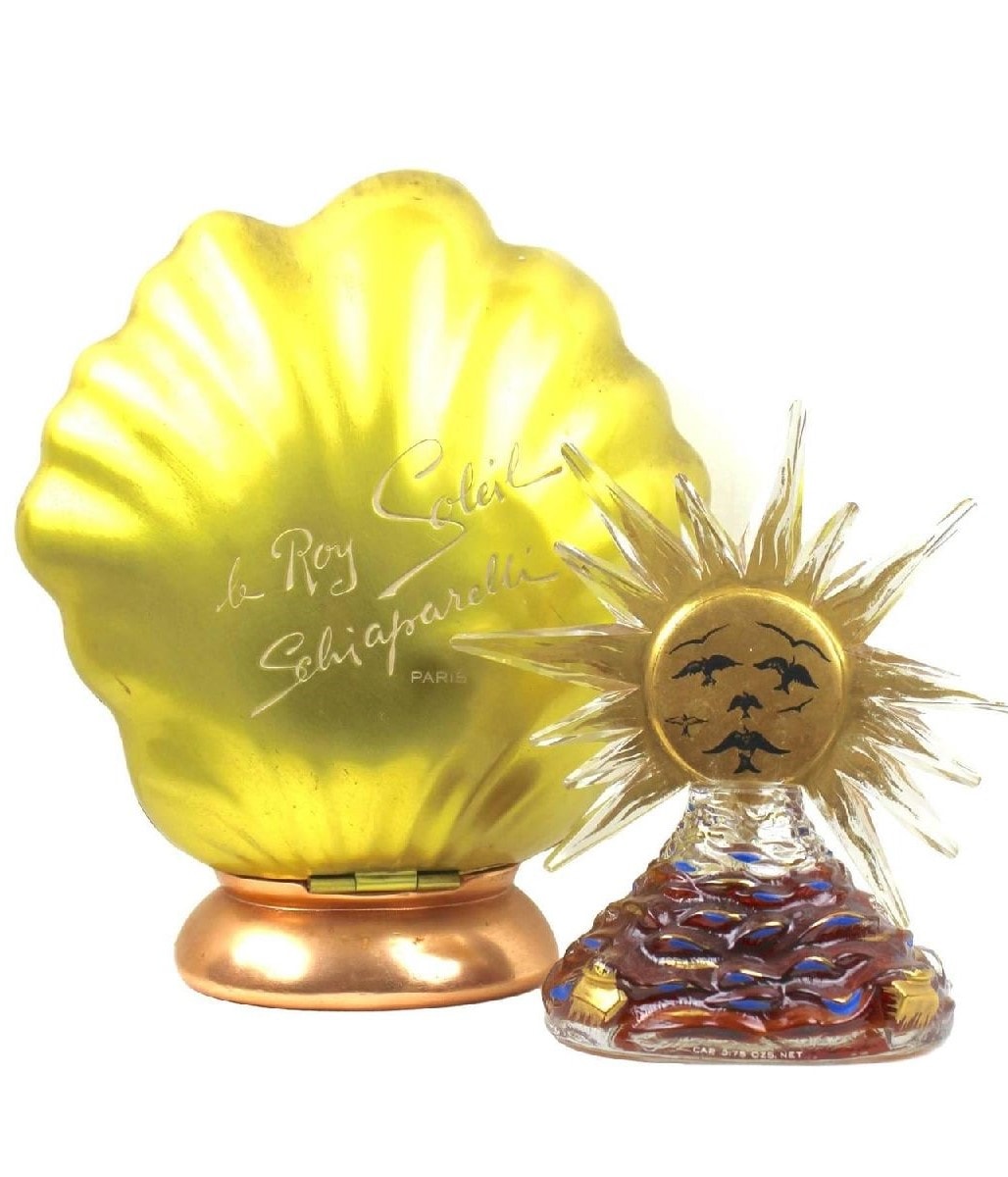
SALVADOR DALI ‘LE ROI SOLEIL
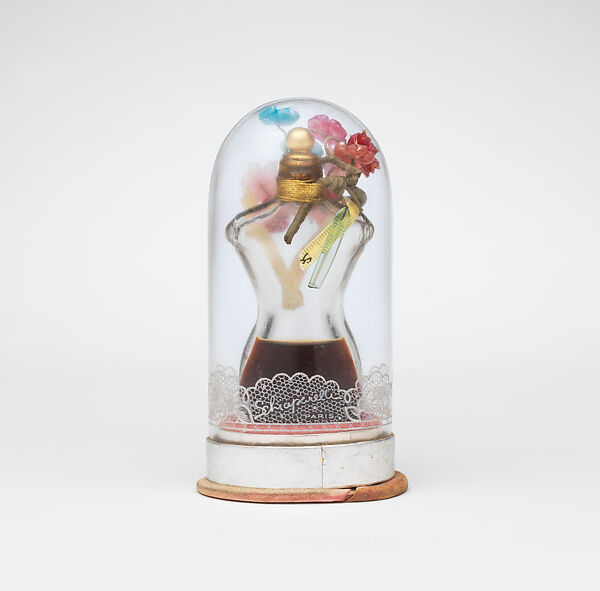
SCHIAPARELLI ‘SHOCKING’ (1937)
She rewrote the gender rules of scent
Today, perfume aisles are laden with minimalist, gender-neutral fragrances of every kind. Though we tend to think of ’90s classics like CK One as pioneers of the trend in modern times, Elsa Schiaparelli was already exploring this some 70 years earlier. Not as a marketing tool, but as a reaction to the political landscape.
The 1920s had produced a new kind of woman. Flappers cut their hair into severe Eton crops, borrowed from masculine tailoring and openly challenged expectations around beauty and behaviour. Women smoked in public, drank in speakeasies and increasing numbers entered the workforce and began earning their own money. Financial independence was reshaping social expectations and, with it, ideas around gender itself.
Fragrance, however, remained rigidly binary. The era’s defining female scents, from Chanel No. 5 to Guerlain’s Shalimar, modernised perfumery but still remained closely aligned to conventional ideas of femininity. But Schiaparelli imagined something more fluid and in 1928, she launched S, a scent designed for both women and men. In the late 1920s this was entirely disruptive. As were the fragrance notes themselves; S was laced with the softness of rose and powdery aldehydes, alongside more traditionally masculine notes of musk and cedar.
We see evidence of how she disrupted gender norms in her couture, but to me, it’s most evident in the culture-shifting way she approached fragrance. As a fierce advocate for female independence, Schiaparelli famously created her “twelve commandments”, encouraging women to step out of the shadows, reject conformity and dress for self-expression. And S was the olfactory iteration of this belief.
She continued to push gender boundaries with perfumery further than anyone had before. Her pine-infused Eau de Santé (1939) was advertised for “a queen – or a king!” – a moniker that could so easily be a modern-day perfume slogan. But above all, she wanted women to have the same freedoms as men. She saw scent as a subtle but powerful form of rebellion; a clever way to challenge gender expectations and claim space.
She made perfume bottles subversive
Back then, perfume flacons were largely designed to be elegant but unobtrusive; delicate crystal vessels with soft decorative flourishes intended to sit quietly on dressing tables without being noticed.
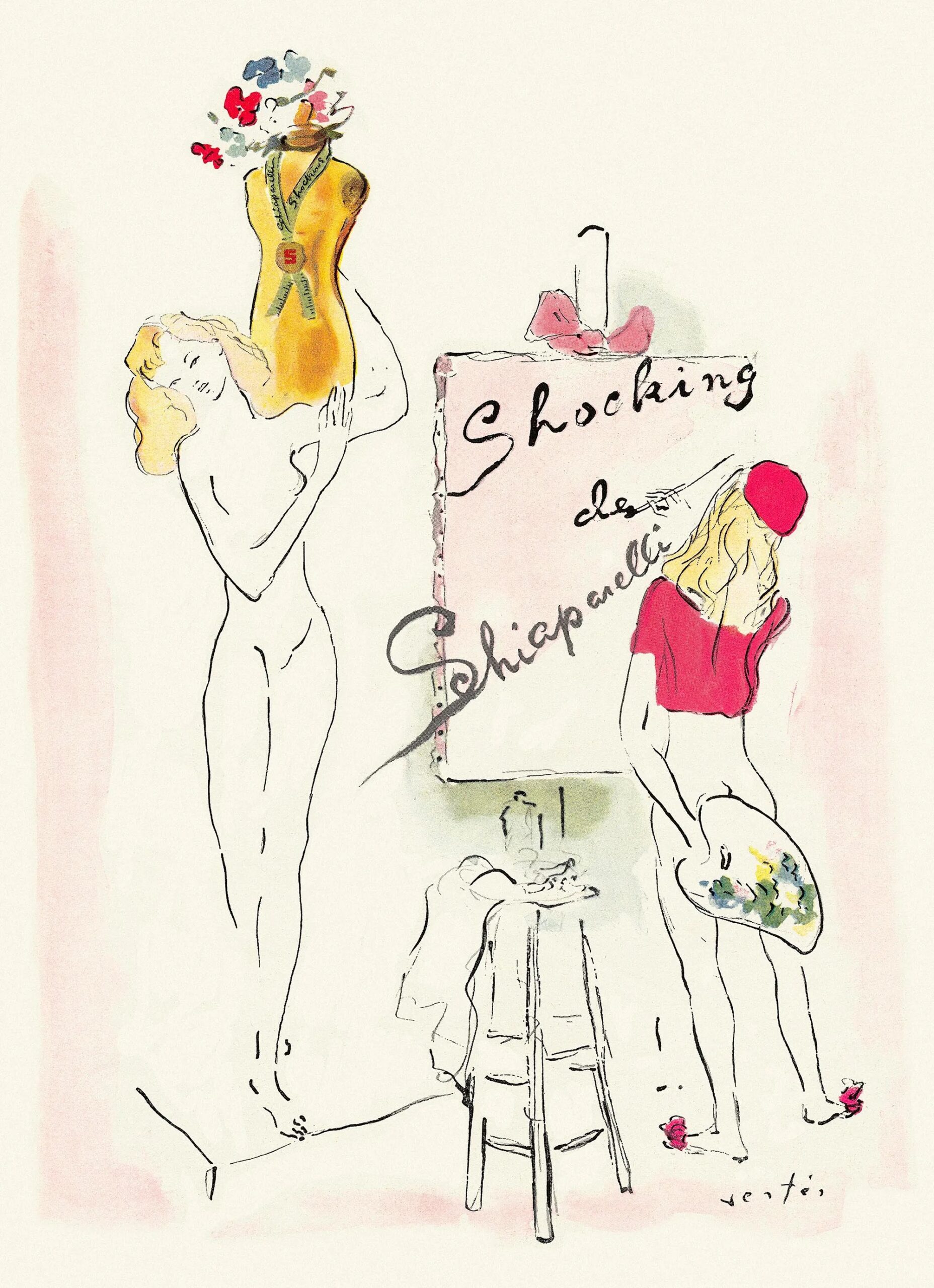
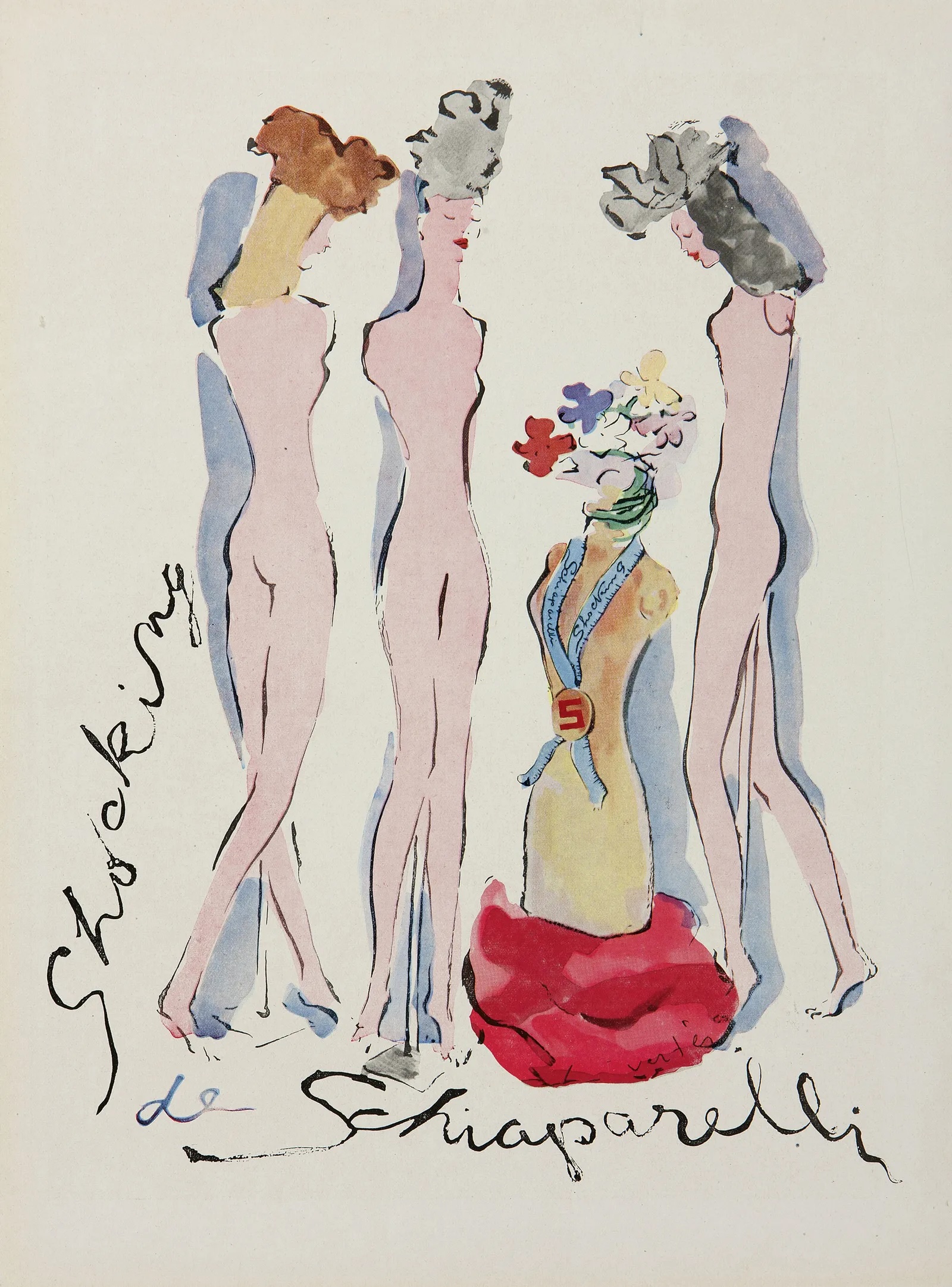
That’s because even by the 1920s, beauty still carried traces of Victorian-era shame and propriety for women. Beauty wasn’t public; it was used behind closed doors in powder rooms. Most fragrance houses accepted those limits as part of the cultural landscape, but Schiaparelli saw them as a challenge. Her most famous creation, Shocking (1937) embodied that instinct perfectly. Designed with artist Léonor Fini and inspired by the curves of Hollywood star Mae West, it arrived in the shape of a dressmaker’s mannequin with an impossibly cinched waist, flowers erupting from the neck and a measuring tape draped around its shoulders.
It was the unfathomable opposite of the modest, traditional bottles of scent made by her contemporaries like Coco Chanel or Jean Lanvin. What Shocking represented was far more radical: not an idealised version of femininity, but a body completely conscious of its own power in a changing world.
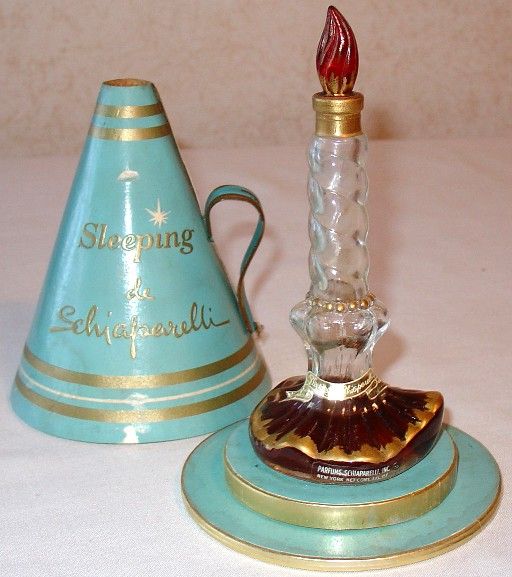
Shocking became a huge success, giving her the confidence to become bolder still with her fragrance bottle design. Sleeping (1938) came housed in a crystal candle, complete with the illusion of a flickering flame (and accompanied by a suggestive advert.) Snuff (1939) brought the same surreal wit, blurring the lines between fragrance and art through a crystal smoking pipe inspired by René Magritte’s Ceci n’est pas une pipe.
In a tumultuous period marked by war, social upheaval and shifting ideas around women’s rights, she understood something radical: objects could shape behaviour. These weren’t vessels designed to disappear into a vanity tray – they were items intended to be displayed, talked about and collected. She saw how fragrance could amplify personality; to embolden, provoke and reveal different versions of ourselves.
The proof of this is still present in modern-day perfumery; you can still see traces of her influence today in the playful torsos of Jean Paul Gaultier fragrances, or the irreverent surrealism of Moschino’s bottles. And vintage Schiaprelli bottles are highly prized items that now sell for thousands. What’s indisputable is that over a century later, the fragrance industry is still borrowing from Schiaparelli’s agenda-setting design playbook.
COURTESY OF SCHIAPARELLI
Her campaigns challenged the rules around modesty
These days, perfume advertising thrives on provocation. Theatrical campaigns, deliberately provocative fragrance names (hello, Tom Ford) and artfully dishevelled lovers have become so commonplace they’re almost expected.
But in the 1930s, fragrance advertising looked very different. Most campaigns sold one version of polished femininity through elegance, class and aspiration. Adverts from the time were all pretty similar and filled with modest women, floral motifs and a carefully curated vision of glamour.
Schiaparelli had zero interest in playing by those rules. Rather than simply selling perfume as an accessory, she built entire worlds around fragrance, by working with avant garde artists and illustrators to create her campaigns. Her adverts were unlike anything that had gone before; filled with humour, fantasy and just enough impropriety to make people look twice.
The most radical example came with Shocking. Inspired by the curves of Mae West and housed in its now-iconic mannequin-shaped bottle, the fragrance already pushed boundaries. But Schiaparelli also enlisted illustrator and set designer Marcel Vertès to create advertisements that resembled surreal storybooks rather than traditional beauty campaigns.
In one now-notorious image, a wide-eyed Little Red Riding Hood appears in a transparent dress pursued by a salivating wolf. Another image shows a topless woman carrying the perfume bottle, with the devil on a leash. Elsewhere, dreamlike figures, nude artists and fantastical scenes unfolded against washes of Schiaparelli’s signature hue, Shocking Pink. This imagery was often created with her longtime friend and collaborator Salvador Dali.
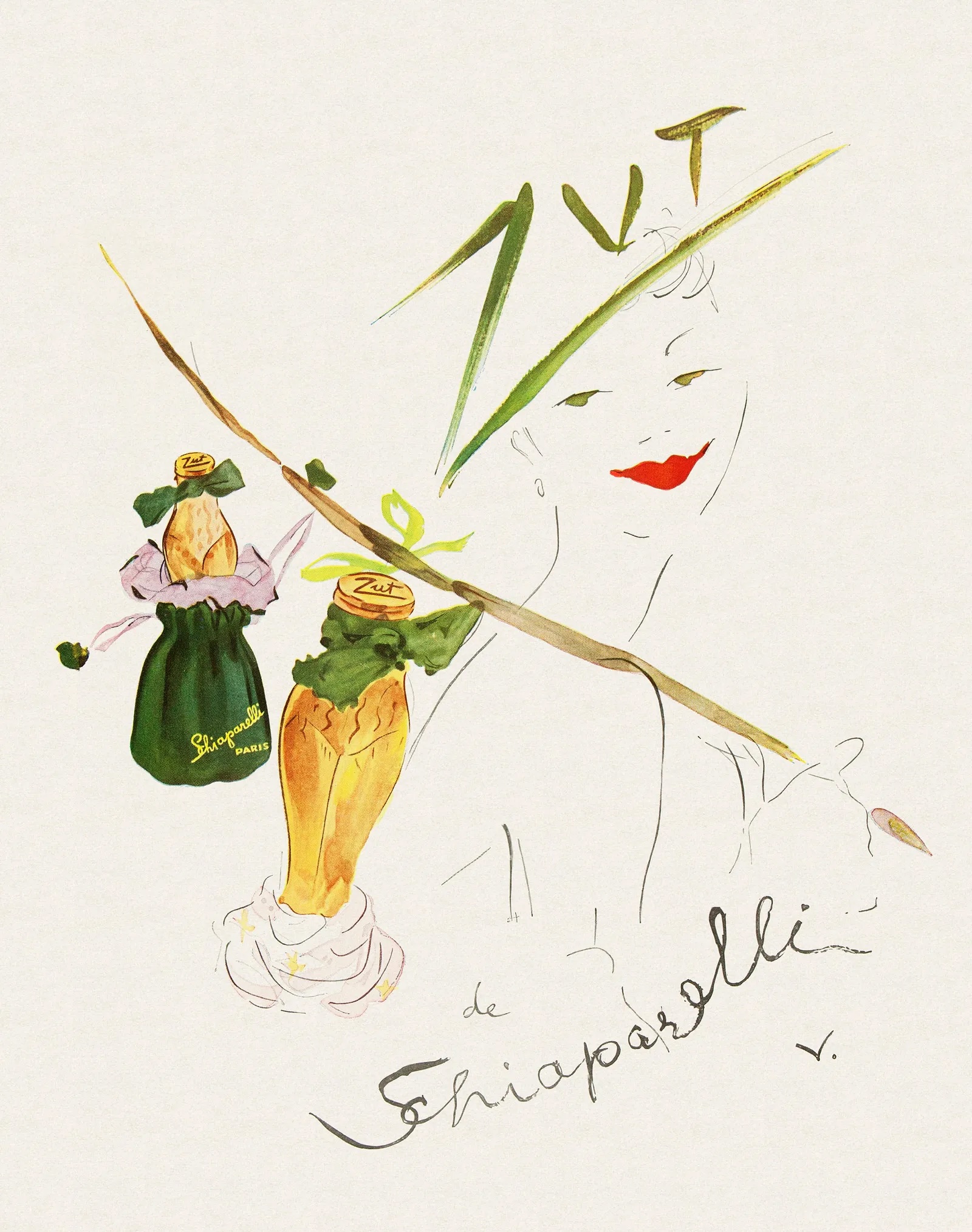
Her campaigns felt playful and absurd, which was radical in itself. But there was something knowingly subversive beneath them too as fashion, art, sexuality and fantasy collapsed into one strange universe. That same irreverence and nod to erotic fantasy ran through later launches too, Sleeping, housed in a crystal candlestick, promised to “light the way to ecstasy” while Zut (1948) captured the mood of the era with a lighthearted 1940s post-war kiss in its campaign. Schiaparelli understood something modern brands still chase with their advertising campaigns: spectacle matters, but originality is what people remember.
She didn’t just sell perfume, she changed how it was used
Perfume was always seen as the finishing touch; a daub used sparingly, reserved for wrists on formal occasions. But Schiaparelli understood that in order to reshape fragrance culture, you had to reshape how people used it.
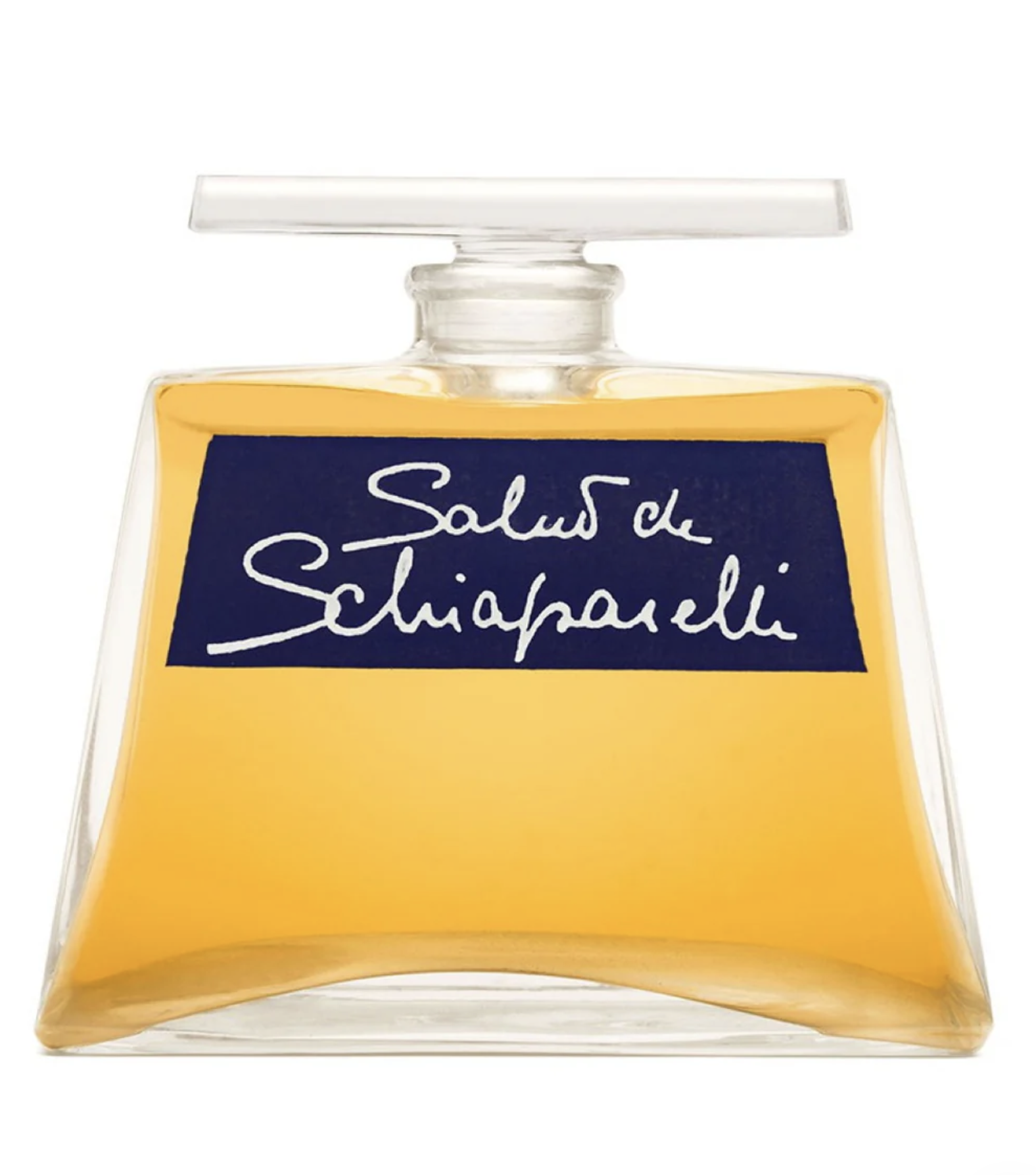
In 1934 she introduced Salut, Schiap et Soucis, the first perfume collection designed as a coordinated trio rather than standalone scents. They were intended to be worn morning, noon and night and encouraged women to think about fragrance not as a singular signature, but as something fluid and changeable throughout the day.
SCHIAPARELLI ‘SALUT, SCHIAP ET SOUCIS’, (1934)
SCHIAPARELLI ‘SLEEPING’, 1938
Today we call them fragrance wardrobes: a way of rotating scents according to mood, occasion, season or identity. The rise of daytime skin scents, trend for bedtime fragrances and TikTok’s endless “perfume layering” rituals? All of them are indebted to the way that Schiaparelli shifted how we view and use perfume.
She also pushed the mandate further with an entirely new fragrance category; perfume ancillaries. In 1943, while living in exile in New York during the Second World War,
Schiaparelli and Salvador Dalí continued their creative partnership through Shocking Radiance, a beauty line designed for the American market. It began with a range of perfumed oils, with exclusive artwork created by Dalí. More than a product launch, it reflected Schiaparelli’s growing belief that fragrance wasn’t simply something you wore. It could be a complete world: immersive, emotional and tied to identity.
The line featured scented powders, bath sponges and other perfumed accessories and that turned washing into another extension of the fragrance ritual. That blueprint feels strikingly familiar now. Hair perfumes, scented body creams, fragrant nail polishes and beauty brands selling complete lifestyle ecosystems dominate today’s market. Think the universe surrounding Glossier, the collectible culture of Rhode phone cases and lip treatments; all of that started with Schiaparelli’s vision of the future.
Fashion tends to remember her for shocking silhouettes and surreal couture. But perhaps her most lasting legacy was recognising something bigger: that identity itself could be playful, fluid and endlessly reinvented. She recognised that beauty was never really just about the product – it was a vehicle for self-expression. And with perfume, she understood something others didn’t; that it was never just a finishing touch – it was truly the main act.
The art of understatement: Jacqueline Rabun and the enduring appeal of minimalism The art of understatement: Jacqueline Rabun and the enduring appeal of minimalism
The art of understatement: Jacqueline Rabun and the enduring appeal of minimalism
A photographer’s love/hate relationship with Seoul A photographer’s love/hate relationship with Seoul
A photographer’s love/hate relationship with Seoul
Tems on why protecting her peace has become her greatest success Tems on why protecting her peace has become her greatest success
Tems on why protecting her peace has become her greatest success
“I’m obsessed with pop music and think I will be forever”: Troye Sivan on new album She’s the Best “I’m obsessed with pop music and think I will be forever”: Troye Sivan on new album She’s the Best
“I’m obsessed with pop music and think I will be forever”: Troye Sivan on new album She’s the Best
Edward Enninful on the enduring impact of the 90s Edward Enninful on the enduring impact of the 90s
Edward Enninful on the enduring impact of the 90s
Topjaw’s Jesse Burgess on Gordon Ramsay, Michelin stars and building a food empire online Topjaw’s Jesse Burgess on Gordon Ramsay, Michelin stars and building a food empire online
Topjaw’s Jesse Burgess on Gordon Ramsay, Michelin stars and building a food empire online
How Lima’s young creatives are using fashion as an act of resistance How Lima’s young creatives are using fashion as an act of resistance
How Lima’s young creatives are using fashion as an act of resistance
Glen Luchford revisits his photographs that captured the spirit of the 90s Glen Luchford revisits his photographs that captured the spirit of the 90s