From writing songs in a shed at the bottom of her parents’ garden to crafting cinematic, emotionally charged pop, 23-year-old Erin LeCount is building a mesmerising world that’s entirely her own. As work begins on her debut album, the singer, songwriter talks stage fright, solitude and why pop needs more escapism.
Erin LeCount is sitting in her shed-slash-studio. The 23-year-old singer, songwriter and producer from Essex swears it’s in this basic wooden structure situated at the end of her parents’ garden that she does her best work, although she’s recently had to declutter to keep the creative vibes high. “There was a lawnmower in here,” she laughs, “there were rakes, there were a bunch of boxes filled with nonsense.”
So far her shed-based hard work has included a suite of indulgent, unselfconsciously epic pop, including last year’s viral hit Silver Spoon and this February’s excellent six-track Pareidolia EP. Charting rocky emotional terrain and buffeted by windswept electronic textures, sky-scraping melodies and LeCount’s high-wire vocals, it feels like the perfect stepping stone for a debut album she’s tentatively just started working on. We caught up via Zoom on a grey Monday afternoon, hence the first question.
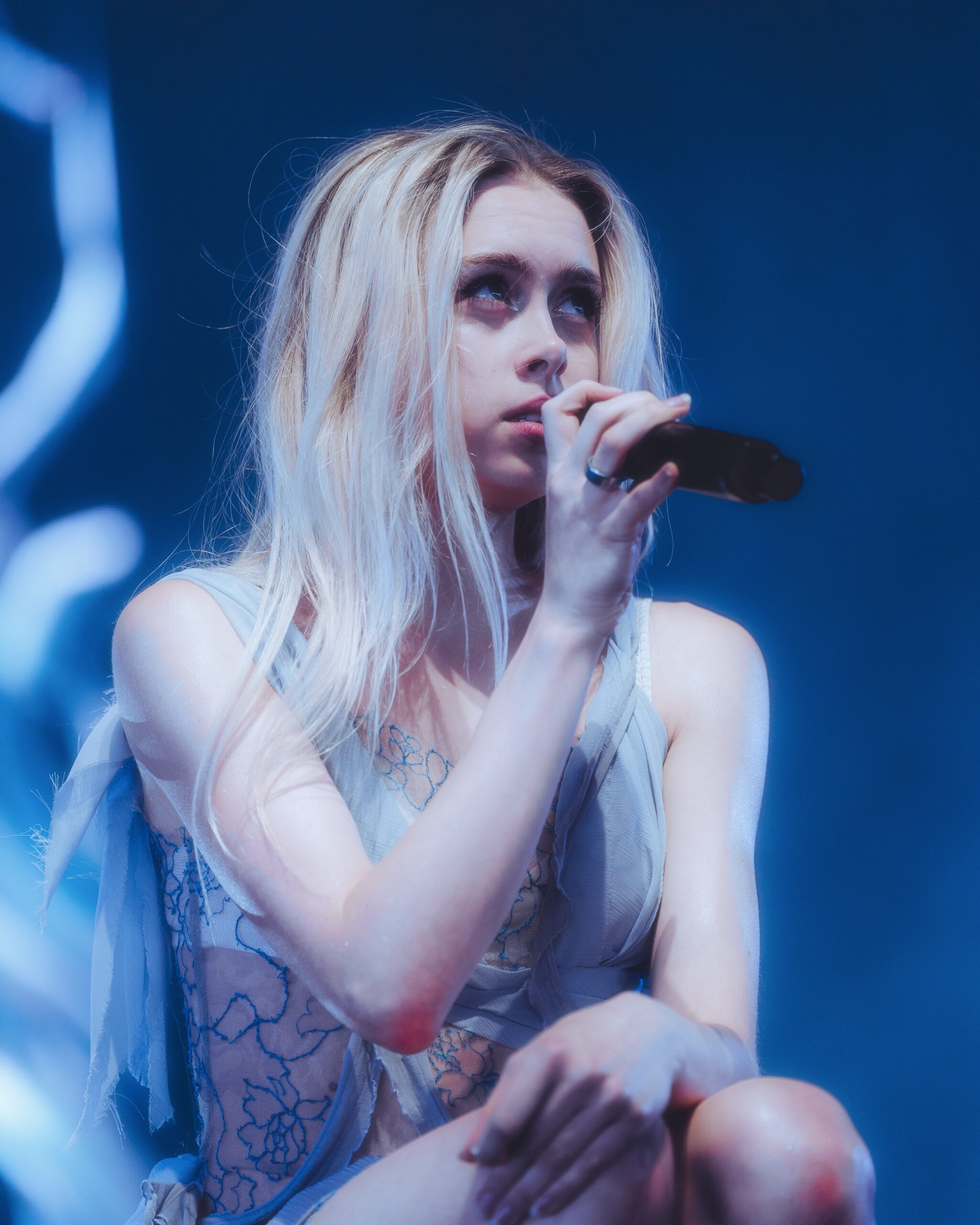
PHOTOGRAPHY LAURA TONINI-BOSSI
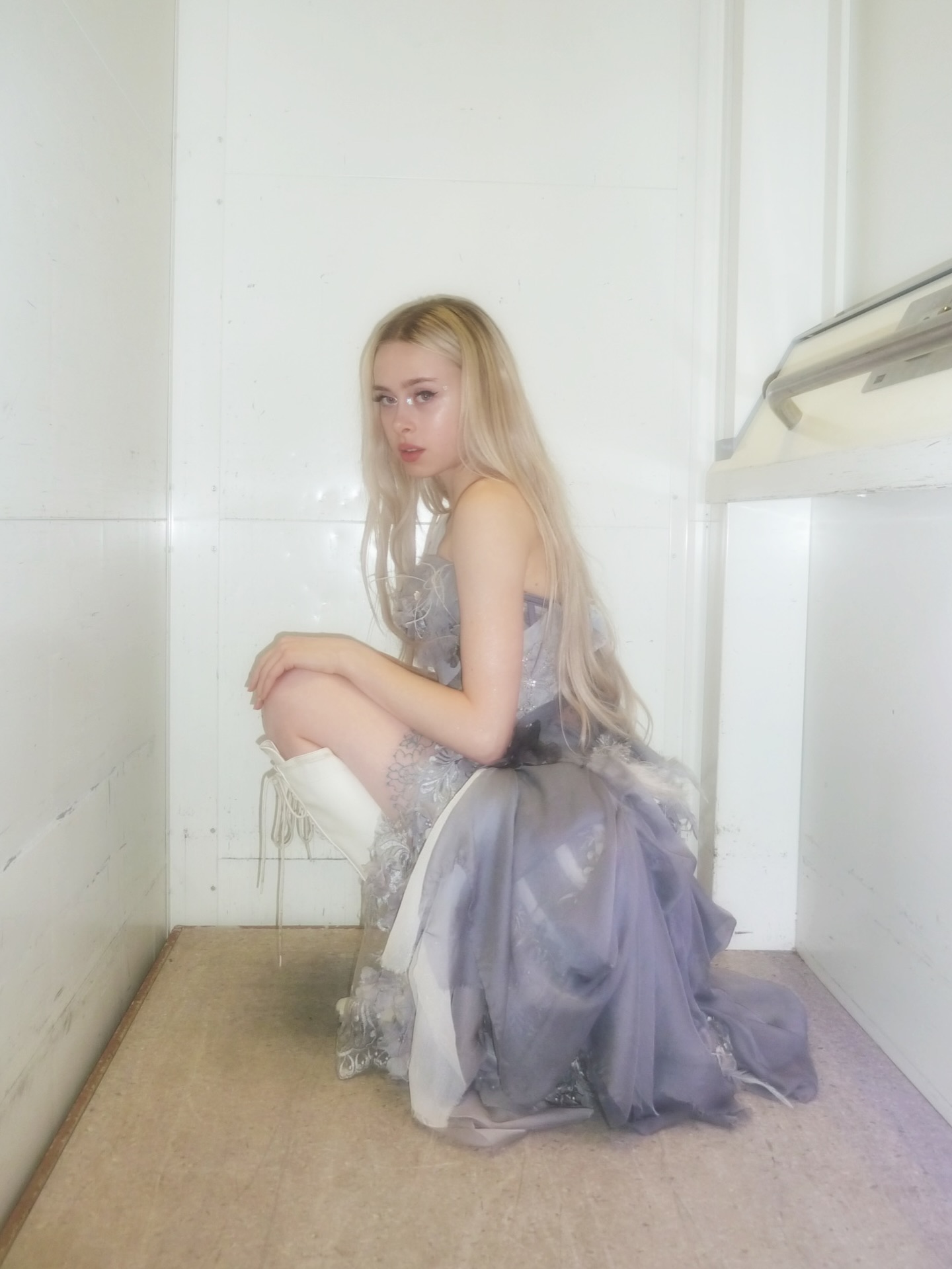
@ERINLECOUNT
Hi Erin, how do you feel about Mondays?
I personally am someone who starts Monday with a hell of a lot of optimism. I like lists and to-dos.
What do the lists look like? Are they work stuff or is it more general, life stuff?
I separate them into two lists. I usually have one that’s small, accomplishable tick-offs, and then the rest is music things, which are way more abstract and subjective. Otherwise I feel like I’ve done nothing, or I feel I’ve been totally void of creativity.
What was the last song you listened to?
Oh my God, have we started the interview?! This is amazing. God, I’ve been listening to nothing but ambient music recently because I find lyrics overwhelming.
Why can’t you listen to lyrics?
I’m in a writing period and making a lot of music, and sometimes when I’m in that headspace of listening to music that I really love with lyrics and melodies, I find it borderline overwhelming.
When did you start writing songs?
The first song I wrote, if we’re being technical, was when I was eight. It was called Strife.
Oh, wow, that’s a big title for a song you wrote at age eight.
I was a really serious child with the weight of the world on my shoulders. But I started writing more about personal things and love and diary-like things when I was about 16.
What did you get out of it? Why do you think you were drawn to it?
When I was younger, I wanted to be an author and I wanted to write books. I was a very theatrical child and realised that you could tell stories and dance and sing at the same time. I always felt like my emotions were 10 times as loud and as intense as they should be. I needed somewhere to articulate that and put that because otherwise… You know, I cried a lot. I was just this big pool of emotion. I still am. I feel like there’s an overflow that needs to be put somewhere.
I always felt like my emotions were 10 times as loud and as intense as they should be. I needed somewhere to articulate that and put that…
Michael Cragg
Who has influenced your songwriting?
Kate Bush has been my North Star in the sense that it didn’t matter if I didn’t really understand [what she was singing about]. I still felt moved by it and I still felt like I understood her voice. I discovered Fiona Apple when I was in my teens, and there was an angst there that I didn’t know was allowed to be spoken about so bluntly in music.
You write and produce your music by yourself, which feels unique in today’s music industry where collaboration is key. Why do you enjoy working alone so much?
I love collaboration. However, I get very overwhelmed by it. Early on I was put in sessions and you’re just set up on these sort of blind dates with strangers in a studio. Music is so intensely personal and everything I was writing was so intensely personal that I just couldn’t function in a room with someone else sharing that. So I learned to do it myself. I shut myself away for quite a long time in my shed and put 10,000 hours in pretty quick. There’s something in the music itself that I can channel and access better when I’m alone. There are moments where it benefits me to come out of my shell and reach out to someone I love and trust who can help me make things better. But when I’m writing, it just feels so delicate and I just feel very protective over it. I love having that control over it.
Has it been hard to keep that control?
I think by the time I started to get any interest from the music industry I’d already established quite harsh boundaries in how I work. I’d felt a lot of apprehension about anyone remotely music industry related coming into my bubble and having an opinion on what I was doing, and how the process unfolded. My label and my managers [LeCount is managed by the same team as Lana Del Rey] were great because they approached me the way you would a scared animal. I’ve met people naturally that have sort of brought me out of my shell. But ultimately, after a certain amount of working with other people and being social and being collaborative, I really need a few months of being on my own, which is the current phase that I’m in. This is my hibernation.
Is there still an assumption that a young female artist in the music industry has a man pulling the strings?
One hundred percent. There’s a statistic that only two percent of producers are women which I think is absolute nonsense. I think women are producing, and non-men are producing, and just not calling themselves producers because they don’t feel equipped to, or they don’t feel that they’ve earned that merit. But people definitely doubt it. People have told me how wonderful it is that I’m a producer and then I’ll pull up a project, or a session file, and they’ll be surprised that it’s fully formed. People aren’t even conscious that they have that bias sometimes. But I’m still learning how to go into a room and not downplay or dumb things down, or sort of shrink in the presence of male collaborators who are more established than me.
Also in the pop space specifically people are shocked that, for example, Mariah Carey is a writer and a producer or Janet Jackson, or Beyoncé, because there’s a sense that you can’t be a visual artist, or a performer, and be knowledgeable in a studio.
Yeah. And pop is fascinating because those artists are the blueprints for so much pop and pop is often looked down upon and I really do think that’s just purely misogyny. Pop is a science and it’s a fascinating one and yet somehow it gets this reputation for being vapid. I can’t think of anything more real than pop music.
Pop is a science and it’s a fascinating one and yet somehow it gets this reputation for being vapid. I can’t think of anything more real than pop music
Michael Cragg
What were you like as a kid? Were you ambitious?
Yes, I was, but sort of with myself. I always had to be doing a lot of things. I was never very still. I was always trying to write, like, ten different books at a time and be a ballet dancer and a singer and save the world. I just had a lot of passion and had no limit on where I wanted to place that.
You suffered from stage fright shortly after appearing on a TV talent show. Are those two things linked?
Definitely linked. I’d never suffered from stage fright before. I’d been scouted for [The Voice Kids in 2017] and it definitely shifted my perspective of what performing was and who it was for and what it was meant to feel like. I came off the back of that confused about what performing was, and not feeling like it was for me anymore. I remember just trying to step on stage at a local pub afterwards for an open mic and genuinely feeling like my heart was gonna stop and I was gonna die. Stage fright took away being able to perform, which I felt like was my purpose. So eventually I just stopped leaving the house and everything felt like stage fright. It consumed me and I stopped going to school. I stopped everything. I had to rebuild my relationship with music completely and what it means to perform. It was really during COVID that I reconnected with music. I’d already been at home for so many years and not in usual schooling for a while. Then it seemed like the rest of the world shut off. That was when I started writing and that was when I started to make things on GarageBand. I rediscovered music in a way where it felt like it belonged to me again. By the time the pandemic restrictions were being lifted and everyone could sort of leave their houses, it felt like I was leaving the house for the first time in many years.
You’re a very theatrical artist, who likes to build worlds for your fans to be drawn into. Do you feel like people are resonating with that more now, after a period of everything being very ‘real’ and ‘gritty’ in pop?
Definitely. That’s the side of pop that I’ve always loved. The wacky and the more conceptual. Pop has definitely been through this ultra confessional, literal songwriter renaissance, parts of which I love and I definitely feel like I slot into every now and then. But I think there is a want for escapism right now. The way I make music is I am completely fucking away with the fairies most of the time. I love indulging in that and I love shows feeling like that. I love a concept. I love not always being literal and not always writing in first person. I like telling stories and that’s what music has always been for me. I think we’re seeking it because the world is a bit of a shit show.
Adwoa Aboah and Emily Ratajkowski tell us 7 things they love 2 hate Adwoa Aboah and Emily Ratajkowski tell us 7 things they love 2 hate
Adwoa Aboah and Emily Ratajkowski tell us 7 things they love 2 hate
“I’m just a girl from Manchester and I opened Prada”: Anok Yai talks identity and belonging with Edward Enninful “I’m just a girl from Manchester and I opened Prada”: Anok Yai talks identity and belonging with Edward Enninful
“I’m just a girl from Manchester and I opened Prada”: Anok Yai talks identity and belonging with Edward Enninful
“Those Black girls ruled”: The enduring influence of 90s girl groups on modern pop culture “Those Black girls ruled”: The enduring influence of 90s girl groups on modern pop culture
“Those Black girls ruled”: The enduring influence of 90s girl groups on modern pop culture
The lightness of being: Nicolas Ghesquière engineers a cooler future The lightness of being: Nicolas Ghesquière engineers a cooler future
The lightness of being: Nicolas Ghesquière engineers a cooler future
The 90s: Art and Fashion opens at Tate Britain The 90s: Art and Fashion opens at Tate Britain
The 90s: Art and Fashion opens at Tate Britain
Her many selves: Matthieu Blazy explores Chanel’s multiplicity Her many selves: Matthieu Blazy explores Chanel’s multiplicity
Her many selves: Matthieu Blazy explores Chanel’s multiplicity
A night at the Versace villa: Victoria Beckham on her favorite 90s night A night at the Versace villa: Victoria Beckham on her favorite 90s night
A night at the Versace villa: Victoria Beckham on her favorite 90s night
Shelf life: Alessandro Michele expands his Valentino library Shelf life: Alessandro Michele expands his Valentino library