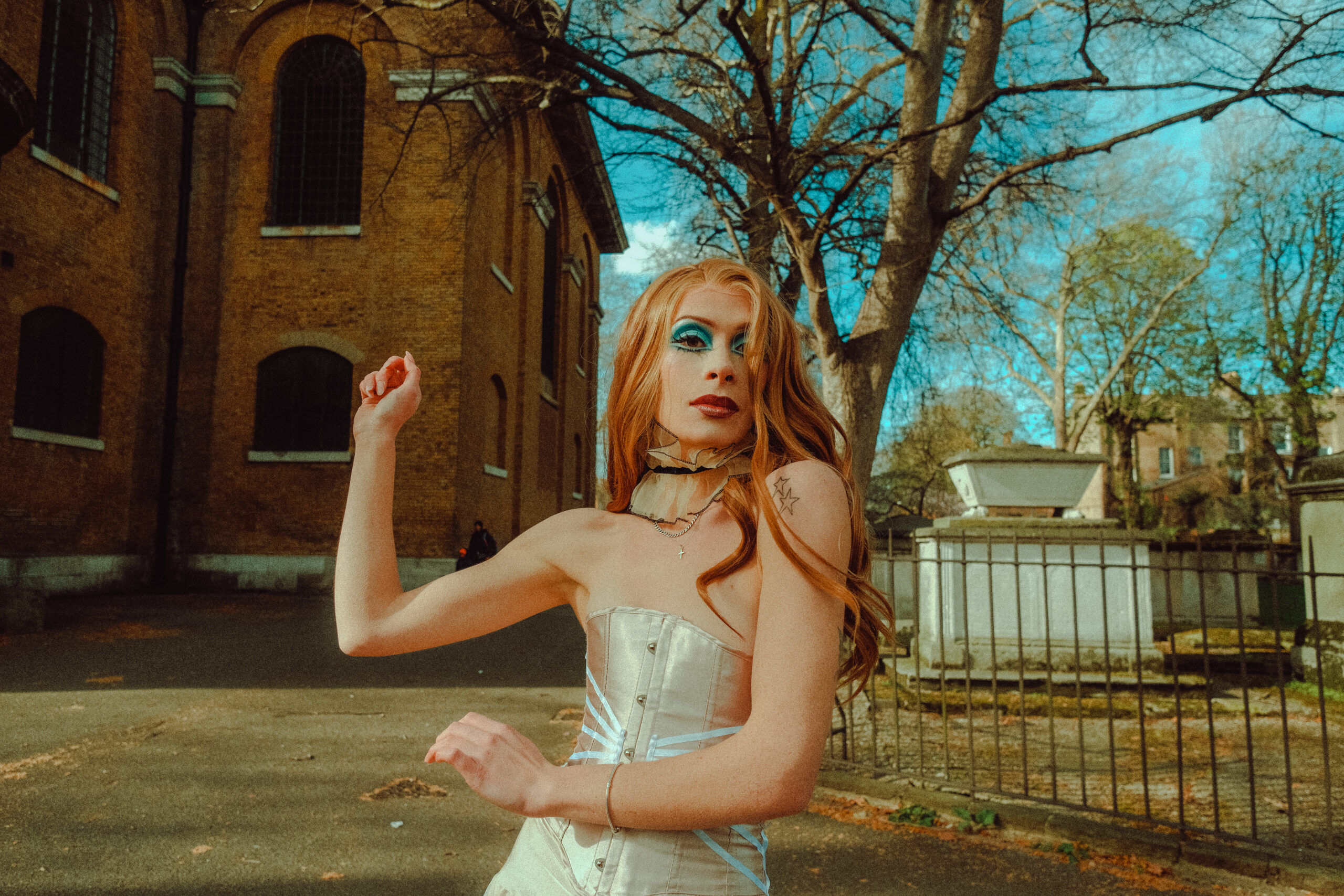
“It’s camp, seductive, vulnerable and very razzy.” We’ve seen the future of comedy and it’s Grace Quigley’s surrealist high-femme fever dream, On Our Backs
PHOTOGRPAHY Joana Veloso
South Londoner Grace Quigley’s one-woman-show might be a work in progress, but it’s one of the funniest, most subversive and thrilling pieces of theatre we’ve seen.
Deep in a dark basement of Dalston performance mecca The Divine, Grace Quigley is busy forming the future of comedy. Created, performed and produced by the 28 year-old, On Our Backs is a thrillingly theatrical, ongoing work in progress that encompasses drag, karaoke and lipsync as well as “shadows, puppetry, cabaret, and a bit of audience participation,” adds Grace. A “splat” of ideas that feels completely cohesive, On Our Backs is an irreverent, subversive, political, radical and ultimately moving examination of the often complex search for, and understanding of, our queer bodies, lives and desires.
The seeds of Grace’s show were sown during a 2024 Arts Council funded research project that led Grace to the Bishopsgate Institute. There she discovered the foundational 1980’s San Francisco-based feminist and lesbian erotica magazine On Our Backs; the publication began to inform Grace’s thinking around the impact of archive materials on contemporary creation and also the societal and sometimes unconsciously imposed limitations on queer life and identity. “It brought forward ideas of wanting to explore femininity, feminine desire, high-femme-ness,” says Grace. “When I first came out, I loved dressing like a boy, repelling men, wanted to shave my head and firmly rejecting pink,” she remembers. “Then I spent most of my time with high femme dykes and dolls; their femmeness was beautiful and powerful, they freed me up. I found a way of being super-femme in a way I didn’t hate. Now, I love pink and I’m saving up for hair extensions… but still live for a boxy T. It’s all balance!”
With an incredibly light touch and via the lens of a particularly brilliant absurdist sense of humour, Grace explores love, friendship, violence, gentrification, homophobia, internalised homophobia, the challenges of parenthood as a queer person and the duality of femme women who can be both victims of, and exploitative of, their identities. The backbone of the performance is an exchange of letters between Dilly “a hopelessly devoted femme dyke searching for love and connection and family” and the real life agony aunt of the magazine, Nina Hartley who’s a “porn star, a nurse and a bit of a legend.”
Throughout, Dilly flawlessly mimes to recordings of Nina’s real-life IG Lives, snippets from a Posh Spice acceptance speech and enlists the audience to do everything from giving her a piggyback to taking a custard pie in the face. “I cannot believe how engaged people are in the participation parts,” Grace laughs. “They are actually keen to help each other and help me and create something together.”
Watching On Our Backs at the Divine felt like witnessing an early iteration of Michaela Coel’s Chewing Gum or Phoebe Waller-Bridge’s Fleabag. A young, queer, woman reckoning with her life, of the multitudes and complexities being human can contain but with a levity that can often accompany the deepest of our darkest days. It’s incredibly prescient and utterly relatable to the audiences it’s intended for.
Grace’s references range from artists such as bell hooks, Candy Darling, Greer Lankton, Pina Bausch, Sinead O’Connor, the films of Yorgos Lanthimos, the book Three Women by Lisa Taddeo and Grace’s own pals. “Things that might seem absurd can feel kind of normal, or at least usual, to me,” Grace points out. “Me and my friends, we’re all quite strange and feel strange. We’ll go through some dark shit but we deal with it in such an extravagant, flamboyant, camp, sensitive, empathetic, queer way. It’s just how we meet a difficult day I think”.”
We caught up with Grace at Bermondsey’s magnificent queer cinema, The Arzner, to find out more about this utterly fascinating piece of work.
In a proverbial nutshell, what is On Our Backs about for the uninitiated?
It is an invitation to spend a hot hour with our character Dilly who’s a hopelessly devoted femme dyke searching for love and connection and family. She is waiting to happen. It folds queer archive into live and, let’s say, slightly participatory performances [laughs]. It’s hopefully camp and seductive and vulnerable and looks at desire, connection and community in a world full of glamour and twinkly things. Dilly lives in a bit of a fantasy and all she asks is that you’re ready to walk into that fantasy with her. Everything is really beautiful and lush and pretty, but you can’t really pull on anything too hard or scratch anything too much because it could fall apart. She writes obsessively to Nina and asks her for advice on sex and love and parenthood and how to build a lesbian life when she hasn’t really seen a survivable blueprint of what she’s looking for. She tries to understand her relationship with her own body and her own desire, having come from her body being the object of desire and transaction – her body is a kind of currency at the time that we meet her.
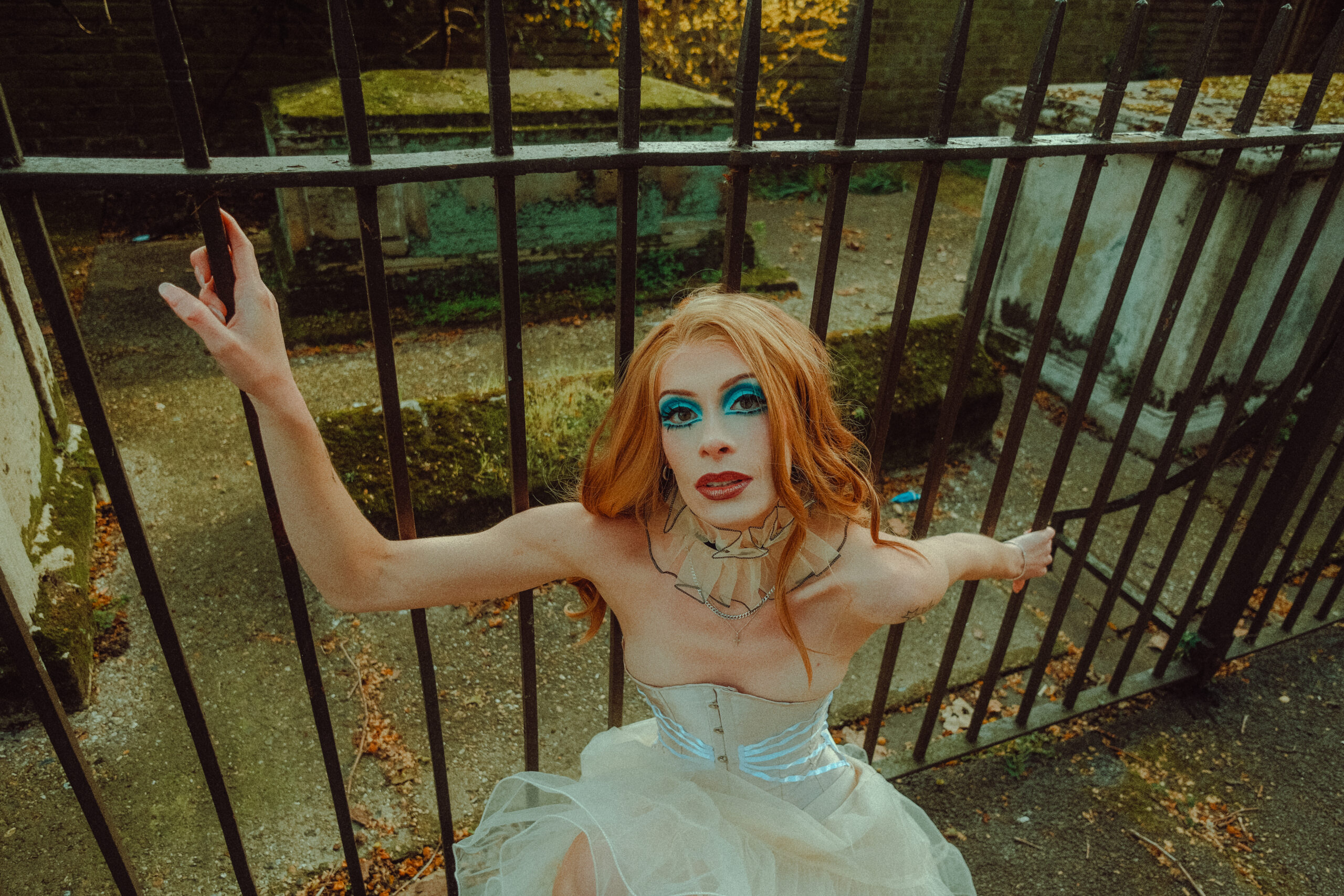
It’s hopefully camp and seductive and vulnerable and looks at desire, connection and community in a world full of glamour and twinkly things.
GRACE QUIGLEY
In what sense?
There’s a huge privilege that comes with being a cis femme lesbian. But it’s also a funny place to sit. People think you’re straight; you get the classic ‘You just haven’t had the right…’ You can’t figure out if you want everyone to know you’re gay or if it’s safer to say “Yes doctor, he does have a temperature over 36”, as you mop the sweat off your sick girlfriend’s head. The decision to out yourself can have a bigger sense of danger. You might also have been with men before and that can be difficult for a partner, or maybe you’re a bi femme and same thing. I understand why this can be difficult but I am interested in it. And I’m interested in the kind of gendered jobs that femme lesbians have often done historically as well. Jobs where—there’s a huge spectrum of it—but where your body is part of how you’re making your money. I also really love, within lesbianism, playing with masc and femme roles and reclaiming that, but also indulging in the silliness and the blueprint of it. Like it’s hot to me, but I probably wouldn’t find man/woman roles so hot if it was between me and a cis man [laughs].
How did On Our Backs become crucial in the formation of the work?
I’m obsessed with magazines and physical print. I use On Our Backs as a look back at older ways of making connections like cruising or flirting or ways to mobilize, inspire and discuss that we seem to be losing – when you walk into a gay bar by yourself it can feel a bit scary and you can go unnoticed where everyone already exists in their cliques or their friendship groups. The show probes what can happen when we really connect. It’s not just me performing in the room, it’s me actively engaging the audience – hopefully in a not horrible way – and seeing if we can actually help each other.
What’s your performance background?
I like people and I find them really interesting and I think that’s probably why I was attracted to acting, storytelling, drag, all of it. I went to the Royal Welsh College of Music & Drama in Cardiff. After I left, I got a big commercial agent and that felt really exciting and sparkly at the time. But I quickly got quite sad about how hard it is to be an actor – even though everyone tells you how hard it’s going to be [laughs]. I wasn’t able to make a living and the parts I was going for were not particularly inspiring or exciting, to me. I was feeling a bit more inspired by clubbing.
Queer raves?
Yeah, I really wanted to be around gay people. I was desperate for it. I’d been to gay clubs in Cardiff but I didn’t know there was, what I’d now call, a community surrounding it. When I become immersed in gayness I discovered so many different worlds; I didn’t really know about art or live art. When I started going to drag nights and club nights at places like the Royal Vauxhall Tavern and the Glory, my world opened up. I realised you could approach storytelling and performance in what felt like, to me, a more exciting way.
On Our Backs has been described as a ‘lesbian fever dream’. Does that feel accurate?
I guess I’m figuring it out. I want it to be some kind of lesbian fever dream [laughs] but also femme desire feels like a big part of it for me. It’s also parenthood and friendship too. Within the fantasy Dilly lives in, her behaviour doesn’t always make sense, which can happen when you’re attempting to escape some kind of violence. Her lack of resources and friends means she does some pretty off-key things. I love how in the magazine the people contributing and the readers are so deeply and beautifully flawed yet given the chance to find out the best way of dealing with things. I think our world of social media has robbed us of the chance to make mistakes, to be unfinished, to dare to begin and grow.
For all the laffs, I found the end of the show, when you dance with Maria the puppet, really moving.
It is quite dark what Dilly is going through, and has been through. It’s twisted. But I am curious about how we deal with the dark things.
What have been some of the responses to the work?
I’ve been unexpectedly chuffed with people’s connection to the sinister side of Dilly’s world. I didn’t think people observing it would necessarily notice, cause I am quite insufferably doing ‘a bit’ for like an hour [laughs]. I also can’t believe how engaged people are in the participation parts. It’s been really beautiful to connect with strangers and have them help me, especially as it is a work in progress. I genuinely need people to help me fulfil some of the creative ideas I have. That’s been really wonderful.
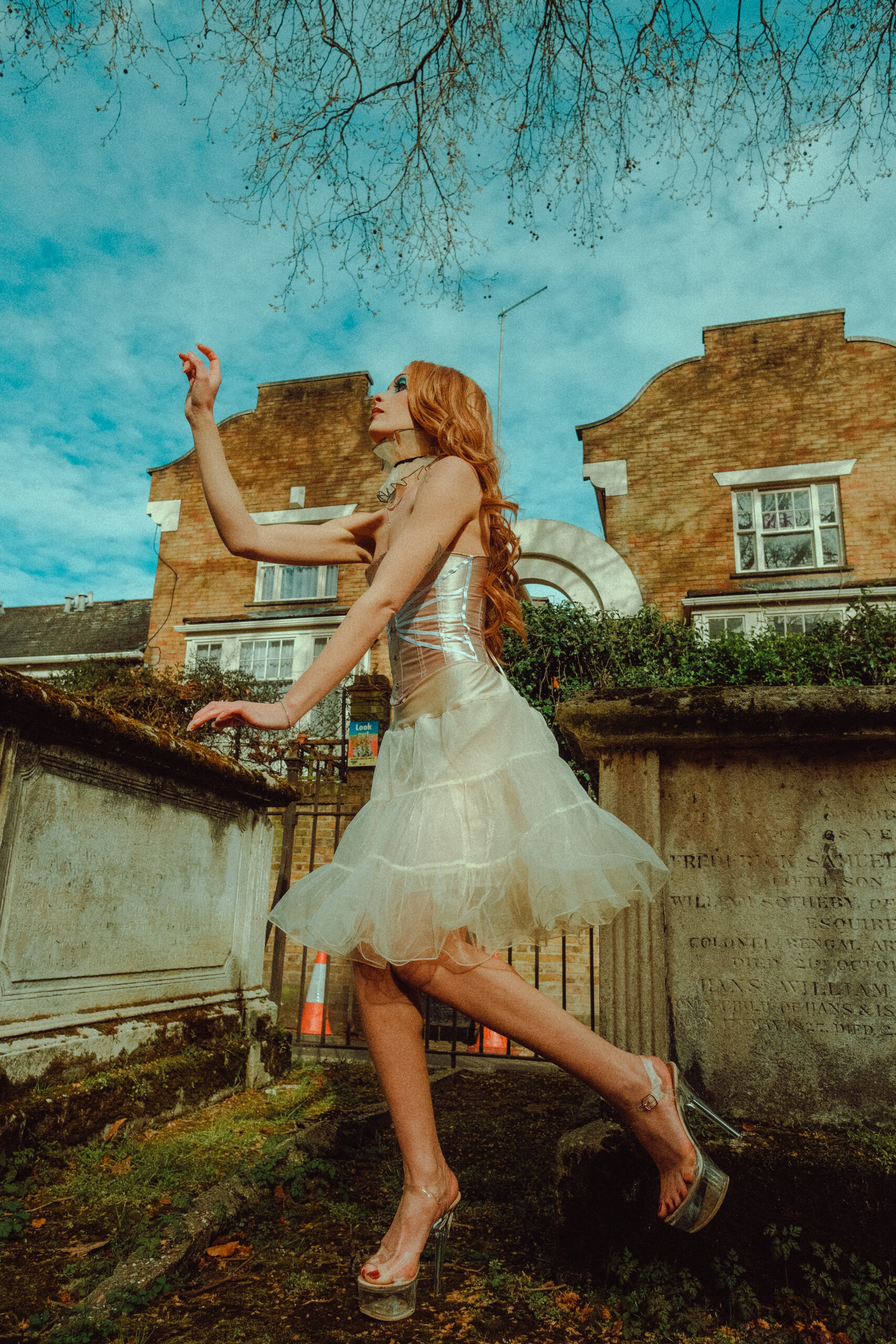
It’s been really beautiful to connect with strangers and have them help me, especially as it is a work in progress. I genuinely need people to help me fulfil some of the creative ideas I have. That’s been really wonderful.
GRACE QUIGLEY
It feels important to underscore how much you’re doing alone. Which is to say everything! Writing, performing, directing, producing, making….
I’ve got so many ideas for the show I want to make. One of my frustrations has been coming up against my own limitations with what’s physically possible for me to achieve because it’s just me. But I’ve learned so much from getting this work in progress on its feet, and next I want to make it ‘a show’. I want to collaborate with other people so I can focus on the character, the story and the performance. I’d love help from a director, a movement director, a puppet maker, a lighting designer. To get anyone to fund anything in these times of ‘risk averse’ creative funding, can be a challenge. Theatres and producers don’t have as much resources so I’ve found it hard to get people to come and see work – especially when the work you’re showing isn’t finished because you need a producer! Hopefully I’ve done enough to get a couple of theatres interested in supporting. But who knows. If anyone reading this is a big hearted queer philanthropist with a niche interest in supporting a drag, punk, lip synch, deeply healing and arousing puppet show then… let’s go to Hollywood! (laughs).
What might life hold for you beyond On Our Backs?
You mean after touring the show and working with loads of amazing people [laughs]? I’d like to work with other people in telling stories – my stories or their stories – whether that be film or a punk band or whatever. I feel weirdly open-minded. I’d like to make film. I’d like to do more theater. I would like to create a show with a group of people. It’s an exciting space for me to be in. Whatever happens, it’s a terrifying and razzy time.
“I didn’t do what everyone expected me to”: Nia Archives on lessons in love and the jungle projects you should be listening to “I didn’t do what everyone expected me to”: Nia Archives on lessons in love and the jungle projects you should be listening to
“I didn’t do what everyone expected me to”: Nia Archives on lessons in love and the jungle projects you should be listening to
“Now I feel like I’m in an age where I can just be myself”: Jan de Villeneuve on embracing her authentic self and what it takes to be a model “Now I feel like I’m in an age where I can just be myself”: Jan de Villeneuve on embracing her authentic self and what it takes to be a model
“Now I feel like I’m in an age where I can just be myself”: Jan de Villeneuve on embracing her authentic self and what it takes to be a model
“We’ve been jamming”: Rema spills the TEA upon the release of his new single “We’ve been jamming”: Rema spills the TEA upon the release of his new single
“We’ve been jamming”: Rema spills the TEA upon the release of his new single
Aaron Pierre makes his DC Universe debut as John Stewart in HBO’s Lanterns Aaron Pierre makes his DC Universe debut as John Stewart in HBO’s Lanterns
Aaron Pierre makes his DC Universe debut as John Stewart in HBO’s Lanterns
“This is just the appetizer”: Naisha is one of India’s hottest new artists and her debut EP 911, is the proof “This is just the appetizer”: Naisha is one of India’s hottest new artists and her debut EP 911, is the proof
“This is just the appetizer”: Naisha is one of India’s hottest new artists and her debut EP 911, is the proof
“Just be ready to take off most of your layers!”: This is Benji B’s ultimate party guide “Just be ready to take off most of your layers!”: This is Benji B’s ultimate party guide
“Just be ready to take off most of your layers!”: This is Benji B’s ultimate party guide
Lydia Garnett explores the ‘luxury of doing nothing’ in Playing House Lydia Garnett explores the ‘luxury of doing nothing’ in Playing House
Lydia Garnett explores the ‘luxury of doing nothing’ in Playing House
“It’s a portrait of a woman I don’t believe cinema has shown before.” Anna Cazenave Cambet’s Love Me Tender is completely compelling “It’s a portrait of a woman I don’t believe cinema has shown before.” Anna Cazenave Cambet’s Love Me Tender is completely compelling