From Christie’s to Sotheby’s, meet the women behind the rostrums of the world’s most prestigious fine art auction houses
Harriet Quick meets four women who command the rostrum at some of the world’s most prestigious sales, where it’s all about drama, delicacy — and millions of dollars.
GEORGINA HILTON
PHOTOGRAPHY JOYCE NG AT ARTEM PROJECT. PHOTO ASSISTANT TK CHAN. RETOUCHING SPARKPOT STUDIO
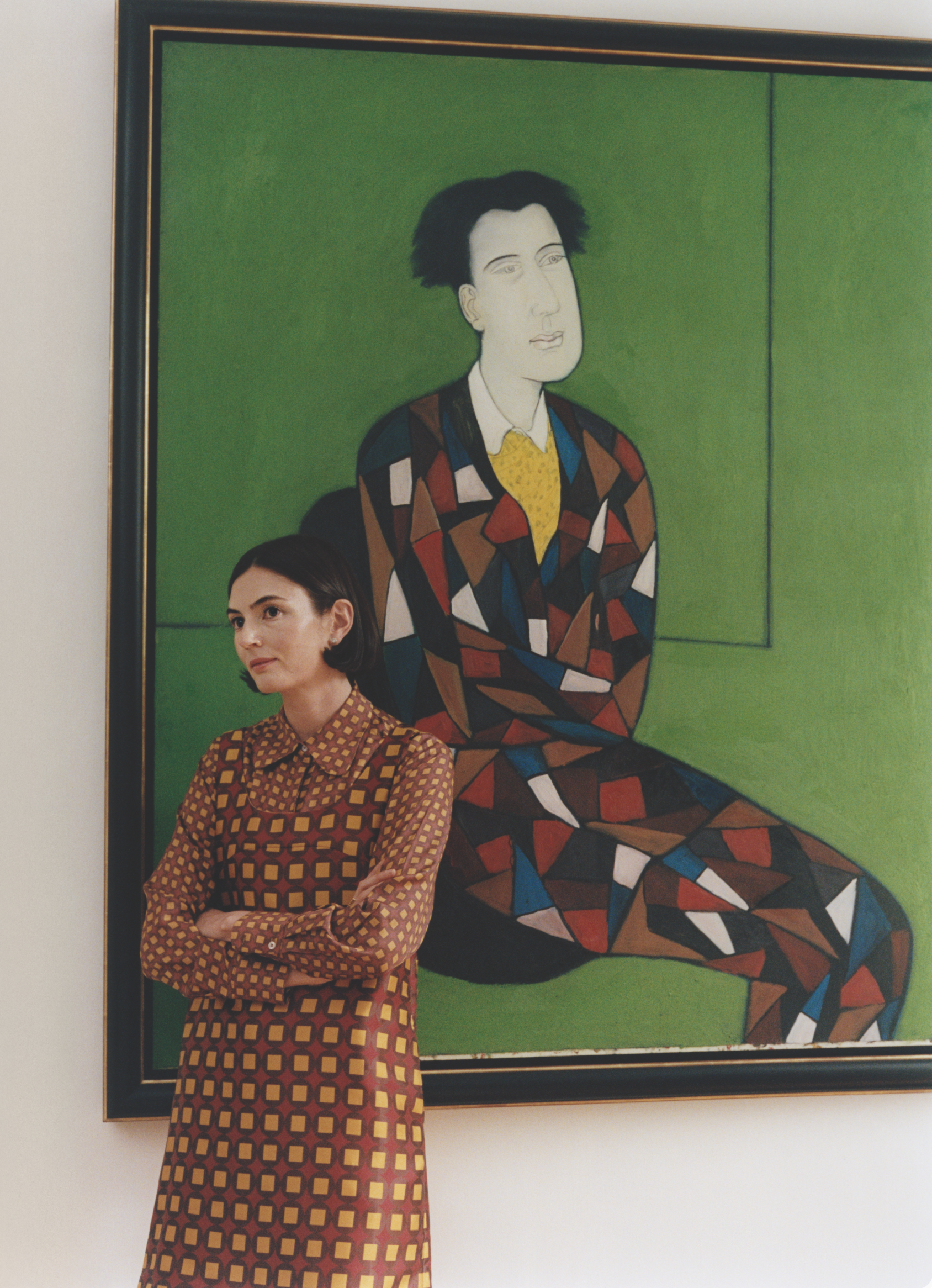
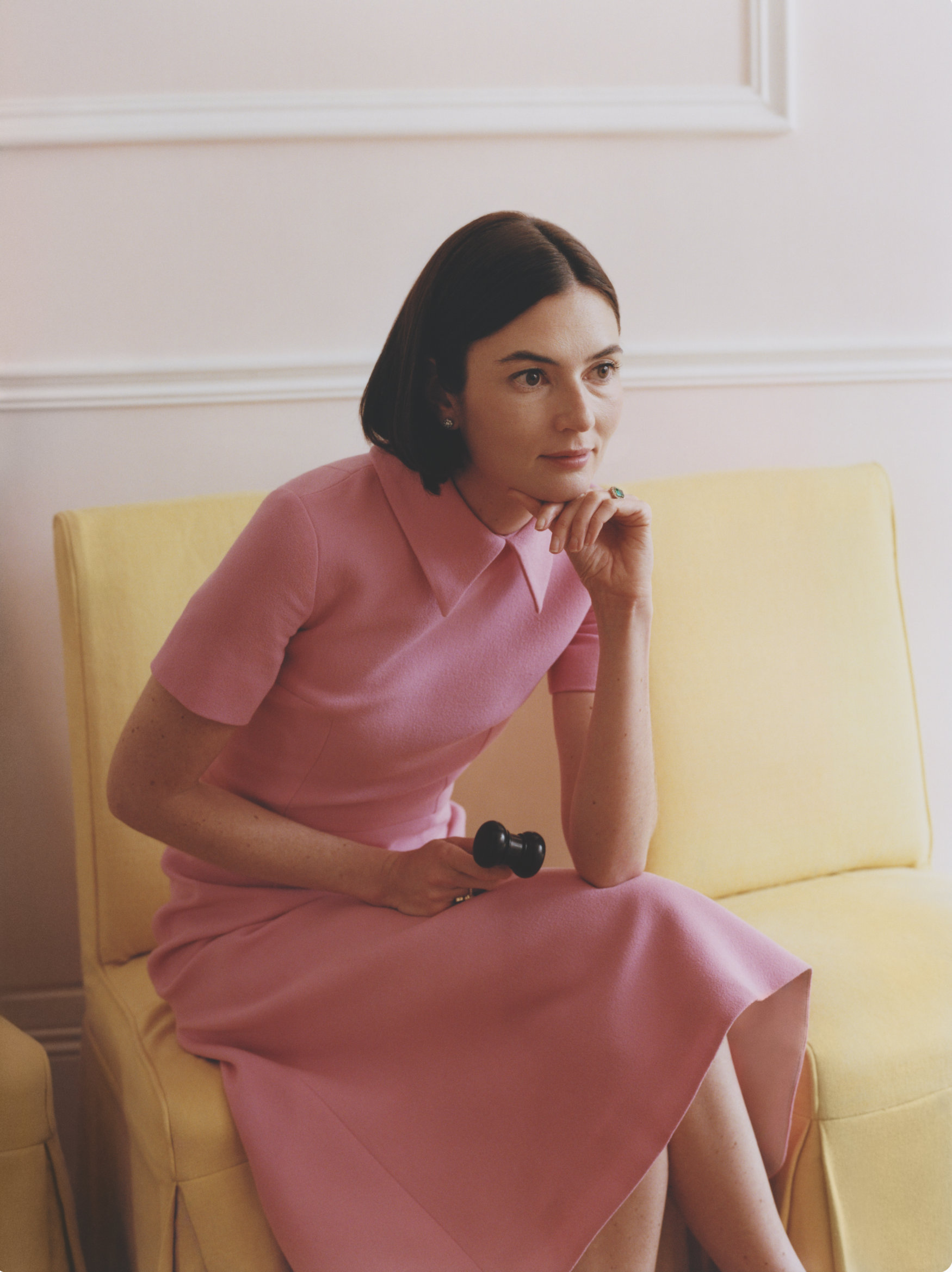
When a rediscovered Michelangelo drawing of a foot came up for auction at Christie’s New York in February, anticipation ballooned. “It belonged to a gentleman who had no idea what he owned and that in itself is miraculous. Because he had no idea, you’re always in a great position to talk about a nice appealing estimate,” says Georgina Hilton of the lot that was the star attraction of the Old Master Drawing sale. Hilton flew from Hong Kong to oversee this section of the sale. Bidding started slowly from a $1-1.5m estimate and 41 minutes later the drawing hammered at $23.1m. “It was just extraordinary,” says Hilton with a smile that could be peeled from the screen of Emily In Paris, such is her resemblance to Lily Collins.
But this is Georgina in Hong Kong. In 2019, she moved to the territory from Christie’s London to head up sales of classical western art, specifically, Old Masters — a category typically dominated by specialists twice her age. The hire plays well into the changing tastes of Asian collectors, institutions and not ably, Gen-Z collectors. “Less than 10 years ago we sold a Picasso in Hong Kong for the first time, and now you won’t see a sale at Christie’s or Sotheby’s without one,” says Hilton, who studied History of Art at the University of Manchester. From which she stepped straight into a client services role at Christie’s. “I remember that first day standing outside number 8, King Street. So excited, but with so much to learn.” Initially manning the call center — “Hello, Christie’s Client Services. How may I assist you?” — Hilton set her sights on the auction room and started as a “spotter”, the person who signals bidder interest to the auctioneer. At 22, she put herself for ward for the auctioneering try-outs (selling five lots to an internal panel) but was advised to come back in a few years.
Hilton got stuck in at the Old Masters department, and equipped with new smarts she re-entered the auctioneer fast track. “Often people have got the movement, the drama and the theater, but they can’t get the numbers. You have to be able to handle numbers, because in a real auction the estimate can change as well as the reserve, and absentee bids are coming in right at the last moment. But as numbers become second nature, confidence grows,” says Hilton.
I am known for my particularly dramatic gavel style. But it’s so much about your use of language and creating a sense of intimacy.
GEORGINA HILTON HEAD OF CLASSIC ART,
ASIA PACIFIC AND AUCTIONEER, CHRISTIE’S
In Hong Kong, Hilton was in at the deep end handling online sales during COVID-19. “I was doing far more sales than in London and in a completely new environment with different bidding traits. In a London sale room, for example, it’s all about authority. In Hong Kong, it’s more about showing respect, giving the bidders time,” says Hilton. Her distinct, energetic style helps keep social-media audiences — that might top 500,000 — riveted. “I am known for my particularly dramatic gavel style. But it’s so much about your use of language and creating a sense of intimacy. You want to be able to give equal attention and offer equal motivation for every bidder to get the lot,” says Hilton, who now trains upcoming talent.
Alongside client advisory work, she takes groups on tour to significant collections and sites in Europe. Hosting charity auctions across Asia is also an important part of her role. “At gala dinners there’s a huge amount at stake with super high-value lots. The crowd is incredibly glamorous and charity requires a completely different approach,” she adds.
Now she’s started collecting, too — mainly Hong Kong artists from the 1980s and 1990s. “People speculate every five minutes and there’s always a new trending opinion. A few years ago in Hong Kong, everyone was obsessed with post-millennium art. Now I think we’re returning to slightly earlier artists and the modern names are back. It’s reassuring to have a track record. With Old Masters, there’s 500 years’ worth of data to show the importance of these pieces. For me, client-to-client, day-by-day, lot-by-lot is what matters,” says Hilton.
YÜ-GE WANG
YÜ-GE WANG. PHOTOGRAPHY JAMIE SALMONS
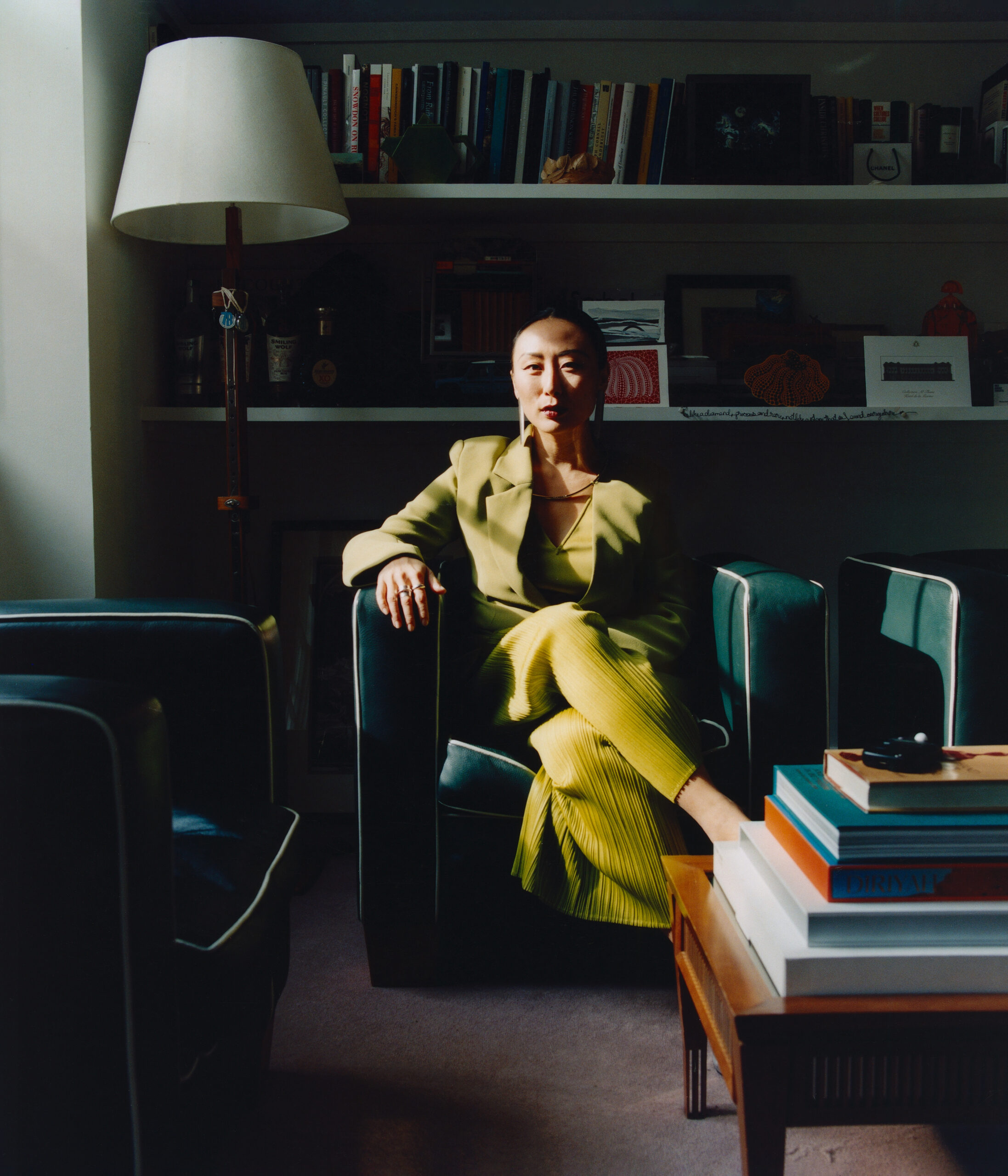
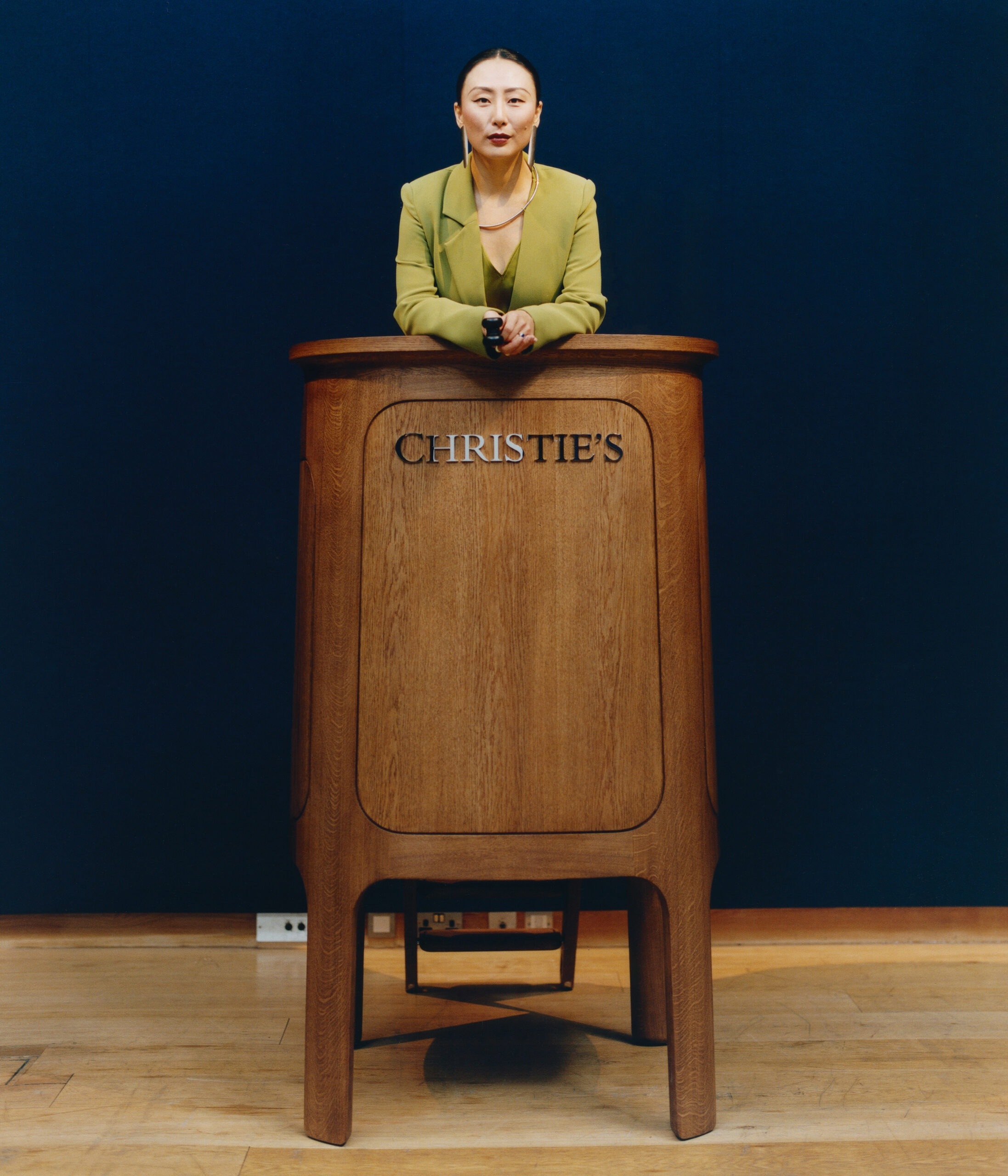
I sold my first painting to my father when I was three years old. I knew my worth already. It was an image of colorful stones: very creative, very abstract,” laughs Yü-Ge Wang of her early entry into art. “I wanted to go into fine art and painting. That’s not an option if you have Asian parents, especially immigrant parents, so I ‘painted’ and studied on the side,” she adds. At Christie’s since 2013, Wang is now a leader in her field serving as director and senior client advisor specializing in postwar and contemporary art.
Wang, today dressed in a bright Issey Miyake dress, has that rare left/right brain equilibrium — as dexterous with data sheets and pie charts as she is with Francis Bacon’s oeuvre. Born in Beijing and raised in Bavaria, Germany, she studied a BA and a BSc in parallel (business administration and history of art) before moving to London to study an MSc in Art, Law and Business at Christie’s Education in London, a course accredited by the University of Glasgow. “Back then, the marriage between art, money and business was not really something people openly talked about. You either took an academic route or went into business,” says Wang.
She was hired by Christie’s in 2015 and joined client services. Her first experience of auctioneering on the trainee course had her hooked. “I was like, ‘Oh my God, this is what I want to do!’. From that moment, it took another five-and-a-half years. If you look at all the people who are auctioneering right now at Christie’s, I think it took me the longest out of all of them to get there,” she smiles, recalling her first auction with precision — July 31, 2020. She became the first female Asian auctioneer on the Christie’s rostrum outside of the APAC region. From the rise and rise of female artists to the crash of NFT sales and the slump in luxury sales, the art market has witnessed wild change in the last few years. “Now we’re seeing a lot of new-generation collectors, which will be very interesting, especially for traditional auction houses.
The way they spend money, the way they enjoy things, it’s just a very different way of seeing value,” says Wang, noting that around 46% of new buyers at Christie’s are Gen-Z and millennials. They might be collecting rare Pokémon cards, dinosaur bones or Sahara Longe paintings, but they are united in their admiration of a great auction “performance.” These performances can attract a lot of attention on social media; Wang’s highlight lot at a sale in July 2025, the Union Jack flown at the Battle of Trafalgar, gained 200k organic views on YouTube.
It’s one of the oldest professions in the world but little has changed. You’re still standing on the world’s smallest stage.
YÜ-GE WANG DIRECTOR AND SENIOR CLIENT ADVISOR,
AND AUCTIONEER, CHRISTIE’S
And yet the auctioneer’s role remains the same. “It’s one of the oldest professions in the world but little has changed. You’re still standing on the world’s smallest stage, boxed in, and within that limited space you must get maybe half a million people into your hand and make it interesting. You can’t even take a sip of water because it destroys the rhythm,” she laughs. Wang delivers her selling style with a relaxed elegance and sweeping slow-motion gestures. “An auction is hugely psychological and of course you are catering to a vast array of personalities. Every bidder is slightly different. Some are very discreet and just move a little finger. Online, you can’t see the bidders, but I pay attention to the pace of the clicks,” says Wang.
Accidents do happen, such as when the phone lines crashed for 15 minutes during an auction at the Convention Centre in Hong Kong. But there’s also euphoria: Wang hammered Marlene Dumas’ Miss January for $13.6m at Christie’s 21st Century Evening Sale in New York in 2025, setting the record for the sale of an artwork by a living female artist. The 2024 sale Vivienne Westwood: The Personal Collection was another high, as Wang was able to indulge her love of fashion. Meeting French football icon Zinédine Zidane at a watch auction was thrilling, too, she adds. “Female auctioneers bring a certain sense of emotional intelligence, which is more and more important because it’s a complex environment. Every little decision you make can influence a sale and every one or two extra bids makes a huge difference in the long run,” says Wang.
HELENA NEWMAN
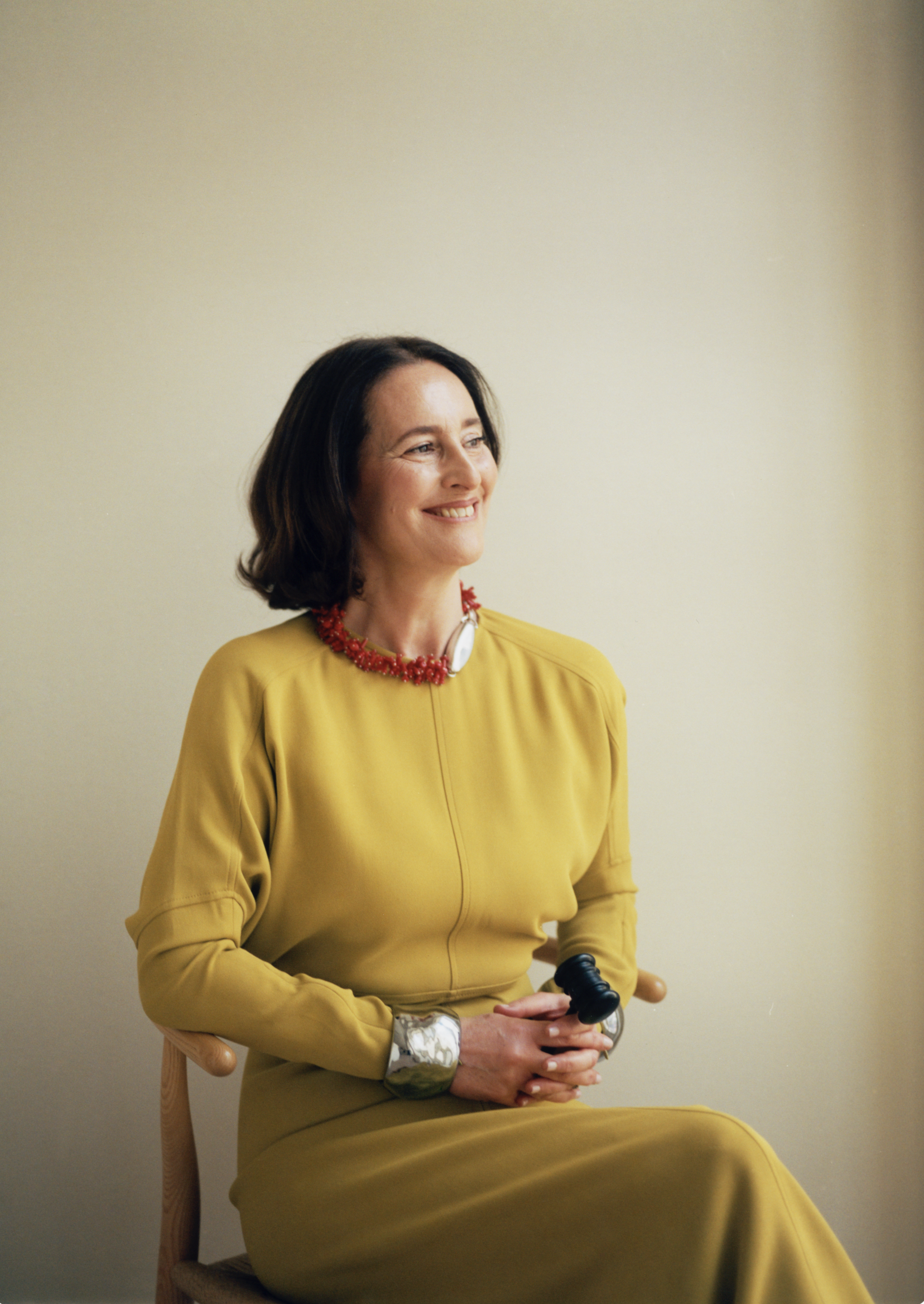
PHOTOGRAPHY SIMONS FINNERTY. POST PRODUCTION HAMMER LAB
I’m interested in the best of the best. I’ve sold two works for over $100m — a Modigliani and a Klimt — and I would like to auction something more above $200m, probably a Picasso. There are still some great works out there that could come forward and rarity is driving the value,” says Helena Newman. Nibbling around a plate of fish cakes at Sotheby’s Restaurant on New Bond Street, plasma screens rolling out auction highlights in the background, Newman talks at a clip; animated, mischievous.
As chairman of Sotheby’s Europe, chairman of Impressionist & modern art worldwide, and senior auctioneer, Newman is a role model. The Oxford-educated, classically trained violinist has been at the auction house for her entire professional career. She arrived, in 1987, at the start of huge headline-making sales and fireballs of excitement with Van Gogh’s Irises achieving $53.9m at Sotheby’s, setting a world record for the highest price for an artwork. “There was a huge surge of interest,” says Newman, who began her apprenticeship in 1988, pulling on her university studies in 19th and 20th-century French and German literature and linguistic skills. “You learn so much from cataloging, and, remember, this was pre-digital, so people would come in with the works like Antiques Roadshow! ” She was involved in significant restitution cases for masterpieces by Egon Schiele and Gustav Klimt and raised her first gavel aged 26. “My experience as a musician really helped with timing, pace, projection and the ability to channel nerves into excitement,” she adds. Newman took her first Evening Sale in 2016 and now heads up Evening Sales in London and New York. “These are the visible benchmarks of how a market is performing, when people gauge the mood. There’s a huge responsibility,” explains Newman.
As a woman you need femininity and authority, otherwise people will walk all over you.
HELENA NEWMAN, CHAIRMAN, SOTHERBY’S EUROPE, CHAIRMAN, IMPRESSIONIST AND MODERN ART WORLDWIDE, AND SENIOR AUCTIONEER, SOTHERBY’S
She has witnessed the cyclical nature of the market and the impact of economic crashes and political upheaval. Today, war and economic uncertainty means tastes are shifting again. “There is a flight to safety, the equivalent of investing in gold. The ultra- contemporary market is now more muted; the appetite is for blue-chip, tried-and- tested artists that people see in museums and institutions across the world,” says Newman. The great wealth transfer is also bringing troves of Impressionist and modern art to the market. Heirs, particularly in the US, are selling off single estate collections, often amassed by their parents in the 1970s and 1980s, to pay off inheritance taxes.
In November 2025, Sotheby’s handled three great estates belonging to Leonard A. Lauder, Chicago philanthropists the Pritzkers, and an anonymous collection of Surrealism led by Frida Khalo’s El Sueno, which rocketed to a sales price of $54.7m. Newman, for her part, stood on the rostrum for the first Modern Evening Auction in November at Sotheby’s new NYC home, the
Breuer Building on Madison Avenue, which included works from two private estates. Rostrum performance is one aspect of her role. Newman and her peers are also tasked with bringing exceptional work to sale, and bidding for clients. “The Lauder collection was a career highlight and so close to my expertise. To go view it, bring it to market and see the reaction with thousands queuing round the block to see it! That was the biggest blockbuster,” smiles Newman of the sale and its star lot: Klimt’s Portrait of Elisabeth Lederer, which hammered for $236.4m. In a review she was described as an iron fist in a velvet glove. “As a woman you need femininity and authority, otherwise people will walk all over you and try to split the bids.
But you’ve got to take people with you — you can’t be an old school marm!” says Newman, who favors Victorian Beckham dresses and a mid-heel for her performance. But commanding from the rostrum is only one aspect. “I’m motivated by the intoxicating mix of the art, the people, the stories, the commercial binding of it all and the theater of the moment. It’s the whole thing and the relationships you build along the way with the collectors. Some I know through three generations,” she says.
REBECCA TOOBY-DESMOND
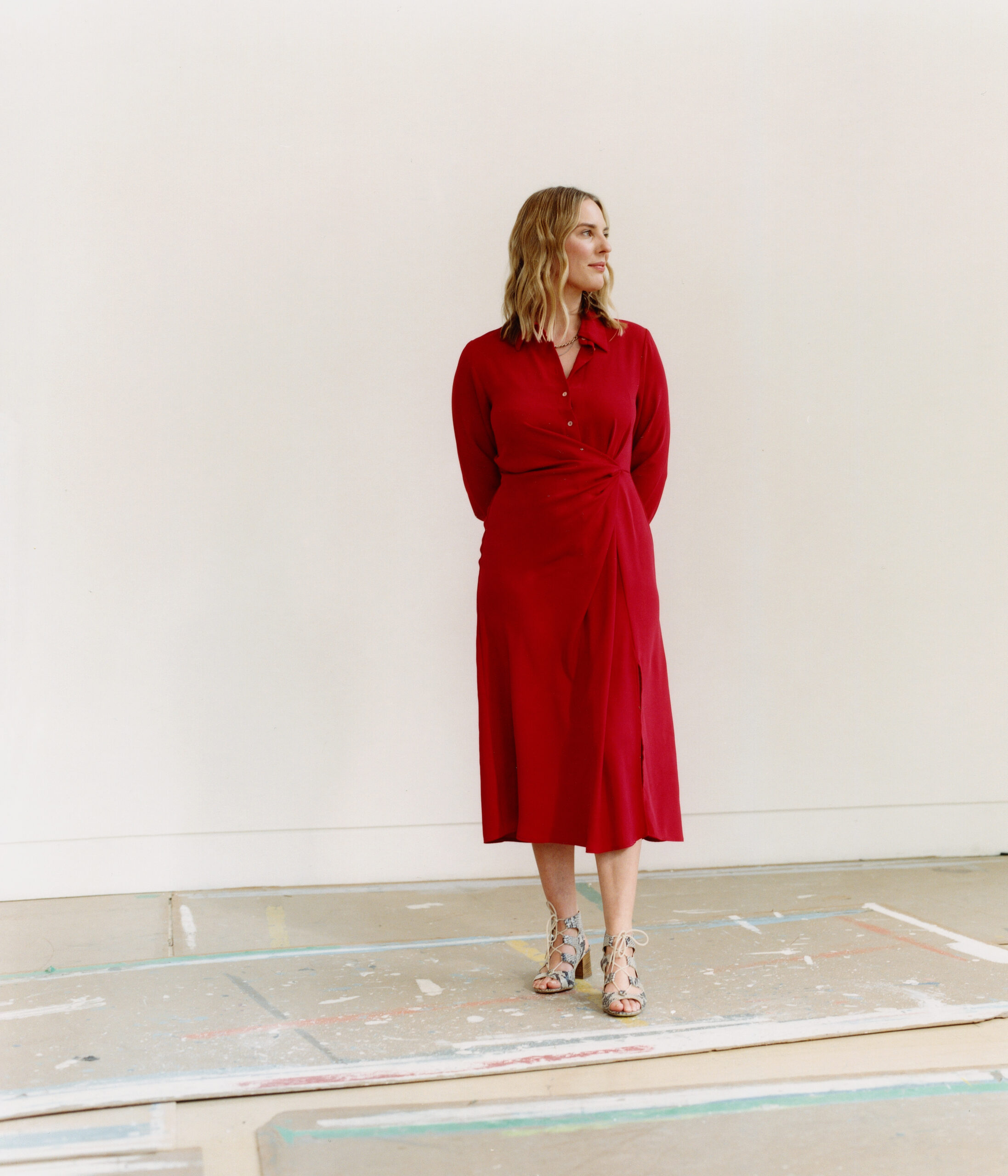
PHOTOGRAPHY JAMIE SALMONS
One of my favorite editions ever is the Joseph Beuys Capri-Batterie: a yellow lightbulb with a prong that attaches to a lemon that, over time, obviously decays,” smiles Rebecca Tooby-Desmond of the absurd objet that was produced by the German sculptor in 1985. As head of sale for Editions at Phillips she surveys and assesses a bounty of work, from etchings to woodcuts, lithographs, screen prints, bronze maquettes and photography. “An edition can be anything that’s produced in more than one form, more than one example,” says Tooby-Desmond. With her wide eyes and blond locks, Tooby-Desmond has developed a magnetic ‘on-rostrum’ persona and achieves knockout results, like the white glove David Hockney Editions sales in 2022 and 2023. The term indicates a sell-out and often means record prices. She’s also proud of the Edition Schellmann auction in Januar y 2024. Jörg Schellmann, a German entrepreneur, worked with Pop artists to manufacture and produce high-quality multiples which literally made Pop Art pop. Lots included Andy Warhol proofs and a Keith Haring totem, and the sale achieved $5.7m.
“People often ask me if I’ve had acting training because the assumption is that auctioneers are performers. But for me, it’s not a performance in that sense. Bidders want to be encouraged because it makes them feel, and quite rightly, that they’re acquiring a great piece. So let me ‘speak’ to each of them and see if they actually want to buy it,” says Tooby-Desmond of the vital interaction. She studied 19th-century European art at The Courtauld, but her interest was first triggered on reading the book The Art of the Steal: Inside the Sotheby’s-Christie’s Auction House Scandal, which documents a price-fixing incident. “Although that was a negative moment in auction-house history, it drew my attention to the cycles, the scale, the pace, and also the democracy of auctions. If you want to acquire an artwork and you’re the last man standing, you get it,” she says.
A good auctioneer can both encourage a client to bid more and drive the rhythm, the pacing and the excitement.
REBECCA TOOBY-DESMOND, HEAD OF SALE,
EDITIONS, AND AUCTIONEER, PHILLIPS
She started off in 2012 on the front desk of the Phillips Berkeley Square HQ, answering phones. Her lucky break came when Robert Kennan, who was hired from Bonhams to set up Editions in the UK at Phillips, took on Tooby-Desmond as “his right-hand/jack-of-all-trades/gal Friday. The department had a spunky start-up feeling from the beginning,” she smiles.
Fascinated by the innovative, as well as the traditional technologies used in creating multiples, she learned on the job and went from telephone bidding to auctioneer training (led by Barbara Strongin), and hammered her first 20 lots in 2017.
“The training was brutal, X Factor style, but I credit Strongin for making me the auctioneer I am today. Anybody can learn the numbers and get up there and execute a sale, but a good auctioneer can both encourage a client to bid more and drive the rhythm, the pacing and the excitement,” says Tooby-Desmond. She even interrupted her maternity leave to stage the Editions sale in January 2026 (another white-glove sale) and will be back in force for the Evening & Day Editions sale in June. “It was nice to know I still had it,” she smiles of her return to the rostrum. The biggest pleasure? “When you’ve got young collectors buying their first piece of art; being part of that journey is absolutely wonderful,” she says.
This is how you throw a party in Ibiza This is how you throw a party in Ibiza

This is how you throw a party in Ibiza
The art of understatement: Jacqueline Rabun and the enduring appeal of minimalism The art of understatement: Jacqueline Rabun and the enduring appeal of minimalism
The art of understatement: Jacqueline Rabun and the enduring appeal of minimalism
A photographer’s love/hate relationship with Seoul A photographer’s love/hate relationship with Seoul
A photographer’s love/hate relationship with Seoul
Tems on why protecting her peace has become her greatest success Tems on why protecting her peace has become her greatest success
Tems on why protecting her peace has become her greatest success
“I’m obsessed with pop music and think I will be forever”: Troye Sivan on new album She’s the Best “I’m obsessed with pop music and think I will be forever”: Troye Sivan on new album She’s the Best
“I’m obsessed with pop music and think I will be forever”: Troye Sivan on new album She’s the Best
Edward Enninful on the enduring impact of the 90s Edward Enninful on the enduring impact of the 90s
Edward Enninful on the enduring impact of the 90s
Topjaw’s Jesse Burgess on Gordon Ramsay, Michelin stars and building a food empire online Topjaw’s Jesse Burgess on Gordon Ramsay, Michelin stars and building a food empire online

Topjaw’s Jesse Burgess on Gordon Ramsay, Michelin stars and building a food empire online
How Lima’s young creatives are using fashion as an act of resistance How Lima’s young creatives are using fashion as an act of resistance