Is Backrooms A24’s scariest horror movie yet?
Directed by 19-year-old Kane Parsons, Backrooms turns internet-age anxiety into one of this year’s most unsettling horror films. Lead actor Chiwetel Ejiofor speaks to EE72 about liminal spaces, trauma and bringing one of the web’s most obsessive fictional worlds to the screen.
The year’s most anticipated horror film is, undoubtedly, Backrooms. The A24 film, starring Chiwetel Ejiofor and Renate Reinsve, had an unusual genesis: its origins lie in a 4chan thread about liminal spaces (dubbed “backrooms”) that spawned a massive community of fans enthralled by internet-era storytelling and lore-building. The backrooms originated in 2019, after a 4chan user posted a photo of an empty craft store and claimed that it felt “off.”
From there, users began adding to its lore: It was part of a gigantic alternate dimension with its own bizarre logic and layout. People became fixated on the concept, and the world of backrooms itself became a phenomenon when, in 2022, a 17-year-old named Kane Parsons released a webseries inspired by the backrooms on YouTube that has since racked up tens of millions of views.
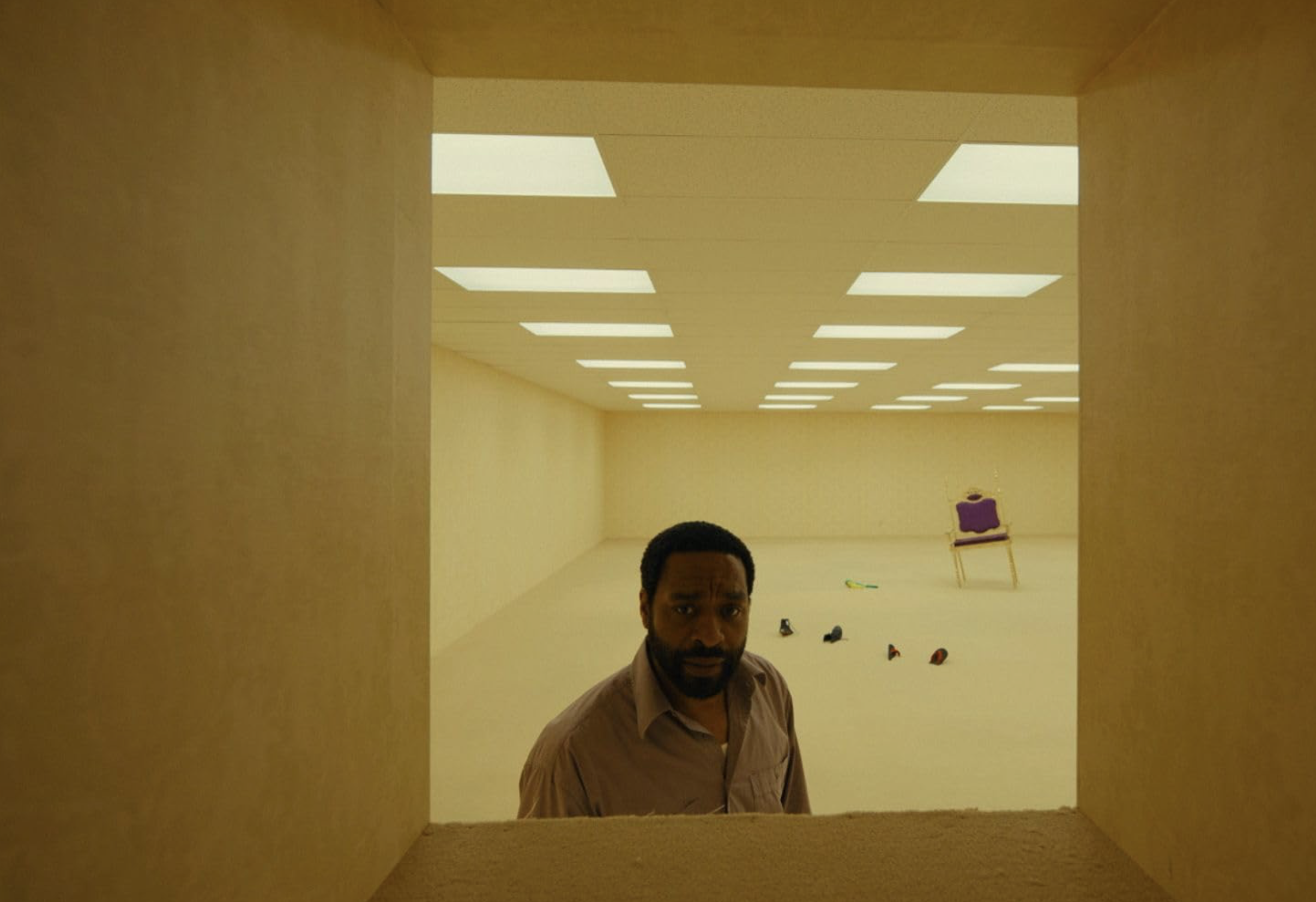
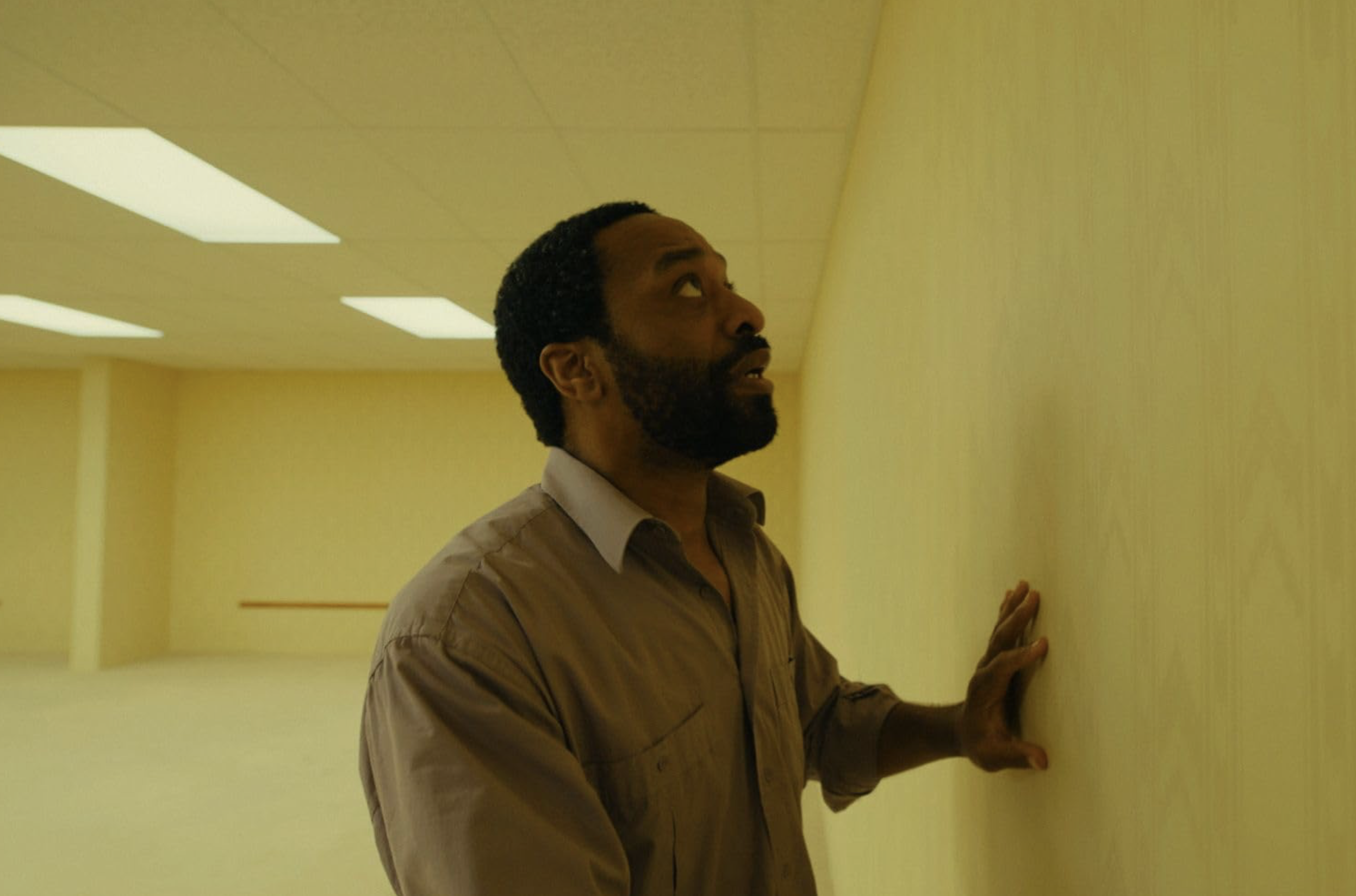
Needless to say, the Backrooms film adaptation—also directed by Parsons, in his feature debut—arrives with a huge amount of hype, and a lot of expectation from fans. The finished product might surprise them: it’s a strange, minimalist (and often terrifying) film that explores themes of trauma and masculinity without abandoning the web series’ sci-fi bent. The film follows Clark (Ejiofor,) a furniture store owner who’s trying to get over his separation from his wife with the help of his therapist, played by Reinsve. Aside from that, the less that’s explained, the better.
EE72 caught up with Ejiofor to discuss the brave new worlds he explores in the film, and what it was like bringing a beloved piece of internet culture to the screen.
COURTESY OF A24
Were you familiar with the concept of Backrooms before you signed on to the film?
I knew a little bit about liminal spaces, and I knew about [the concept of] no clipping, [a key part of Backrooms lore] from back in the day playing Doom, that video game. But those were my only two reference points. And then I was sent everything, the script, but also all of the links to Kane’s work and to [his original] Backrooms YouTube series, and then just started on a deep dive that I’ve been on ever since. It was fantastic.
The film itself is very much about the subconscious, analysis, and trauma…I’m interested in why you feel like those themes were such a fit for like this as a piece of IP.
Looking at Clark, and his psychology and journey… As a person who’s of an age, you become aware that there are certain patterns that you fall into. There is a certain cyclical nature to experience, and sometimes you can feel a little lost. The idea that somebody who is in a very fraught state of that, in an extreme state of that, encounters something that mirrors his psychological space with a physical space, but doesn’t know whether it’s a figment of his imagination and needs some sort of validation… I think there was something very telling about that, and very, very rich. You could project anything onto the Backrooms, but there is a feeling and a sense of it always being reflective of an interiority. Every individual has to bring whatever they bring in there—it’s not necessarily giving you anything, it’s just [bringing] out what’s already in you. Whatever those fears are, they’re going to be expanded to breaking point in that kind of space.
Your character does go through a lot, even though for long stretches of the film, it’s just you. I’m interested in what that experience is like, of not having anyone to play off.
I haven’t really done anything like this before, where you’re really following a train of thought in silence for periods of time, but where the objective is that everybody who is with you is also in the driver’s seat. Everybody is wondering with you what’s around that corner, and so then you peer around that corner and you all discover it together. There was something about that that I love—everybody becomes that character for a period of time. There are people who’d be like, ‘Listen, I’m done, I’m gonna head back now,’ and there are people who push that little bit further and see what’s around the next corner. I find that the audience starts to split as people are agreeing or disagreeing with the choices that are being made by the character, which is why I think it’s a theatrical film. It needs to be played in the cinema, so that you can really embrace all of that difference.
Which camp do you think you fit into, in terms of pushing forward or pulling back?
I mean, in the end I would go forward, but it would take me a long time. I think there would be places where I would probably sit for an uncomfortable length of time before trying to figure out what the next thing might be. But I would definitely keep going, because I’m just too curious.
[In Backrooms] everybody becomes that character for a period of time. There are people who’d be like, ‘Listen, I’m done, I’m gonna head back now,’ and there are people who push that little bit further and see what’s around the next corner.
Chiwetel Ejiofor
There’s a lot of quite technical work towards the back half of the film, a lot of practical effects and CGI—I’m interested in how it was working on those bigger set pieces.
A lot of the stuff that we did was practical. I think Kane was really big on just on keeping everything as practical as possible. But the sense was for me that it felt all very present—it held that mysterious, bizarre weirdness of that space and of the people that are in that space. I was grateful for that.
This was Kane’s first feature—I’m interested, did you have any trepidation working with a first-time director?
The first conversation I had about it was when I was being sent the materials. Somebody said, ‘You should know that he’s 19.’ If I think of myself at 19, I wouldn’t have been directing this picture, you know. And then I saw the series, and it was so well paced, and it just had all of the intentionality of really exceptional filmmaking.
I knew [after watching the YouTube series] that it was going to be a conversation that was way beyond the age of Kane — it was going to be a conversation about the richness with which he had envisaged and completely seen this world. By the time we had that first conversation on Zoom, I just didn’t think about his age again, it just didn’t really occur to me.
“It’s my dream trajectory”: Hayes Warner on how a handwritten letter landed her a debut role in Ryan Murphy’s The Shards “It’s my dream trajectory”: Hayes Warner on how a handwritten letter landed her a debut role in Ryan Murphy’s The Shards
“It’s my dream trajectory”: Hayes Warner on how a handwritten letter landed her a debut role in Ryan Murphy’s The Shards
“I did the craziest thing I’ve ever done for a project”: How Rosebush Pruning landed Lukas Gage his most challenging role to date and a new therapist “I did the craziest thing I’ve ever done for a project”: How Rosebush Pruning landed Lukas Gage his most challenging role to date and a new therapist
“I did the craziest thing I’ve ever done for a project”: How Rosebush Pruning landed Lukas Gage his most challenging role to date and a new therapist
“I’m always interested in doing something I haven’t done before”: Gugu Mbatha-Raw on Possession and challenging the cultural zeitgeist “I’m always interested in doing something I haven’t done before”: Gugu Mbatha-Raw on Possession and challenging the cultural zeitgeist
“I’m always interested in doing something I haven’t done before”: Gugu Mbatha-Raw on Possession and challenging the cultural zeitgeist
“I love creating in chaos”: Odeal on his days as a fencing instructor and love of all things creative “I love creating in chaos”: Odeal on his days as a fencing instructor and love of all things creative
“I love creating in chaos”: Odeal on his days as a fencing instructor and love of all things creative
The HaloBraid is the new piece of beauty tech disrupting the braiding world The HaloBraid is the new piece of beauty tech disrupting the braiding world
The HaloBraid is the new piece of beauty tech disrupting the braiding world
Ama proves that it’s all in a name with her self-titled sophomore album Ama proves that it’s all in a name with her self-titled sophomore album
Ama proves that it’s all in a name with her self-titled sophomore album
“It’s camp, seductive, vulnerable and very razzy.” We’ve seen the future of comedy and it’s Grace Quigley’s surrealist high-femme fever dream, On Our Backs “It’s camp, seductive, vulnerable and very razzy.” We’ve seen the future of comedy and it’s Grace Quigley’s surrealist high-femme fever dream, On Our Backs
“It’s camp, seductive, vulnerable and very razzy.” We’ve seen the future of comedy and it’s Grace Quigley’s surrealist high-femme fever dream, On Our Backs
“I didn’t do what everyone expected me to”: Nia Archives on lessons in love and the jungle projects you should be listening to “I didn’t do what everyone expected me to”: Nia Archives on lessons in love and the jungle projects you should be listening to