“My work — our work — has only just begun”: Del LaGrace Volcano takes us on a tour of their extensive photographic history
Del LaGrace Volcano is one of the world’s most important living image-makers, radical thinkers and visual documenters. Hattie Collins meets Del as they prepare for exhibitions this month and beyond in London, Edinburgh, Estonia and Dublin. And below, Del tells the stories behind some of their most memorable photographs.
When Del LaGrace Volcano, soon to be 69, gave a talk at Kings College in London in February 2025 it was immediately clear that not only are they a technically brilliant and emotionally intuitive photographer but they’re a gifted raconteur too. Across the course of two hours, Del entertained a rapt audience, riffing on the (often unprintable) tales of close relationships with artists and writers such as the late Derek Jarman and Kathy Acker. There were ruminations too on meeting The Matrix co-director Lily Wachowski who became a collector of their work and of being painted by Jenny Saville in 1999 (in a work coincidentally titled Matrix). You could feel the audience tilt forward as Del unravelled rambunctious yarns that included escaping from the Italian Mafia in early-eighties New York, escorting Chinese funerals by motorcycle in San Francisco’s North Beach with punk rocker Olga De Volga and of the pleasures and perils of cruising on Hampstead Heath with queer friends and filming those encounters on Super 8 (Pansexual Public Porn is available on Pink TV).
It’s perhaps unsurprising to discover that Volcano is now writing a book (working title: Imperfectly Honest: The Visual Memoirs of a Queerly Led Life). “Although,” says Del with a straight face, “before the final volume can be published some people have to grow up, others have to die and a few statutes of limitations have to run out.”
Just as important – and as delightfully unpredictable – is the work itself and the thinking behind it. Across five decades Del has documented, filmed, photographed and written from a deeply political perspective. Their practice is erotic, radical and profoundly and perfectly their own, challenging our pre-programmed ideas about the body, sexuality, gender and intersex bodies and exposing how these are shaped and restricted by race, class and representation.
Del, who was born and raised in Santa Maria, California and s/he was given their first Polaroid camera at the age of 12 before being exposed to the magic of the darkroom via the father of an older woman who had seduced the then-16 year-old. Their interest grew while hitchhiking around Europe two years later with a friend who was making B&W pictures on a twin lens Rolleiflex. “I was very impressed by that,” remembers Del. On their return to California, the self-described “juvenile delinquent runaway with excellent GPA and SAT scores,” enrolled on a Film, Photography and Philosophy course at Allan Hancock College. “One of my first jobs there was as a photo lab assistant and projectionist for the film department but I also was tasked with creating a slide library of living and dead photographers such as Arthur Truss, Dorothea Lange, Gordon Parks, Claude Cahun, Diane Arbus, Imogen Cunningham, Ruth Bernhard, Man Ray and Edward Weston, to name check a few with bodies of work that inspired me. There were other examples too, of the many ways the photographic lens has been used as a tool of imperialism and patriarchal power.”
Del, back then known as Della Grace, went on to win a full scholarship, choosing to study Photography at San Francisco Arts Institute, whose alumni includes Annie Leibovitz, Ansel Adams and Catherine Opie and professors such as Angela Davies (Volcano snuck into the radical academic and activist’s oversubscribed class). Arriving in the city in 1979, a year after the assassination of Harvey Milk, they found lodging at the Goodman Building, a commune-cum-low rent hotel and the former home of Janis Joplin. It was a space where critical thinking, social justice and rallying against the patriarchal and hierarchical norms through art and protest was centered. “The Goodman was queer long before queer was celebrated,” recalls Del. “We were Black, white, trans, old, young, hetero, homo and all points in between. The Grateful Dead did benefits for us and [poet and painter] Lawrence Ferlinghetti was a regular visitor. Best of all, as we were on rent strike I paid only $200 for the 18 months I lived there.”
As a small-town girl and scholarship student, the young Della Grace felt out of place at the elite art school populated primarily by the children of upper classes. A friend, Charmaine, introduced Del to [infamous lesbian bar] Scott’s where Del found their folx. “It was at Scott’s that I started to make serious work about my real family, the family I chose. I was there five nights a week snapping away, then going back to the darkroom the same night to develop them and bringing them back to show, share and sell the next night. I sold silver gelatine prints for $5 to $10—or a drink or a joint!—and gave free prints to those who were in them.” Their creative practice was slowly forming. “At the time I considered myself to be a social documentary photographer, making work about the communities I inhabited. Unlike the work I did in the Mission, a Hispanic district where I lived but did not belong, which was highly praised, the images I made with my new family of passing butches and high femme sex workers was not applauded or appreciated. “But,” they add with a gleeful grin, “this work seems to resonate today.”
At the time I considered myself to be a social documentary photographer, making work about the communities I inhabited…The images I made with my new family of passing butches and high-femme sex workers was not appreciated. But, this work seems to resonate today.
DEL LAGRACE VOLCANO
Similar to Nan Goldin, Volcano not only made the pictures but would often appear in them too. Over the proceeding five decades, their work has explored their own gender non-compliant body and their sexual predilections, as well as the friends, acquaintances and lovers made through many iterations and countries; from San Francisco leather bars through to Greenham Common and Chain Reaction, the eighties S/M lesbian night in London. It was around this time, 1991, that Volcano’s pioneering sex-positive photo book Love Bites was banned.
Nodding to that moment, Love Bites Back, the forthcoming exhibition at Edinburgh Arts Festival will show work made in the UK, primarily London and Edinburgh from Greyfriars cemetery to legendary London clubs like The Bell. The focus of July’s exhibition at Auto Italia, Sensual / Mutual, which opens tomorrow, will centre around Del’s time in eighties San Francisco and their work made at ARF, the Asylum for Rowdy Females (and dogs) in the high desert mountains above Santa Fe.
Del’s work has long been admired both in—and outside—the queer community; alongside high-profile collectors, including the V&A, they were given an honorary PhD in the arts from the University of West England, Bristol last year. Also in 2025, London’s hottest bookstore, Climax Books collaborated with Del on the book Queer Dyke Cruising after discovering the series of images taken on Hampstead Heath in 1988 at Tate Britain’s recent Women In Revolt exhibition. And, this year, as well as their image [Johnny Berlin, Berlin, 1996] appearing on the cover of Gemma Rolls-Bentley and Mollie E. Barnes’ foundational tome Queer Art, they have work showing across five exhibitions in three countries.
“We are now officially in the Age of Aquarius and Year of the Fire Horse,” Del the reluctant astrologer notes. “My life, so far, can be characterised as economically precarious and filled with the cognitive dissonance that comes with being told one’s work is “amazing, important, historical” and so on—but rarely being paid accordingly. My lived experience as a single co-parent with two young teenagers in a small conservative Swedish city is very different. Here I am just MaPa or “Del the Dude”. But I am also profoundly grateful to have finally received financial support for my work in Sweden for the past five years, to have a warm, clean bed to sleep in at night and a bit of a social safety net as a Swedish citizen,” they say. “But it feels so strange to be doing well when the world has gone mad with Orwellian double-speak and Trumpian atrocities committed daily. It is so important to find and use our voices, bodies, hearts and minds and do everything we can to disturb, disrupt and dismantle the systems that are actively seeking to destroy or enslave those who fall outside of the white, heteronormative template. So as I stand on the precipice of my seventh decade on Planet Earth, I feel that my work—our work—has only just begun.”
It is so important to find and use our voices, bodies, hearts and minds and do everything we can to disturb, disrupt and dismantle the systems that are actively seeking to destroy or enslave those who fall outside of the white, heteronormative template.
DEL LAGRACE VOLCANO
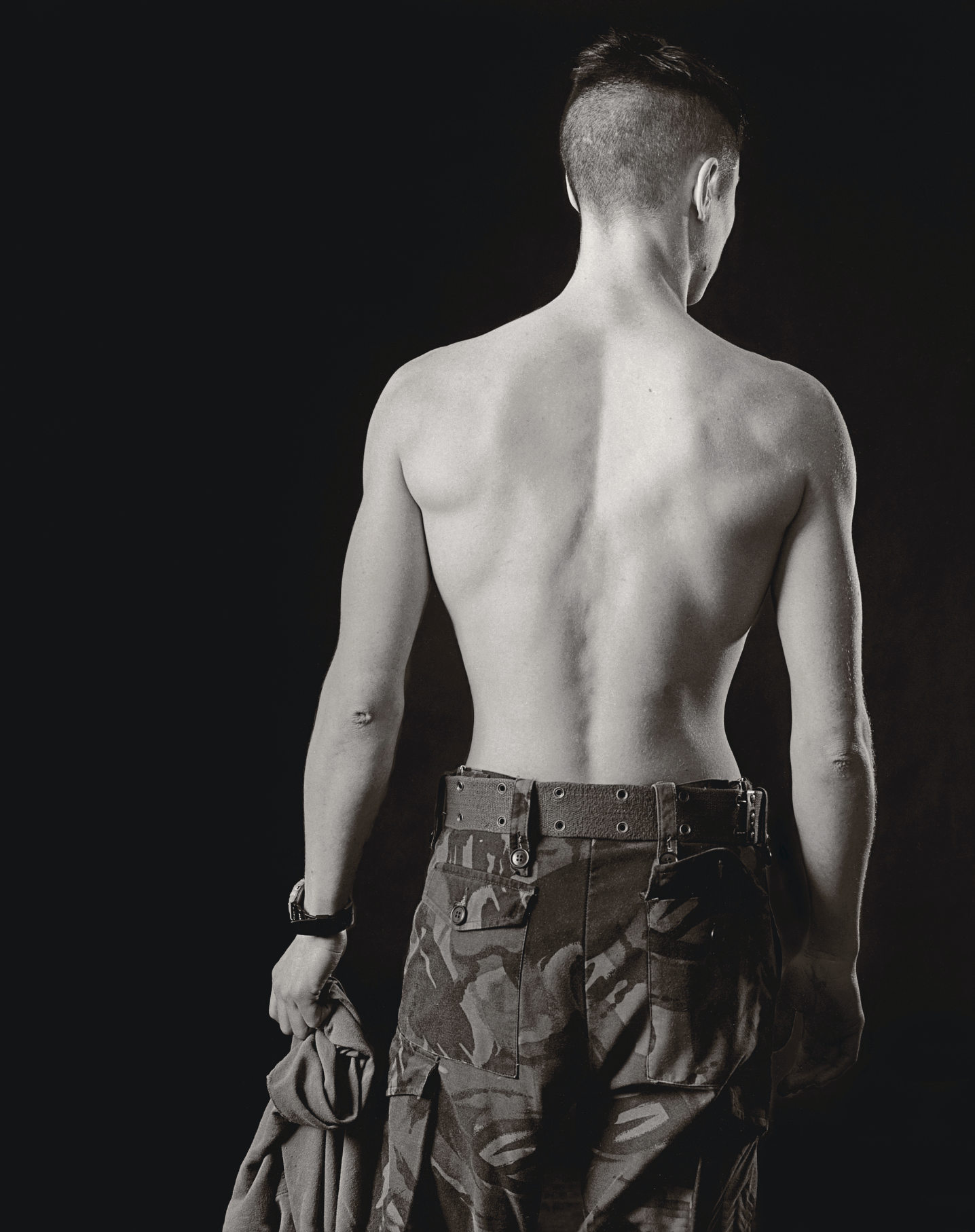
JAX BACK, 1992
“There was a new dyke on the scene, who everyone in London was raving about.Two of my good friends had already hooked up with her and kept saying, ‘Dellal, you just have to photograph Jackie, she’s beyond gorgeous’. I kinda hate for anyone telling me who I should photograph so I coloured myself sceptical. We finally met up in a queer cafe/pub near the canal in Angel. As Lulu came through the door, pulling Jax by the hand I had to admit that she was someone special. But I was hellbent on not looking too impressed just in case she was a jerk. I remember giving her the once over and saying something like, “Yeah, not bad for a tri-athlete and firefighter. But I’d really have to see you without your clothes on.” Jax took me by the hand to the toilets and stripped off. Bravado works for me every time. Wow. The rest is herstory. The images I made with Jackie have brought visual pleasure to thousands of butch dykes, gay men and trans-masculine people everywhere, but it’s femmes who make Jax heartbeat faster.”
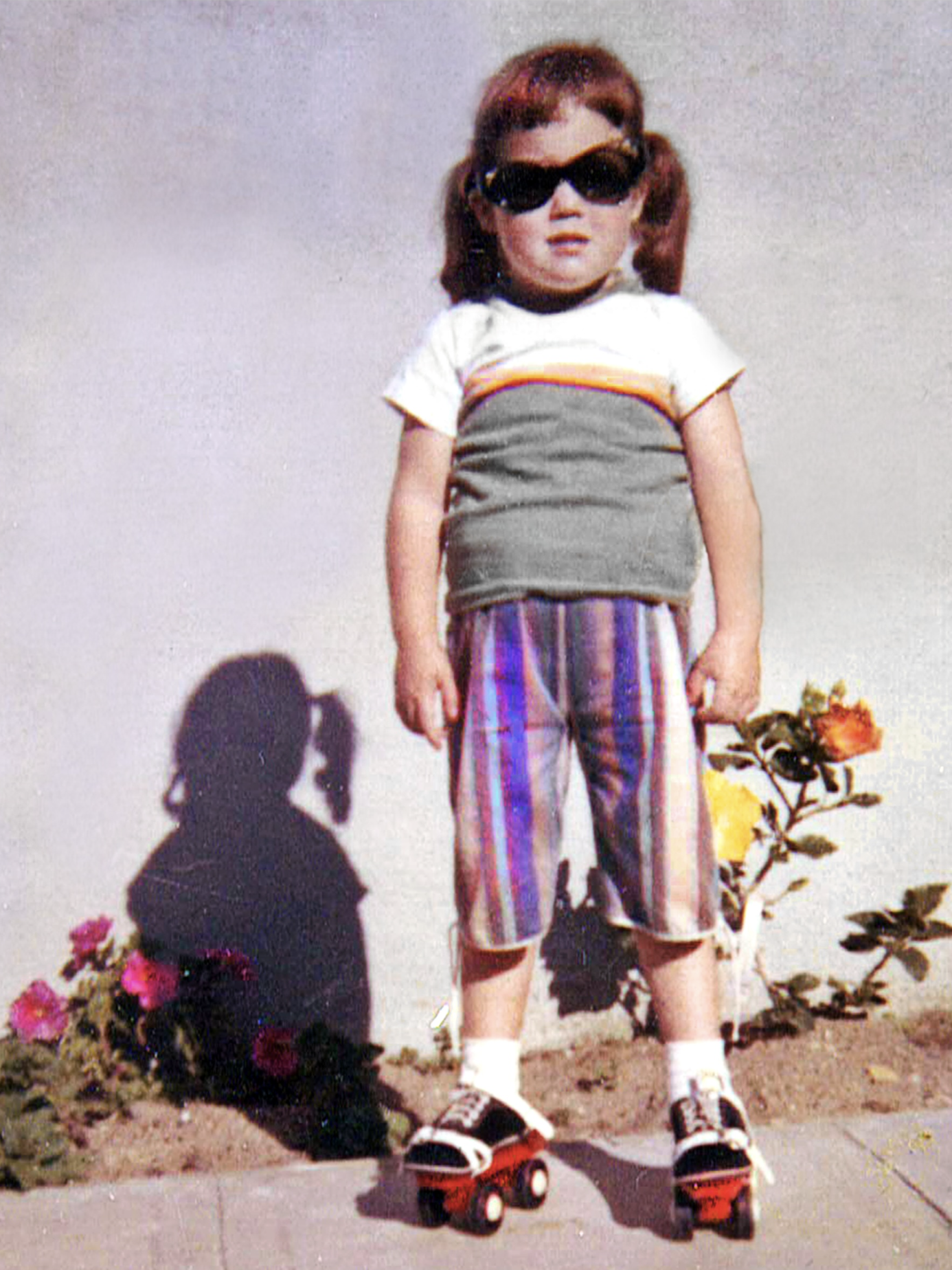
DEBBIE WOOD IF SHE COULD, SANTA MARIA, 1960
“Here I am self styled, posing for my mother, aged three. Debbie will be gracing the walls in Estonia this coming November, as part of a group show on Motherhood along with other works made as MaPa Del. I see this kid and totally recognise myself and how some things don’t change. I’m still a red head, (but only in one location), I still roller skate and I absolutely still have a ‘don’t even think about fucking with me attitude’.”
ZACK AND LOLA FLASH, LONDON, 1991
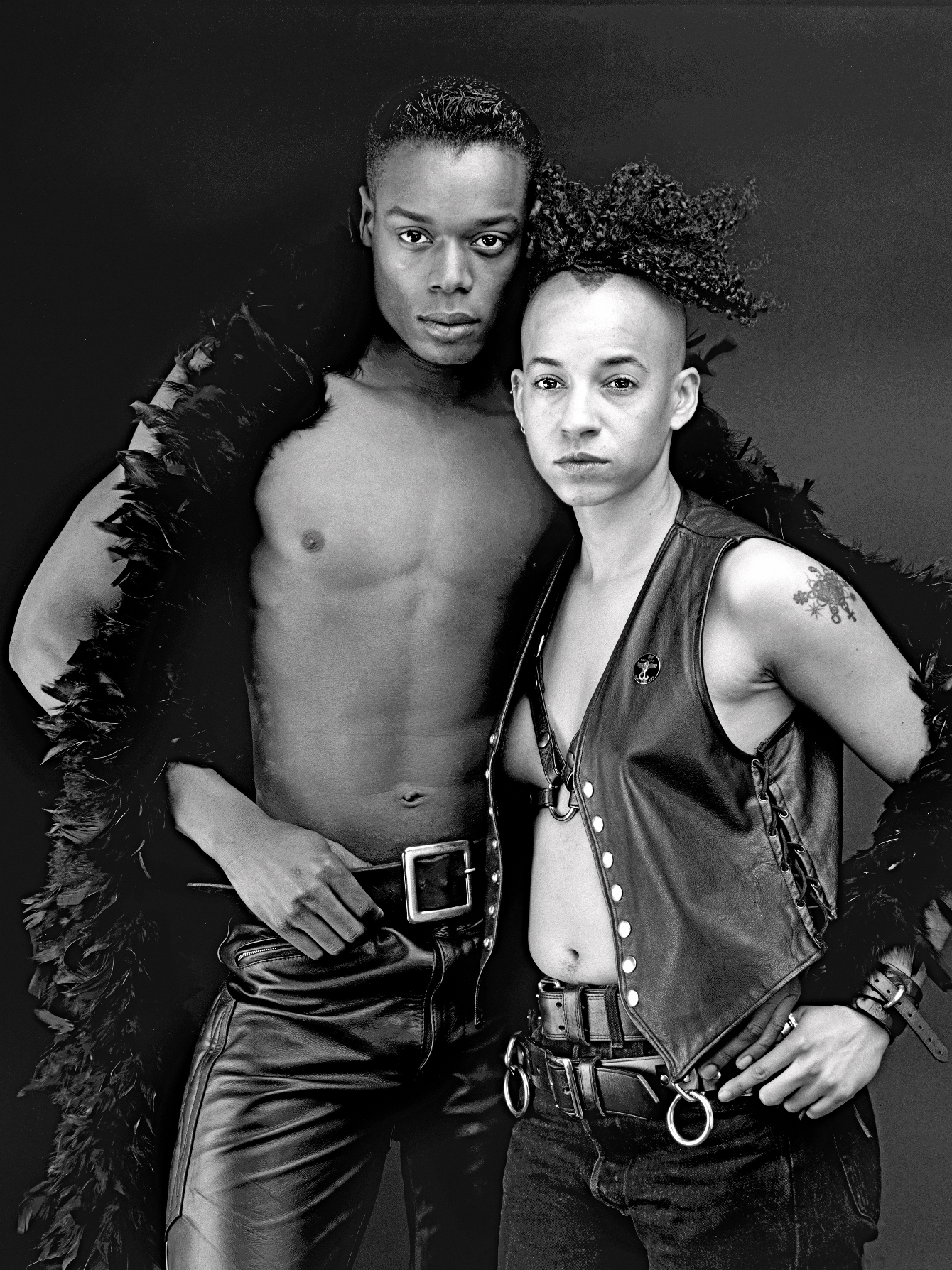
“This image was made in the studio at Polytechnic of Central London when I was working there as a photo/video technician and occasional instructor in fine art B&W processes. I met Zack when I spotted him getting off the underground at Oxford Circus one morning on my way to work. I followed him to Tower Records where he worked, and created a calling card with an embarrassing first gambit I stole from Prince” U Got The Look. It worked and although he had never modeled before he became a model after we worked together. Lola Flash I knew from the scene and she had just started living in London. The title intimate inverts is slightly ironic because although they had not met before the session but they instantly clicked. As did I. This was the first photograph of mine that became part of the V&A permanent collection.”
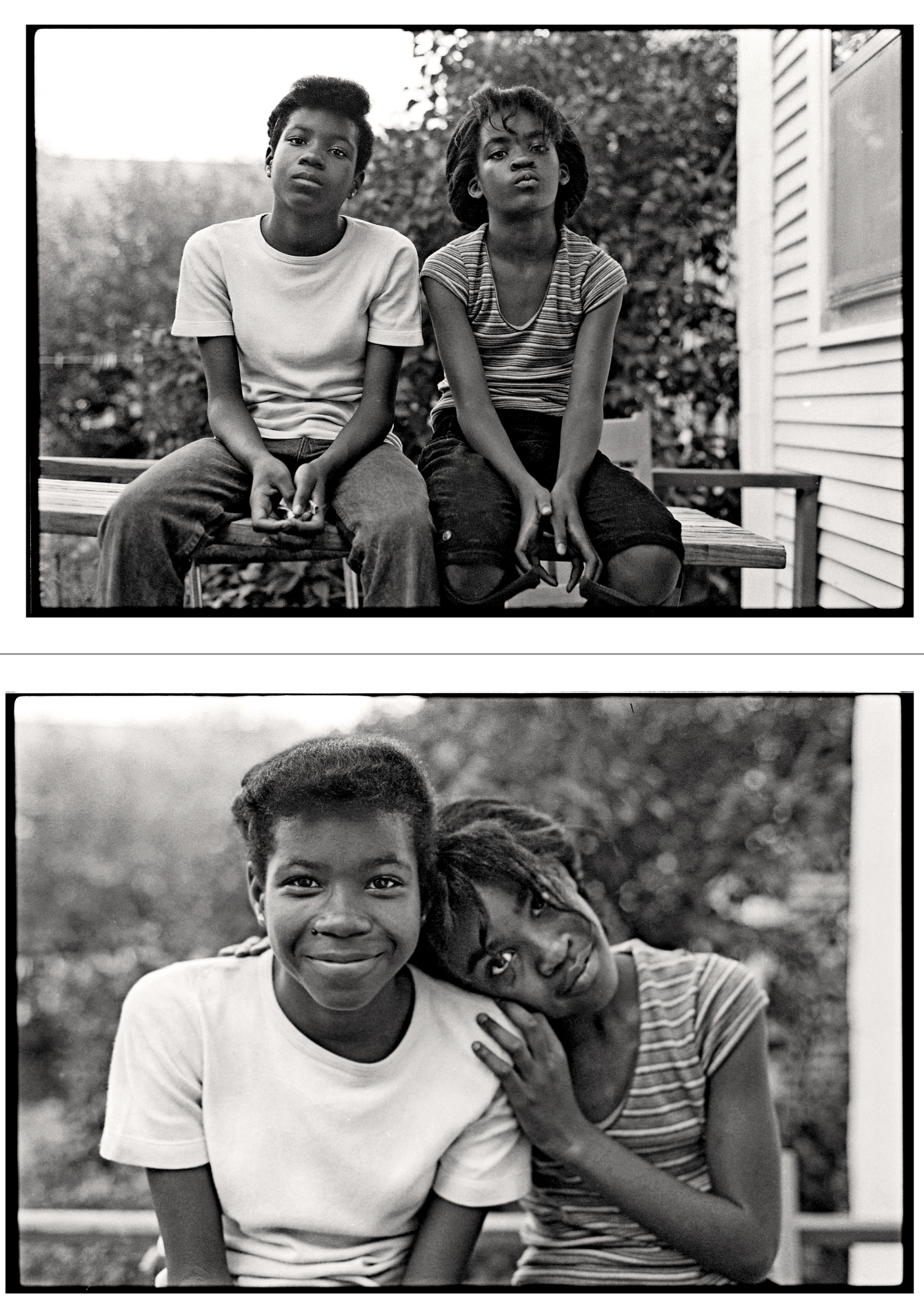
BLACK GIRLS MATTER, MINNEAPOLIS, 1982
“On my way to my first stint living in London on a cross country journey with my serious girlfriend we stopped to visit the offices of The Lesbian Inciter, one of the first publications I was a regular contributor to. Outside on the veranda there were two young girls, just hanging out. I asked them if they wanted to make some photos with me and I guess they said yes and I am sure I asked for their names and where to send copies of the photos, but that was 44 years ago and those scraps of paper are long gone, along with a whole lotta brain cells. I want to gift them copies of the entire series. I want to find them. I want to know who they are, who they were to each other. Were they young sweet hearts? Or just good friends. Does anyone recognise them? I’ve been pitching this as a photo essay, a human interest story to local Minnesota publications for years with no success. I wonder if it has anything to do with the word lesbian attached to the story?”
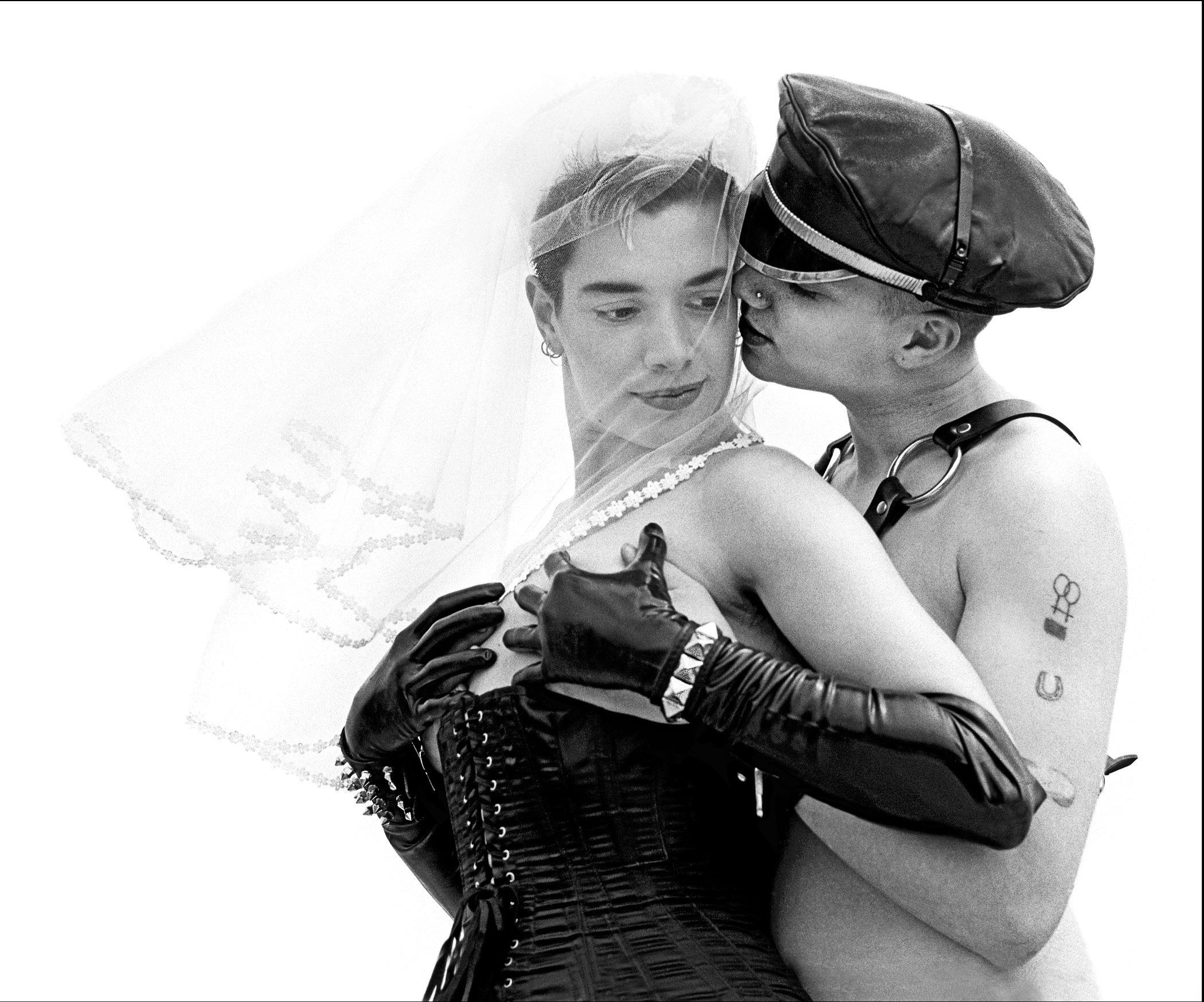
THE CEREMONY, ROBYN AND PERI, ON THE ROOFTOP OF COLERIDGE ROAD, LONDON, 1988
“The hand coloured one of a kind version of this image is to date the most successful sale I’ve yet to make, if we call the highest price successful. It was bought by Lilly Wachowski, who paid me more than I asked for and was one my first photographs of leather dykes ever published. A few months after [my book] Love Bites was published in 1991, it was part of Stolen Glances: Lesbians Take Photographs by Tessa Boffin and Jean Fraser. There were times when some of the more politically correct lesbians refused to exhibit with me. This image was, and is, full of romantic longing and actually quite sweet.”

MELISSA JO & ISLING, LONDON, 1992
“The hand coloured one of a kind version of this image is to date the most successful sale I’ve yet to make, if we call the highest price successful. It was bought by Lilly Wachowski, who paid me more than I asked for and was one my first photographs of leather dykes ever published. A few months after [my book] Love Bites was published in 1991, it was part of Stolen Glances: Lesbians Take Photographs by Tessa Boffin and Jean Fraser. There were times when some of the more politically correct lesbians refused to exhibit with me. This image was, and is, full of romantic longing and actually quite sweet.”
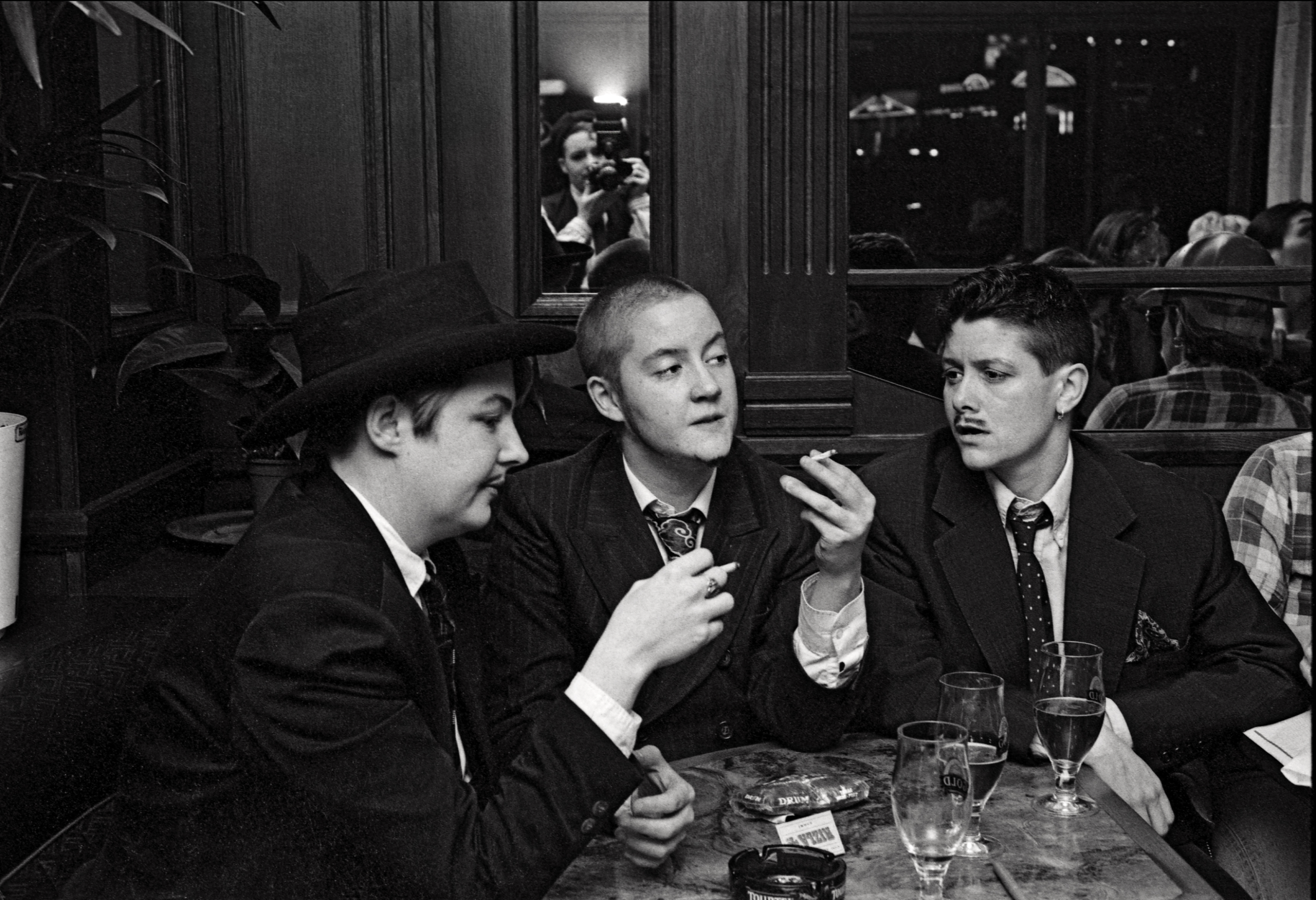
ODE TO BRASSAÏ, PARIS, 1996
“Drag Kings were all the rage in 1996 and there was a lot of interest from both the mainstream and tabloid media. Somehow, our club, Naive, which began at Madame JoJo’s in Soho attracted the attention of rich Parisian queerly heterosexuals. They invited us to the members only club, Les Bains Douche, that counted Catherine Deneuve as a member. Sadly she wasn’t there the night we were. There were maybe ten of us who accepted the invitation for a week, all-expenses paid trip for us to simply come and hang out with them at the club in drag and drink expensive cognac. That was fun. My performance was making photographs in character as SIR VESUVIO. A few from our gang also performed at Les Pigalles next to the Moulin Rouge. The main event though was taking over the streets of Paris, with the penultimate thrill I got making this ode to Brassaï, who became famous for the photographs he made in the late 1920s and early 1930s of Parisian nightlife, including images taken in the lesbian bar Le Monocle. As a young photographer drawn to subcultural experience, I found those photographs deeply arousing and formative.”
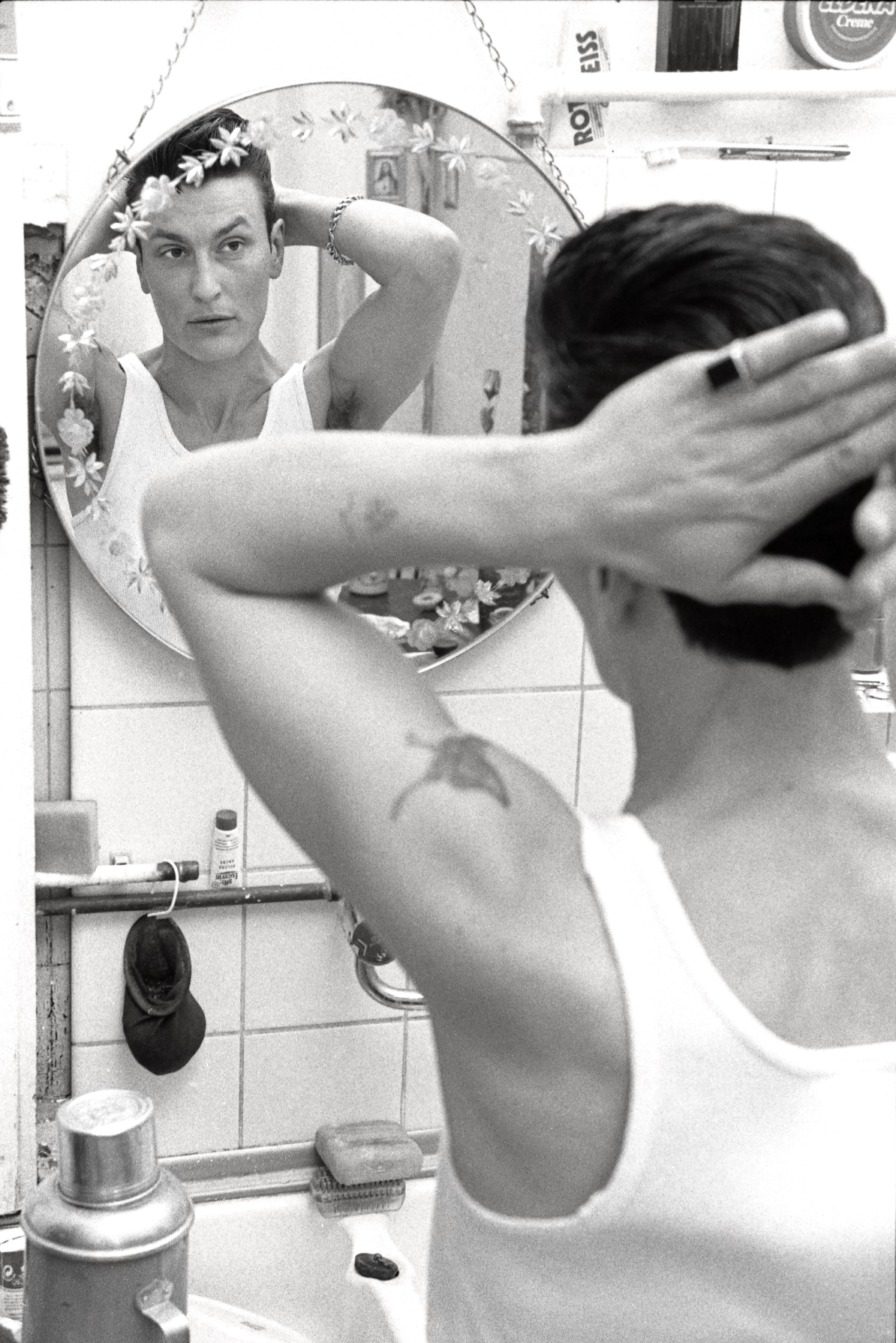
JOHNNY BERLIN, BERLIN, 1996
“In our culture, we are programmed to perceive that beauty and symmetry are inextricably entwined.These are things I don’t possess—though I do have good balance. With this image you have the repetition of the circles, the repetition of angles and good photos too are often about balance. That’s partly what the black line that frames the picture is about. It’s also due to my photographic training too; cropping was forbidden. You had to fill the frame and not waste space. When I was making early work, in 35mm, I had 24/7 access to the dark rooms and chemistry cabinet at college. They were truly excellent; you can blow 35mm right up and they hold. It’s about the graphic quality of the image—what attracts you, what pulls you in. When I process my images, I could look at them for hours. I get lost in them. But then the feeling fades and you need another fix.”
@trulydellagrace
Sensual/Mutual opens at Auto Italia, London, July 16th
Love Bites Back opens at the Edinburgh Art Festival on the 15th August
The art of understatement: Jacqueline Rabun and the enduring appeal of minimalism The art of understatement: Jacqueline Rabun and the enduring appeal of minimalism

The art of understatement: Jacqueline Rabun and the enduring appeal of minimalism
A photographer’s love/hate relationship with Seoul A photographer’s love/hate relationship with Seoul
A photographer’s love/hate relationship with Seoul
Tems on why protecting her peace has become her greatest success Tems on why protecting her peace has become her greatest success
Tems on why protecting her peace has become her greatest success
“I’m obsessed with pop music and think I will be forever”: Troye Sivan on new album She’s the Best “I’m obsessed with pop music and think I will be forever”: Troye Sivan on new album She’s the Best
“I’m obsessed with pop music and think I will be forever”: Troye Sivan on new album She’s the Best
Edward Enninful on the enduring impact of the 90s Edward Enninful on the enduring impact of the 90s
Edward Enninful on the enduring impact of the 90s
Topjaw’s Jesse Burgess on Gordon Ramsay, Michelin stars and building a food empire online Topjaw’s Jesse Burgess on Gordon Ramsay, Michelin stars and building a food empire online
Topjaw’s Jesse Burgess on Gordon Ramsay, Michelin stars and building a food empire online
How Lima’s young creatives are using fashion as an act of resistance How Lima’s young creatives are using fashion as an act of resistance
How Lima’s young creatives are using fashion as an act of resistance
Glen Luchford revisits his photographs that captured the spirit of the 90s Glen Luchford revisits his photographs that captured the spirit of the 90s