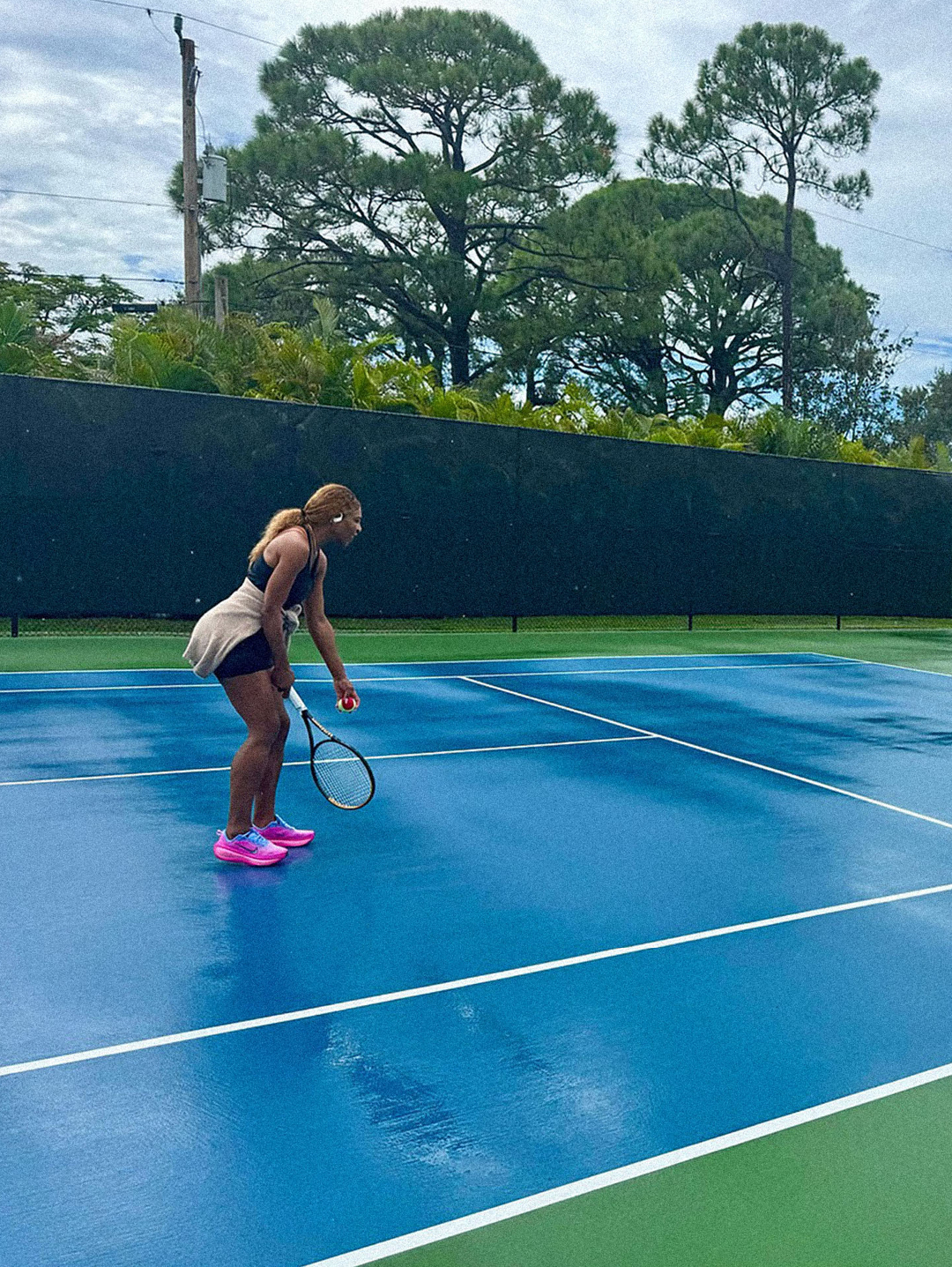
Serena Williams is returning to the tennis courts. But first, she joins EE72 for a moment to reflection
Ahead of her return to tennis at this year’s Queen’s Club, after a 4-year-long hiatus, pro-tennis star Serena Williams penned a personal essay for EE72. Here, she discusses the future she’s shaping for herself and her daughters, and not being defined by the sport she’s dedicated her life to.
What I love most about my life right now is that it no longer depends on tennis. That’s something I never imagined I would say. For so long, tennis defined me; it wasn’t just what I did, it was who I was. The wins, the losses, the preparation, the pressure — everything revolved around my sport. It shaped my whole world. Even my earliest memory is of being on a court. It was the thing I thought about when I woke up, when I went to sleep, and even in my dreams. The only way I knew how to step away from it was to stop completely. I could have stayed retired, and never picked up a racket again— I would have walked away feeling complete. For a long time, that’s exactly what I did. I threw myself into the world of venture capital; I spent up to 10 hours of every day studying companies, evaluating opportunities, and thinking about what I wanted to build. I completely avoided tennis; I didn’t watch it, I didn’t even think about it. Now I’m in a different place and I have the freedom to do what I love. That’s a rare place to be. I don’t need tennis any more, but I choose it anyway. There’s something incredibly powerful about that.
Being an entrepreneur is not easy. I started investing in early-stage companies back in 2013 or 2014; those years blur together now. I remember I was still deep in my tennis career, competing at the highest level, training constantly, traveling non-stop. Not long afterwards, I completed my second “Serena Slam” — winning four Grand Slams in a row. It was a wild time. But even then, I knew tennis wouldn’t always be my entire life and I wanted to prepare for what came next.
Investing resonated with me in a way nothing had outside of tennis.There was something about identifying potential early and helping to build something from the ground up. It required development, discipline and vision — the same qualities that I had needed as an athlete, the same qualities that meant that even at four or five years old, I was on the court, consistently showing up. Maybe not for long hours, but always there, hitting balls over the net on public courts in Compton, with cars passing by and music playing in the background. It didn’t look like much to the outside world, but it was the foundation of everything.
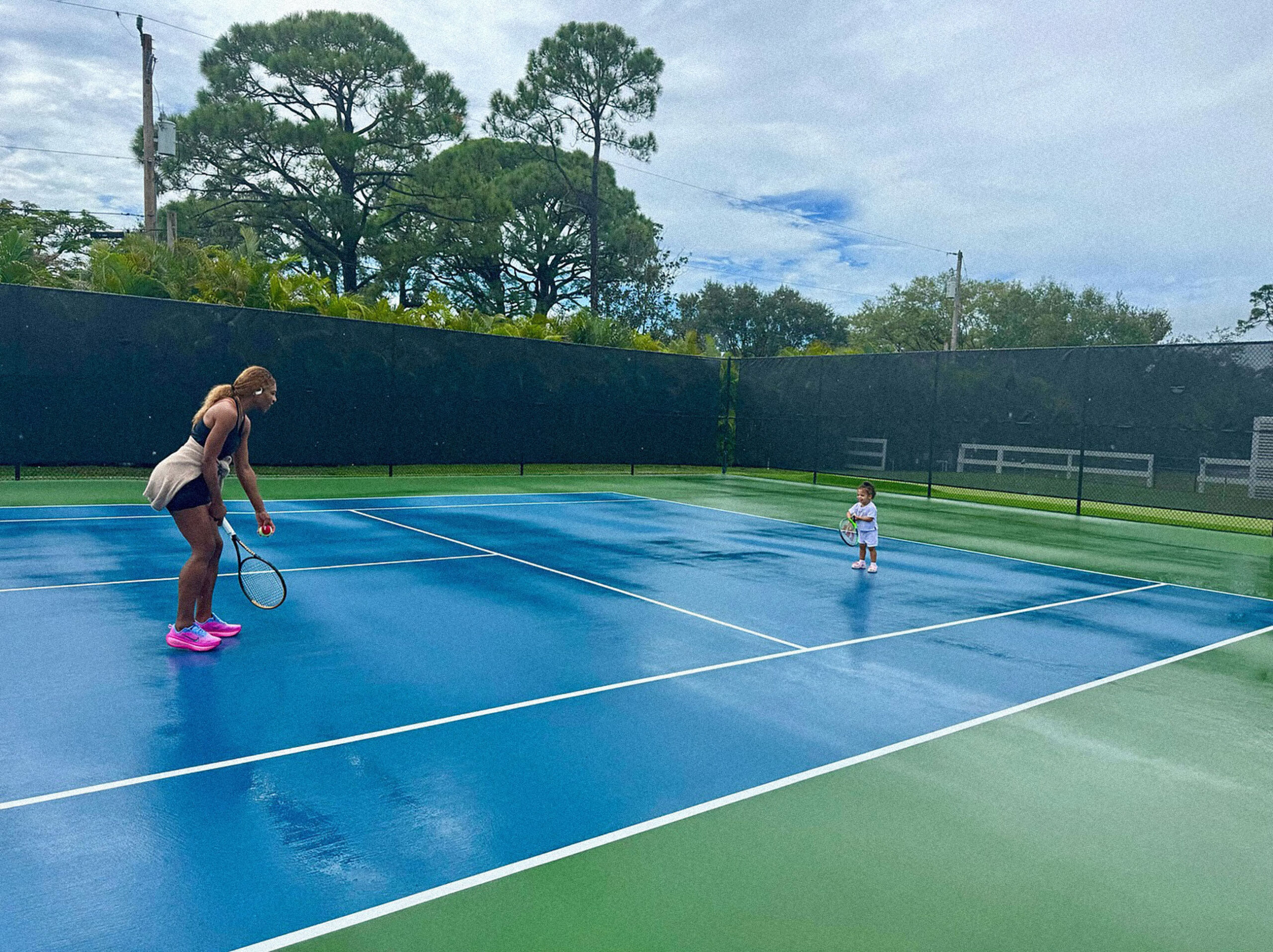
If I did return, it would be about experience, about sharing the moment with my kids. Maybe even a small moment where I can say, Look — this is what Mommy used to do.
SERENA WILLIAMS
And so I fell in love with technology, how it shapes our world, how it changes how we think, shop, communicate, learn and live. The companies that we build today are creating our future infrastructure and, in doing so, they’re shaping how people live tomorrow. That responsibility excited me. responsibility excited me. But I also saw something else. I saw that many founders who looked like me — women, people of color — were often overlooked. Not because they lacked talent or vision, but because they lacked access. I understood that feeling because I had lived it in different ways. Growing up, I didn’t have access to the same training facilities or partnerships that others did. I had to build differently, find another way in. I didn’t let that stop me, in fact it made me think deeply about how we create more access for others. When one of us paves the road, it becomes a little easier for the next.
So I started investing in women, in women’s sports and in founders of color. I invested in people who were building things that mattered, but weren’t always seen. When I think about the companies I’ve been fortunate to back, it reflects the kinds of ideas — and more importantly, the kinds of founders — I’m drawn to. I’ve always been interested in businesses that fundamentally shift access. The online education platform MasterClass was one of my earliest investments, and I was also one of the first instructors on the platform. That was a full-circle moment for me. I went from investor to creator and was able to see first-hand how powerful it is to scale knowledge. It’s not just about content, it’s about who gets to learn from the best in the world, and how widely that access can reach.
And then there’s Esusu, which is helping people build credit through rent payments . It’s something that should have always existed, but didn’t. That’s the kind of idea that stands out to me: obvious in hindsight, but overlooked for far too long. I never thought that I was big enough to completely change the landscape of venture capital because that would be unrealistic. But I did believe I could help a few people and that those few people could help a few more, and so it goes on. That is how change actually happens. Not all at once, but gradually. Today’s athlete is different.
They do more than just play their sport, they’re building brands and long-term futures. That wasn’t always accepted. When I started exploring business, investing, and building outside of tennis, I was scrutinized for it. People questioned whether I was focused enough and suggested that I was distracted, but I always believed athletes could be more.
My dad always told me to have a back-up plan in case Plan A didn’t work out. Considering my Plan A was tennis, it might seem like I didn’t need a plan B, but I still wanted something beyond sport. I wanted to build something that lasted, and define my legacy on my own terms. Through it all, the scrutiny never bothered me; when you’re focused on your purpose, that kind of noise fades.
I always came back to tennis. I loved playing, but the truth is, some days I also hated it, because it demanded everything. It pushed me mentally and physically and tested me constantly. I remember a time at Wimbledon after a tough loss where I felt completely overwhelmed: It felt like every opponent raised their level in a way I hadn’t seen before. The expectation to always show up and be great was relentless. You couldn’t have an off day, because someone else would step into that moment. And what made it harder was that losing became bigger news than winning. Winning was expected, but losing became headlines. That year, I struggled. I even had to withdraw from doubles, and for a moment, I questioned whether I could continue to be a champion. But champions adjust and recover and that’s what I did.
Now, when I watch the game, I see how much it has evolved. These players are incredible. I love watching Mirra Andreeva — she’s so composed, so calm under pressure. Victoria Mboko reminds me of myself: tenacious, fierce, determined. I find myself looking back — not to recapture the glory years, these women are far too good for me to even think about that — but sometimes I wonder if my kids will ever really see me doing what I once loved so much.
At one point, I didn’t think that mattered, but as they grow, I realize it does. I don’t think they fully understand what I’ve done. Not just on the court, but beyond it. I’ve tried to shield them, to give them a normal life, but I also want them to feel proud: I’m proud. These days, I’ll go out and hit a few balls, and I feel something different. A sense of calm. Joy. Tennis has become my happy place.
I never thought it would become that for me, but somehow it has. No pressure. And yes, I’ve thought about a comeback… not a traditional one. Not chasing titles or rankings, but one where I can explore the world with my kids by my side. Seeing athletes like Allyson Felix continue to redefine what’s possible — it makes you think. Wimbledon? Who knows. It’s a possibility.
If I did return, it would be about experience, about sharing the moment with my kids. Maybe even a small moment where I can say, “Look — this is what Mommy used to do.” Legacy can mean so many different things. For some, it’s trophies and for others, it’s records. For me, legacy has evolved. It’s about building things that last, creating opportunities and showing that reinvention is possible. It’s about proving you don’t have to be just one thing.
Today, my life is grounded in something very different. No matter what time I go to sleep, I’m up by 6:00 a.m. or 6:30 a.m. I get my daughter ready for school, make lunches — bento boxes, little sandwiches cut into shapes. I drive her to school, then come home and dive into work with Serena Ventures — reviewing deals, speaking with my partner and team, thinking through where we want to go and how we build.
But I’ve also set boundaries I never had before. My children come first and I spend as much time as I can with my youngest daughter — every moment between calls, between meetings.
We sit on the floor, we play, and I’m fully present. That’s something I didn’t always have earlier in my career, and I don’t take it for granted now. I am one person, determined to do what I believe is best for my career, my family, and my future. That’s what I’ve always done. And maybe legacy is having the courage to write the next chapter.
This is how you throw a party in Ibiza This is how you throw a party in Ibiza
This is how you throw a party in Ibiza
The art of understatement: Jacqueline Rabun and the enduring appeal of minimalism The art of understatement: Jacqueline Rabun and the enduring appeal of minimalism
The art of understatement: Jacqueline Rabun and the enduring appeal of minimalism
A photographer’s love/hate relationship with Seoul A photographer’s love/hate relationship with Seoul
A photographer’s love/hate relationship with Seoul
Tems on why protecting her peace has become her greatest success Tems on why protecting her peace has become her greatest success
Tems on why protecting her peace has become her greatest success
“I’m obsessed with pop music and think I will be forever”: Troye Sivan on new album She’s the Best “I’m obsessed with pop music and think I will be forever”: Troye Sivan on new album She’s the Best
“I’m obsessed with pop music and think I will be forever”: Troye Sivan on new album She’s the Best
Edward Enninful on the enduring impact of the 90s Edward Enninful on the enduring impact of the 90s
Edward Enninful on the enduring impact of the 90s
Topjaw’s Jesse Burgess on Gordon Ramsay, Michelin stars and building a food empire online Topjaw’s Jesse Burgess on Gordon Ramsay, Michelin stars and building a food empire online

Topjaw’s Jesse Burgess on Gordon Ramsay, Michelin stars and building a food empire online
How Lima’s young creatives are using fashion as an act of resistance How Lima’s young creatives are using fashion as an act of resistance