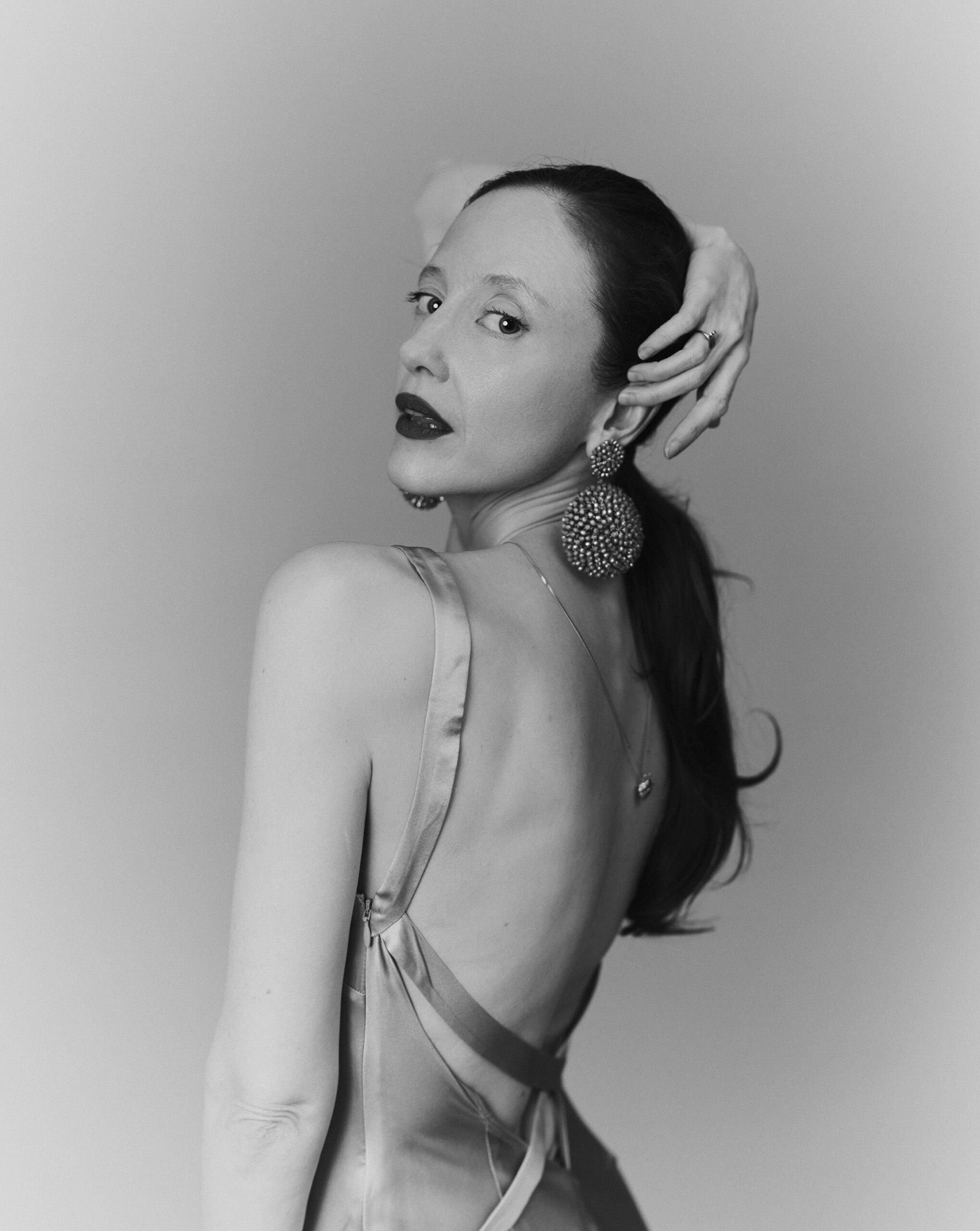
Hedonistic, violent and de-railed: Andrea Riseborough wants you to talk about The Good Boy
The Oscar-nominated actor discusses the art of juggling a diverse roster of characters and the cathartic experience of releasing a project into the world.
Andrea Riseborough is finally done with The Good Boy. “When [a project] ends, there’s a strange kind of delivery. This [interview] is part of that. It’s like a baby,” the 44-year-old actor smiles over Zoom. The project in question – Jan Komasa’s thrilling social commentary The Good Boy – graces screens on March 20th, with Riseborough’s bereft, “catatonic” Kathryn and her husband Chris (Stephen Graham) holding the hedonistic, violent and de-railed Tommy (Anson Boon) hostage. Whilst there, they impose some eerily unconventional methods of rehabilitation.
The suspense is free-flowing, and the ending, a surprisingly uplifting head-scratcher, leaves you to contemplate the true meaning of family. It begs the question: can people really change, and if so, at what cost? But while the world ponders this twisted tale, the Oscar-nominated actor is experiencing the catharsis of her project entering the world, and focusing on her next, The Queen of Fashion: Alex Marx’s biographical drama, spotlighting the incredible life of fashion editor and stylist Isabella Blow, in which Riseborough steps into the central character.
The jump from depraved kidnapper to one of Britain’s most influential fashion editors is steep, but Riseborough is accustomed to shape-shifting. She played a lottery-winning Texan, spending her spoils on alcohol and gambling in the punch-to-the-gut project To Leslie. Its impact landed her a nomination for Best Actress at the 2023 Oscars alongside Cate Blanchett, Ana de Armas, Michelle Yeoh and Michelle Williams. In the critically acclaimed and Oscar-winning Birdman or (The Unexpected Virtue of Ignorance), alongside cast mates Michael Keaton, Emma Stone, Naomi Watts, Edward Norton and Zach Galifianakis, Riseborough disappeared into the role of Laura, an insecure Broadway actress. She’s even played a psychologically fragile assassin in the sci-fi horror Possessor.
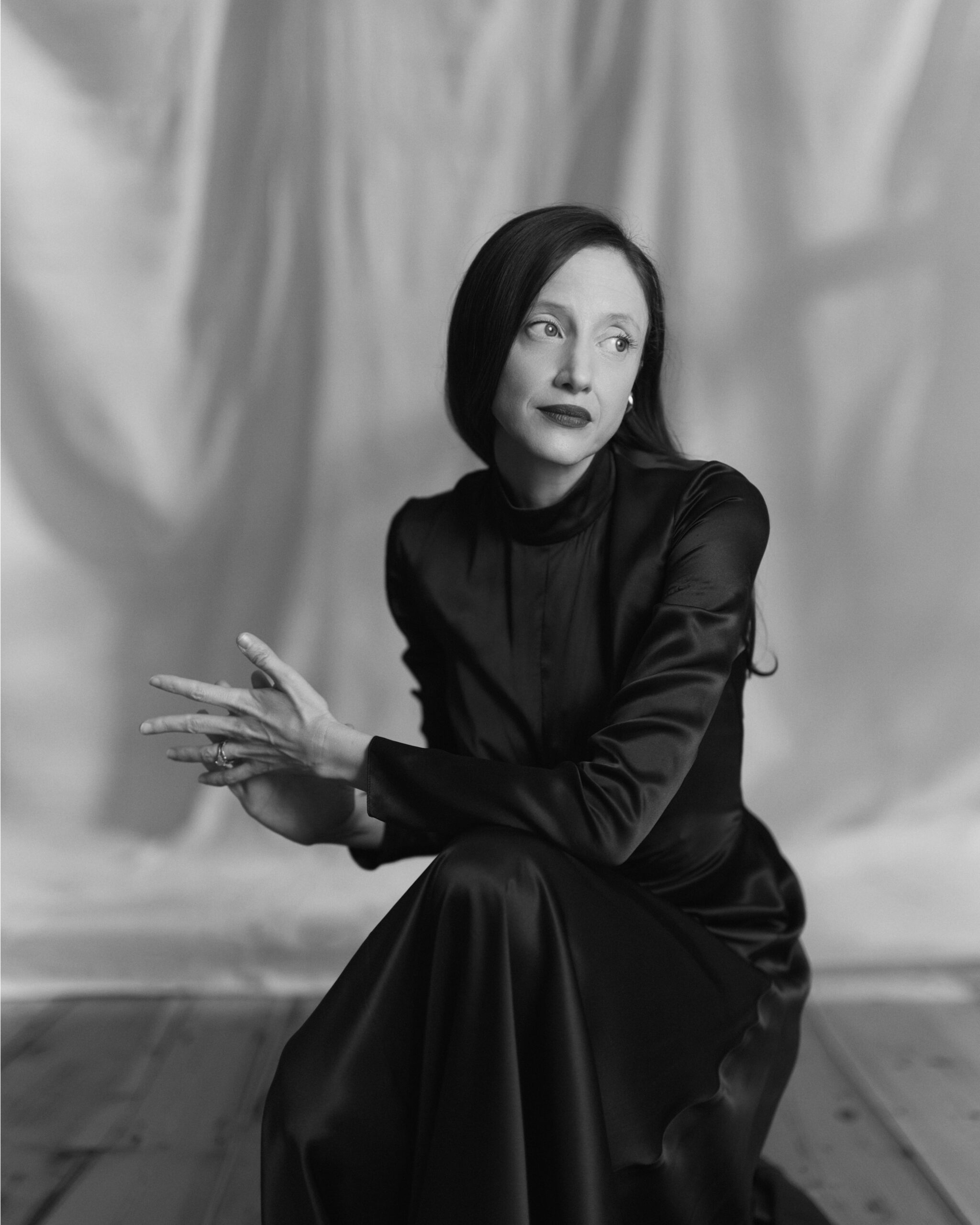
IMAGES COURTSEY OF BY PIP
It would be fair to call Riseborough a chameleon. But these capabilities have been nurtured through rigorous training. She graduated from London’s prestigious Royal Academy of Dramatic Arts in 2005 and undertook the National Youth Theatre’s coveted intensive training process REP Company. “Only after you leave, and then, in the most wonderful way, you’re spat out into a really insane world, do you look back and think, ‘Goodness, that equipped me for so many things because I was holding so much at once’,” she contemplates, sighting her education as the genesis of her character morphing abilities.
Ahead of upcoming roles — including the Ghost of Christmas Past in Ti West’s supernatural A Christmas Carol to Isabella Blow in The Queen of Fashion — she sat down with EE72 to discuss shedding the skin of The Good Boy.
You attended the Royal Academy of Dramatic Arts. Tell us about your formative experiences there and how they’ve shaped the actor you are today.
It was hugely formative. If I were to guess the number of hours that we put in per week at RADA, I would say it was probably somewhere between 60 and 65. We were there all the time. It was incredibly intensive training. One of the things I really valued about RADA was that you got a deep enough understanding of many different tools so you felt that you were genuinely taking them on and integrating them. This was classical theatre training, method training, and a brilliant way to learn your instrument. It felt very holistic. We had such a fantastic year. The group text chain has been pinging away today. The whole year is on there.
How long has that group chat been running for?
Very sadly, we lost someone from our year. It was so horribly unexpected. Since then, we have recommitted to being there as a community for each other. It’s been so satiating and heartening. When you train with people, you go through something that is incredibly specific, especially at drama school. It goes from dealing with things like Shakespeare to rolling around on the floor and pretending to be a tree. It’s a very odd, freeing, partly academic, but very practical experience. There’s so much of it, and it’s coming so fast. Only after you leave and then, in the most wonderful way, you’re spat out into a really insane world, do you look back and think, ‘Goodness, that equipped me for so many things because I was holding so much at once.’ One of my first post-drama school work experiences was at the National Youth Theatre. I was doing three plays at the National in REP, and I was doing two plays outside of that. I was making a film at the same time and that was all happening at once. I was playing such extraordinarily different characters. They were all from different places in the world and from different backgrounds. I just wouldn’t have been able to hold that much had I not had that incredibly strong foundation that RADA gave me.
Juggling characters has been a huge part of your career. It’s almost like you’re a shape shifter. How do you go about leaving certain characters at the door and picking up others in such close proximity?
It’s very odd because you go from playing somebody at the upper echelons of society to somebody who’s in abject poverty or dealing with horrible addictions that they’re struggling with. Maybe they’re facing the end of their own life or the grief of a child. At the beginning of The Good Boy, there’s a huge amount of grief that my character is going through, to the point that she’s basically catatonic. She’s unable to function. Throughout the film, she awakens. Her husband and Tommy really ignite her back into the world and allow her to reconnect with her son, played by Kit Rakusen. It is strange to pick them up and put them down… Outside of action and cut, I’m definitely able to step away, detach and relax, because I have to in order to regenerate myself enough to bring the energy that I need between action and cut. When a project ends, there’s a strange kind of delivery. This [interview] is part of that. It’s like a baby.
When a project ends, there’s a strange kind of delivery. This [interview] is part of that.
It’s like a baby.
Angela Riseborough
Have you had that moment of letting go of The Good Boy yet? If not, when will you have that moment?
I’m having it now. This is also one of two films I’m working on with Jan. My relationship with him is continuous. So, I’m sure that we’ll continue to process that well into the next piece. It’s such a special story because it manages to encapsulate some really abusive, dysfunctional, dark behaviour, but also connection, freedom of thought and moments of quiet that are very difficult to achieve in modern life. You see how Tommy is drawn to the family, and you see how he desperately needs that time to reflect. It’s almost as if he doesn’t know himself when he arrives, and he is slowly going through a process of internal discovery. Another thing that is a huge catalyst for him is literature. That is what my character is able to give him, as she’s an early modern scholar. She’s able to give him all these books, and it opens up a whole new world of critical thinking in his brain. He absorbs the experience of human life and what it is to be human. He’s given a vast array of books, but many of them are about what it is to be in society and to have the human experience. That all reflects the story that we’re telling in a sense.
The ending of the film stayed with me. Why do you think he returns to the family at the end of the film?
It’s important to see the story from every perspective. He’s being raised by a single mom who is probably battling to get any time to herself. Perhaps she just wants to completely and mindlessly scroll and switch off when she’s not at work, or, if she’s not working, maybe she’s having a difficult time dealing with that. Everybody has their own experience, so I think you can see from all sides why helicopter parenting is attractive to him over the sort of emptiness that he’s been feeling. That doesn’t mean his mother does not love him. It doesn’t mean that there’s no love there; it just means that life is fast and fleeting, and it’s harder to get an actual connection. It’s wonderful to see Tommy sitting with the family. Of course, the setup is dysfunctional. But it is incredible to see him without a phone. I think you can understand why he craves that. Before, he was filling that spiritual hole with substances.
There are some very dark themes, but, surprisingly, there’s a human core to the project. It’s so impressive that you and the cast offer that.
I can’t imagine a version of this that didn’t have this depth because I know Jan’s work. I know Stephen’s work. Anson and Kit are wonderful. It would never even appear to me as something that wouldn’t have that depth. But thinking back on it, I suppose it could have been quite sensational. It seems a lot of films are quite sensational. They’re shocking, but perhaps not very substantial. The best we can hope for in anything creative is the beginning of a new conversation or a valuable conversation about where we are societally… It’s a vital part of how we understand our human experience.
The best we can hope for in anything creative is the beginning of a new conversation or a valuable conversation about where we are societally… It’s a vital part of how we understand our human experience.
Angela Riseborough
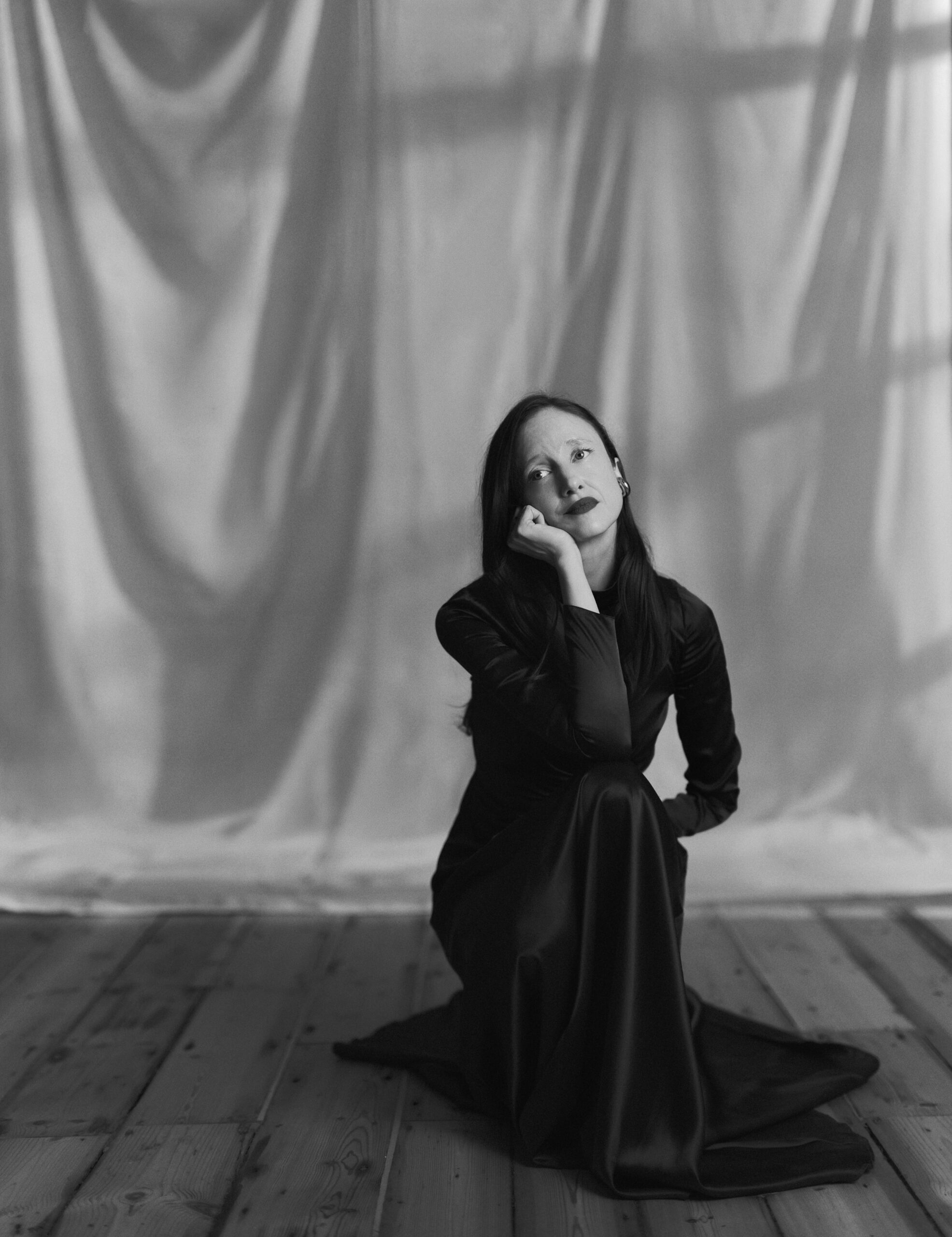
IMAGES COURTSEY OF BY PIP
I’d also love to talk to you about an incredible project you’ve got coming up where you’ll be playing Isabella Blow. How did that project find you, and what made you want to sign up for the role?
A very old friend of mine from my time at the National Youth Theatre had written a script, and he felt closely connected to this story because of something a friend of his had gone through. That was about eight years ago, if not more. We’ve been on the journey ever since. It’s difficult for me to talk about it because we’re not having a posthumous conversation. The thing that I loved most about the story was Isabella’s generosity, tenacity, and enthusiasm for artistry. She showed kindness and generosity by wanting to share people’s talents with the world. It’s quite an extraordinary and selfless position to be in. That’s what I’ll say for now… It’s still kind of in term. Is that what they say in America when having a baby? The bun is not yet out of the oven [laughs].
You have also played editor Audrey Withers. What is it about women in this sphere that draws you in?
I just thought Audrey Withers was one of the most inspiring people I have ever researched or played. What was really interesting about Audrey Withers was that she wasn’t very interested in fashion, which is extraordinary for the Editor of British Vogue. She was dealing with lots of different opinions, often very conservative ones. She was a socialist, and that was very unusual in the fashion world at the time… She was very interested in innovative people. Innovation is one of the things that excites me more than anything. I began to read about it and realised how forward-thinking she was.
What’s next? Is there a role you’re seeking out?
It seems to be a seasonal thing. You come into a new season, and you think, ‘Hmm, this is what I really want to explore.’ Also, great writing, great work, and working with excellent collaborators isn’t easy to come by. It’s hard to find great work. But everything that I do, I feel, is that. Everything I commit to is with people I feel kinship with, or it’s about something that is worth exploring. So those are the things that I’m drawn to.
“When I think about it, I’ve never not been performing,” Ramla Ali brings her fighting instincts from fashion to film “When I think about it, I’ve never not been performing,” Ramla Ali brings her fighting instincts from fashion to film
“When I think about it, I’ve never not been performing,” Ramla Ali brings her fighting instincts from fashion to film
Lindsay Perryman is the American photographer documenting trans-masc tenderness, togetherness and top surgery Lindsay Perryman is the American photographer documenting trans-masc tenderness, togetherness and top surgery
Lindsay Perryman is the American photographer documenting trans-masc tenderness, togetherness and top surgery
How Timothée Chalamet and A24 redefined movie promotion How Timothée Chalamet and A24 redefined movie promotion
How Timothée Chalamet and A24 redefined movie promotion
The new vanguard of British painters The new vanguard of British painters
The new vanguard of British painters
Potent, playful, and political: Catherine Opie on her landmark UK exhibition Potent, playful, and political: Catherine Opie on her landmark UK exhibition
Potent, playful, and political: Catherine Opie on her landmark UK exhibition
Do you have to be online to be relevant? Do you have to be online to be relevant?
Do you have to be online to be relevant?
“I know I will be making art till the day I die” Tracey Emin takes to the Tate “I know I will be making art till the day I die” Tracey Emin takes to the Tate
“I know I will be making art till the day I die” Tracey Emin takes to the Tate
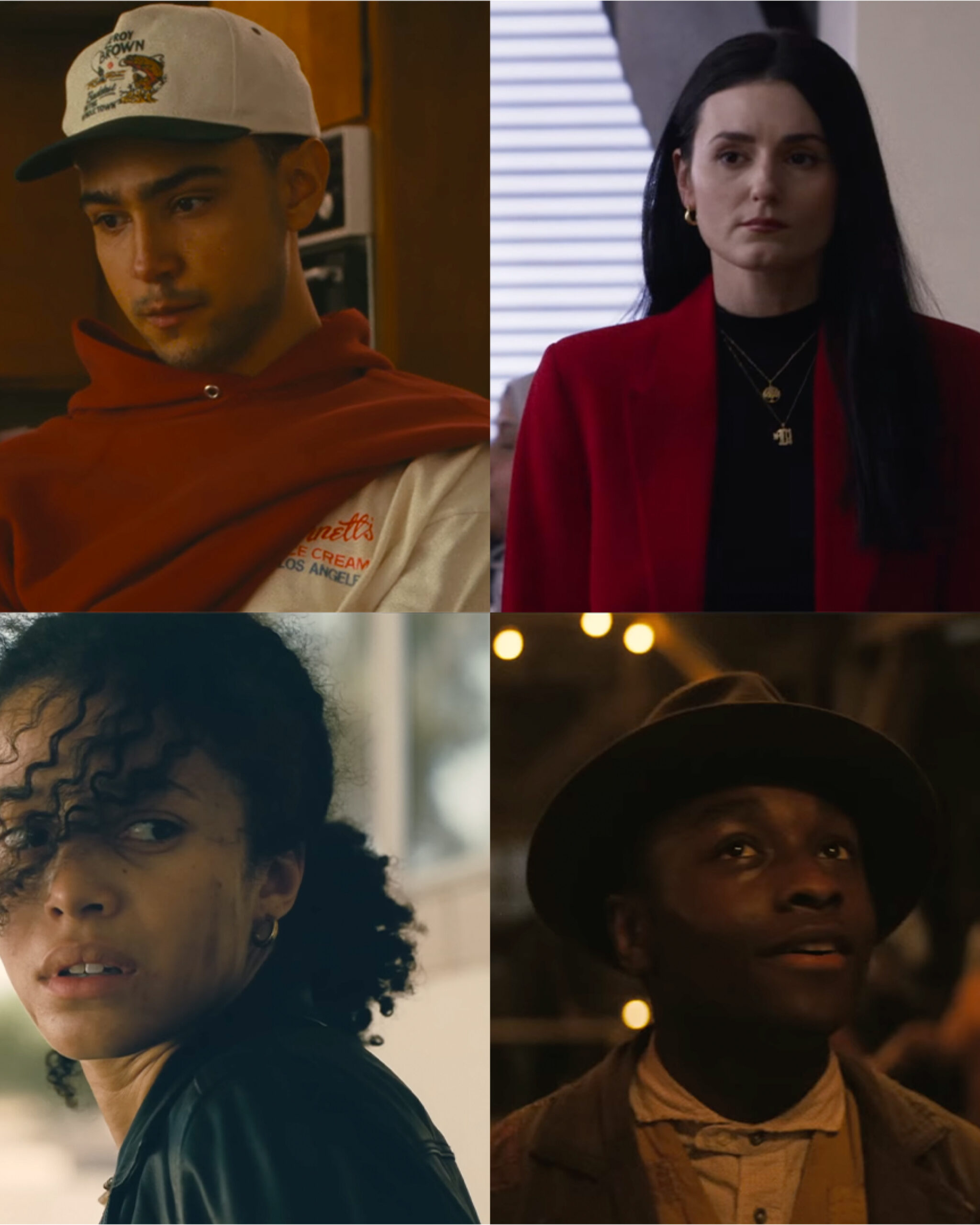
From Sinners to One Battle After Another: Meet this year’s BAFTA EE Rising Star nominees From Sinners to One Battle After Another: Meet this year’s BAFTA EE Rising Star nominees