How Anti-Aging talk has impacted our minds
The beauty industry may have retired the phrase “anti-ageing”, but our fear of growing older remains firmly intact. As social media, cosmetic interventions and shifting beauty standards intensify the pressure to stay youthful, Ata-Owaji Victor investigates the psychological impact of ageing in a culture that still treats it as something to overcome.
For many years, few offences were more likely to get you unceremonially added to a “do not invite” list than making an ill-advised political joke or asking someone how much money they earned. Now, we’ve swung in almost the opposite direction, with everything from sleep quality to burnout all now deemed acceptable topics of public discussion. Somewhere between the rise of self-care and the democratisation of therapy speak, we collectively decided that very little was off-limits. Yet, despite this appetite for openness, there remains one subject that still feels oddly difficult to discuss honestly.
We might be well-versed in tweakment protocols or bombarded by social media videos documenting elaborate multi-step ‘daily sheds’, but how we interact with ageing both as a biological reality and as an emotional experience, remains in a strange grey space. While the beauty industry has largely retired the phrase “anti-ageing”, replacing it with softer language like longevity and optimisation, the underlying anxiety remains. Much like how elements of diet culture have been readily rebranded as wellness, the vocabulary around aging might have shifted, but the message often remains the same, growing older is acceptable, provided you don’t look like you’re doing it.
While the beauty industry has largely retired the phrase “anti-ageing”, replacing it with softer language like longevity and optimisation, the underlying anxiety remains
Ata-Owaji Victor
Conversations about aging feel uniquely loaded due to the fact they often bring up complex feelings about identity, mortality, and control, explains psychotherapist and author Tasha Bailey. She explains to EE72 that, “For women especially, signs of aging can impact our sense of self-worth. We live in a society where we have been continuously judged and valued by our beauty as women. And so aging creates a shift in our perspective on how we might be viewed by the world, and we might ask ourselves who am I now if I’m no longer physically admired the way that I used to be? This can lower self-esteem, bring feelings of invisibility, shame and loss of identity.”
For women especially, signs of aging can impact our sense of self-worth. We live in a society where we have been continuously judged and valued by our beauty as women.
Psychotherapist and author Tasha Bailey
This exhausting thought cycle is often exacerbated by the fact that our younger faces are permanently archived online. According to Dr Helena Lewis-Smith, Associate Professor of Psychology at the University of the West of England, it’s why concerns about looking older are beginning much earlier than people might expect, often surfacing in late twenties and thirties. “This is less about specific visible signs of ageing and more about increasing self-comparison and awareness of societal appearance ideals,” she explains. These appearance ideals – that make youthfulness akin to peak attractiveness and success in adulthood- start early in life, adds the professor. “Studies suggest that by around 3 to 5 years of age, children already show a tendency to associate attractiveness with positive traits.” This cementing of a “beauty is good” bias, Dr Lewis-Smith tells EE72, “highlights how deeply embedded societal appearance ideals are, even before formal social learning about beauty standards becomes explicit. If this is discussed negatively within family environments, these attitudes can become internalised, creating a layered effect.”
When we notice ourselves aging, we’re rarely just responding to the change itself, we’re responding to the gap between what we see and what we’ve been taught we should look like. This discrepancy can trigger self-criticism and lead to body image concerns. It’s a heavy weight to carry because ‘looking’ like you’ve aged has been historically positioned as something to resist at all costs. The beauty industry has adapted to this eagerly, with a global survey of the market by the International Society of Aesthetic Plastic Surgery, from 2024 reporting that surgical facelifts alone have jumped in popularity by 7.4 per cent globally since 2020. Staving off the physical elements of aging is also now largely framed as maintenance, prevention, and a point of personal responsibility, which makes it all the more difficult to not internalise negative ageing talk.
The benchmark for what it is to be an older person has also drastically shifted in a way that allows everyone from Pamela Anderson to Angela Bassett the freedom to rewrite the rules on ageing in their careers, but it’s made our willingness to ‘look’ our age even more complex.
Dr Lewis-Smith points to the growing popularity of cosmetic injectables among younger adults as further evidence of this layered relationship. An example of this complicated shift, she notes, “is the rise in younger adults seeking cosmetic injectables, such as Botox or dermal fillers. These procedures were traditionally associated with correcting signs of aging later in life, but are now often used preventatively.” From a psychological perspective, this “reflects both earlier internalisation of societal appearance ideals and a move toward managing appearance concerns before they become externally visible.”
While the historical weight of beauty standards has uniquely centred on women, modern digital trends like looksmaxxing have rapidly expanded this pressure to men. “We’re seeing a broader cultural shift in which appearance maintenance is becoming a shared expectation across genders, although it is expressed in somewhat different ways. At the same time, these pressures are still shaped by a clear double standard of aging, with aging often perceived more negatively for women than for men.” Dr Lewis-Smith notes that elevated body image concerns can lead to “anxiety, lowered self-esteem, increased self-consciousness and narrowing self-worth until it becomes organised primarily around appearance rather than relationships, achievements, or other aspects of identity”.
Persistent concerns about aging often create a cycle of self-monitoring, mirror checking, and compulsive comparison. When hyperfixation emerges from the feeling that your appearance no longer aligns with an internalised ideal, Dr Lewis-Smith warns that a routine becomes unhelpful when it shifts from flexible self-care to rigid, rule-bound behaviour. “For example, if missing a skincare or exercise routine leads to significant distress, anxiety, or guilt, this may indicate that the behaviour has become problematic.” The irony is that many of these behaviours are framed as self-care. Skincare routines and beauty treatments are frequently marketed as acts of empowerment, and for many people, they genuinely are. There is nothing inherently problematic about wanting to look after your skin, but there’s a strong case for figuring out the distinction between what those behaviours are doing for you physically versus psychologically.
This requires a tiny bit of introspection, explains psychotherapist Tasha Bailey. Rather than falling into a guilt spiral about blindly following beauty scripts, Bailey tells EE72 that “the question becomes less about what we’re doing and more about why we’re doing it. Does it soothe us or stress us? Does it expand our lives or make them smaller?”
Perhaps that’s why some of the healthiest approaches to aging require shifting the conversation away from fixing and towards just talking. Bailey encourages a more compassionate methodology, suggesting we approach our skin with greater curiosity. “When you notice yourself being critical of your skin, it can be a good idea to reframe the problem. Rather than “my skin looks terrible today”, shift this to “my skin is having a difficult day.” It’s a reminder that skin goes through different phases depending on our diet and environmental factors, and that it’s not about us being inadequate.” Although so much of ‘self-love’ rhetoric has become diluted, Bailey tells EE72 that, “you can even treat your skin as though it’s a person (and actually your longest friendship!), and imagine only speaking to and about your skin as you would a loved one.”
When asked how individuals can navigate these conversations if they start to feel uncomfortable, Bailey advises starting from within. “Check in with yourself first: what are you feeling and what is it triggering for you? Having that inner reflection will help you with communicating your needs when these uncomfortable conversations come up. Give yourself permission to set boundaries.” Focusing less on what we should look like and even cleaning house by diversifying our social media feeds so that we are regularly seeing and celebrating skin of different ages and maturities can serve as a vital reset.
Having go-to responses the same way you have an elevator pitch for your career or a joke in your back pocket for a first date can protect your peace when negative aging talk arises.“Simply saying, ‘I’m working on not being so hard on my appearance,’ ‘I’m trying to focus less on anti-aging conversations lately,’ or ‘let’s talk about something else’ can be a great way to communicate your boundaries and segue to something else without stopping the conversation.” says Bailey. This gentle reclamation of agency offers a less ‘age anxiety’ path forward and “If someone is being disrespectful on the topic and you’d prefer to walk away,” says Bailey, “you have full permission to not engage at all—especially if it costs you your peace and wellbeing.”
The lightness of being: Nicolas Ghesquière engineers a cooler future The lightness of being: Nicolas Ghesquière engineers a cooler future
The lightness of being: Nicolas Ghesquière engineers a cooler future
The 90s: Art and Fashion opens at Tate Britain The 90s: Art and Fashion opens at Tate Britain
The 90s: Art and Fashion opens at Tate Britain
Her many selves: Matthieu Blazy explores Chanel’s multiplicity Her many selves: Matthieu Blazy explores Chanel’s multiplicity
Her many selves: Matthieu Blazy explores Chanel’s multiplicity
A night at the Versace villa: Victoria Beckham on her favorite 90s night A night at the Versace villa: Victoria Beckham on her favorite 90s night
A night at the Versace villa: Victoria Beckham on her favorite 90s night
Shelf life: Alessandro Michele expands his Valentino library Shelf life: Alessandro Michele expands his Valentino library
Shelf life: Alessandro Michele expands his Valentino library
Reality check: Miu Miu puts the everyday on a pedestal Reality check: Miu Miu puts the everyday on a pedestal
Reality check: Miu Miu puts the everyday on a pedestal
Royal treatment: Comme des Garçons examines modern grandeur Royal treatment: Comme des Garçons examines modern grandeur
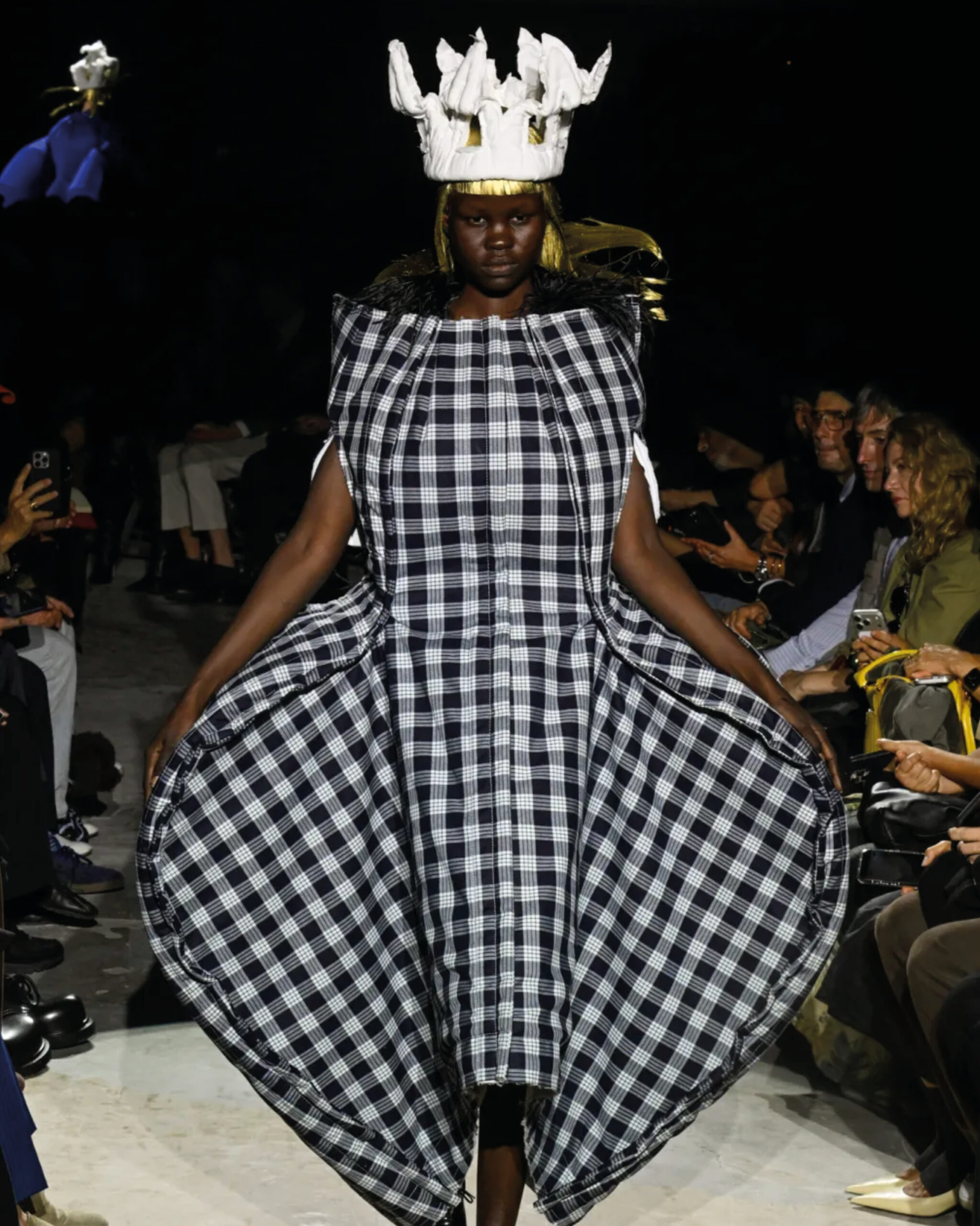
Royal treatment: Comme des Garçons examines modern grandeur
A wardrobe for life: Hermès makes desire crystal clear A wardrobe for life: Hermès makes desire crystal clear