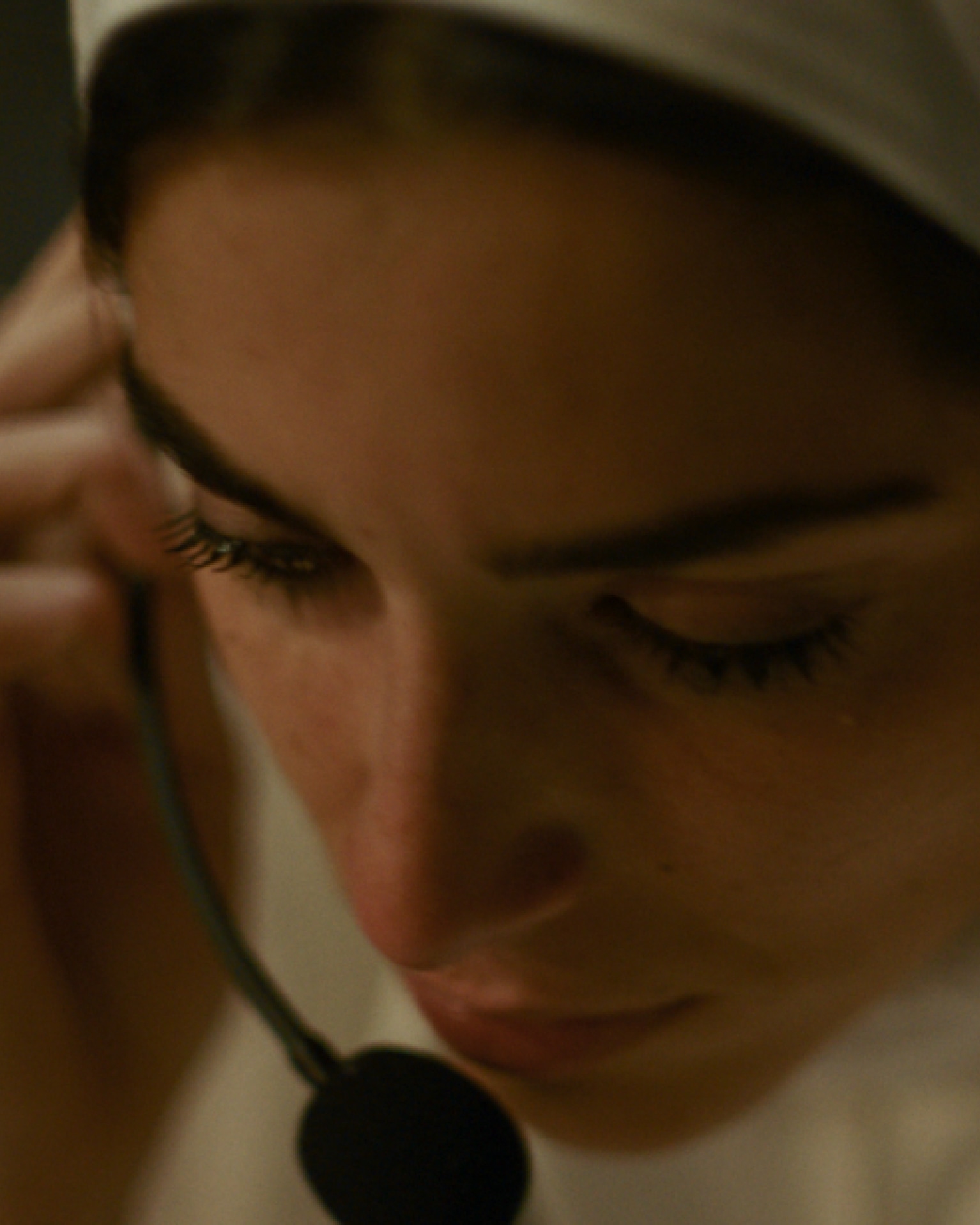
“A child should never be put in a position where they have to beg for survival.” Saja Kilani on The Voice of Hind Rajab
The Jordanian-Palestinian actor discusses bringing Hind Rajab’s story to the screen, the ethics of testimony, and why cinema can refuse erasure.
“I’m so scared, please come.” These were some of the final words spoken by five-year-old Palestinian girl Hind Rajab during a three-hour call with the Palestine Red Crescent Society (PRCS), whose operators tried desperately to rescue her. It was 29 January 2024. Hind, travelling with her uncle, aunt and cousins as they attempted to flee approaching Israeli forces, came under fire in the Tel al-Hawa neighbourhood of Gaza City. For a time, she was the only survivor, trapped inside the car and surrounded by the bodies of her relatives, pleading with dispatchers for help as an Israeli tank approached. When the PRCS was finally granted safe passage to send an ambulance, both the medics and Hind were shot at and killed. A Forensic Architecture investigation later found that 335 bullets had been fired at the vehicle, and that the tank operators had a clear view of the children inside.
The recording of that call forms the heart of The Voice of Hind Rajab, a docudrama that stages the emergency response moment by moment, occasionally intercut with footage of the real PRCS workers. Hind’s voice had already resonated far beyond Gaza, coming to symbolise the human cost of Israel’s assault. The film has since amplified it, premiering at Cannes to a 23-minute standing ovation.
For actor Saja Kilani, who plays PRCS supervisor Rana Hassan Faqih, the story carries particular personal resonance. Born in Jordan to parents of Palestinian heritage, the 28-year-old grew up immersed in Palestinian culture, raised on stories of traditional dabke dancing and home-cooked maqluba, the layered rice dish flipped upside down before serving. Her grandparents’ stories often returned to the lives they had built before they were displaced in the Nakba of 1948.
For years, Kilani says, she didn’t feel worthy of calling herself Palestinian because she had never lived there. “But the older I get, the more I realise how many Palestinians live in the diaspora, and that doesn’t make you any less. If anything, it has strengthened my identity,” she says. After moving to Canada at 15, Kilani studied theatre and international relations, initially planning to become a lawyer. She views cinema not just as entertainment but as education, and films rooted in real events have become a way to bridge those two worlds, illuminating how deeply interconnected we all are.
A few days after The Voice of Hind Rajab received an Academy Award nomination, we spoke to Kilani about bringing Rana to life, the ethics of telling real stories, and the power of cinema to centre voices too often pushed to the margins.
Did you meet and build a relationship with Rana in order to portray her authentically on screen?
The first thing I did after reading the script for The Voice of Hind Rajab was contact Rana. We spoke on the phone for about four hours and stayed in touch throughout filming. We still speak to this day and I’m lucky enough to call her my friend. I wasn’t researching her so much as getting to know her on a human level. She’s incredibly strong, and she gave me everything I needed from her perspective: what happened that day, who she is, and why she’s so passionate about what she does. She’s very inspiring, and she taught me how courageous it can be to be vulnerable. When I was preparing for the role, Rana also gave me a piece of advice that stayed with me throughout. She said, “I don’t want you to copy me. I just want you to listen to the voice and let that guide you.” That allowed me to approach the character from a really honest place.
What struck you most about working with director Kaouther Ben Hania, and her approach to telling the story of Hind and those who tried to save her?
The film was held with so much care. I really admired Kaouther’s decision not to re-enact Hind’s voice. The original recording became the backbone of the film, especially because it’s a little girl. It speaks to the idea of not underestimating a single voice. In rehearsals we didn’t hear Hind’s voice. Kaouther saved it for the shoot. Because we filmed chronologically in one location, we heard new parts of the recording day by day, in real time. In rehearsals, the only voice I worked with was Rana’s. Kaouther created a space where I felt safe to express myself honestly and vulnerably, because the environment on set was not only supportive, but deeply respectful of the story. You could feel how much she believed in it. She was actually working on another film that she stopped when she heard Hind’s voice in the news. She felt she would be complicit if she didn’t do something. That tells you a lot. It’s very rare for a filmmaker to step away from a project they’ve been developing for so long simply to follow what their heart is telling them. And that commitment was evident on set.
As a result of Islamophobia, women in Muslim-majority countries are often depicted in the Global North as oppressed or submissive, and rarely as narrators of their own stories. With women front and centre in this film, do you feel it challenges those racist misrepresentations?
I’ve honestly been interviewed non-stop since this film came out, and not one person has asked me this question. So thank you, it’s refreshing! I don’t think there was a deliberate intention behind it. I think the film was simply trying to be as honest as possible about what happened. And when you speak about something honestly, you start to see the cracks, not in the story, but in our industry, in our narratives, and in the things we’ve been conditioned to believe. This film taps into reality, and in doing that, it reveals that so many of these distortions come from us, from how stories are framed, whose voices are amplified, and whose are ignored, rather than from the truth of people’s lives. I’m really proud to be part of a film that deconstructs those assumptions without setting out to make a point. It simply tells the truth, and in doing so, it quietly dismantles a lot of what we’ve been taught to believe.
Original footage of the real-life PRCS workers is integrated through phone screens held over the actors’ faces, as though everything is unfolding in real time. Why was it personally important for you to have the real people depicted in the film?
It felt very important to show not only that this story is real, but that there is actual footage of what happened, that it exists as testimony. Bringing the real people into the film also mattered because the story is told from their perspective. So often, the role of PRCS workers is overlooked. It felt important to centre them, because they are the ones who carry these experiences with them forever.
A child should never be put in a position where they have to beg for survival. If that’s something we can’t agree on, then that’s not a political failure. It’s a human one.
Saja Kilani
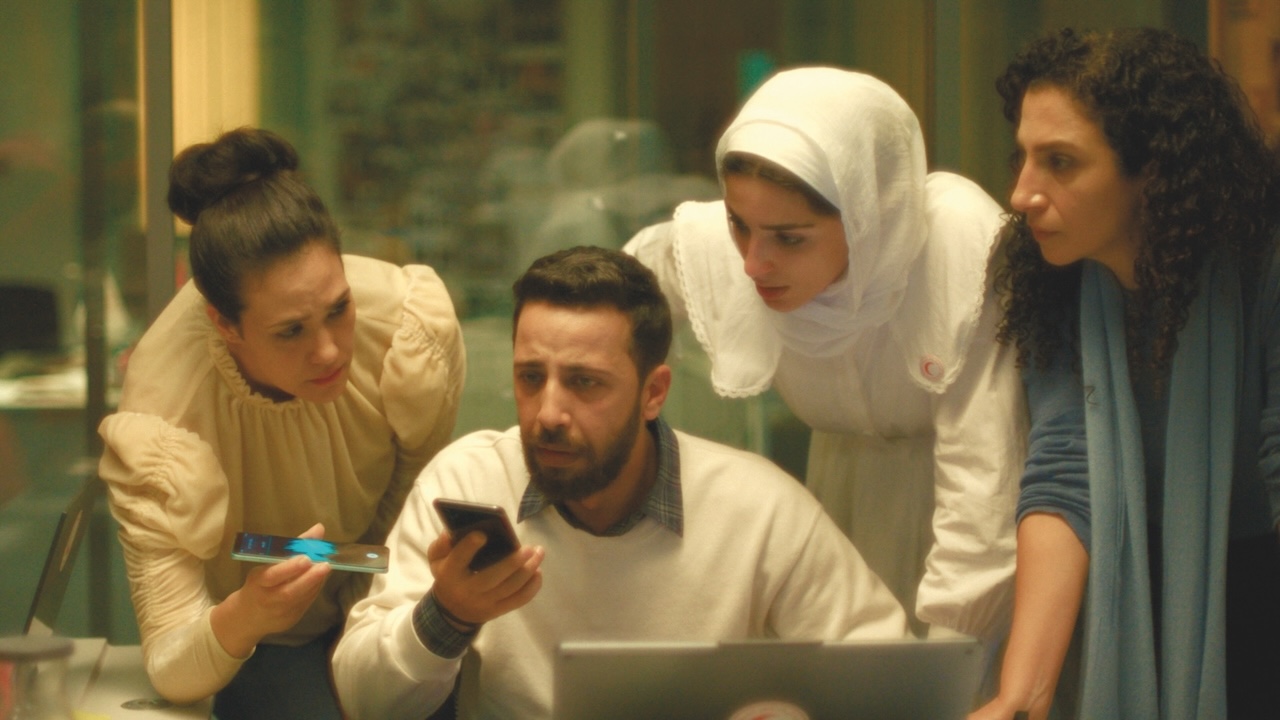
THE PALESTINIAN RED CRESCENT SOCIETY ON THE PHONE TO HIND IN THE VOICE OF HIND RAJAB, FILM STILL COURTESY OF WILLA
How do you hope this film preserves Hind’s voice, and what does her story come to represent when so many Palestinian lives are reduced to statistics?
Hind’s mother recently said something that really stayed with me. She said she’s proud this film was made, because otherwise her daughter’s voice would have been lost in the news. And I think that’s exactly it. Hind doesn’t only represent children. She represents anyone living under occupation. Her story now exists rather than being absorbed into statistics. There is a voice behind it. There is a life behind it.
I really believe in the power of cinema. Sometimes cinema is confrontational. It looks you directly in the eye and reminds you of the humanity we are in danger of losing. As an artist, you have to be hopeful. Especially when stories are being erased, our role is to fight to keep them alive. Stories like Hind’s deserve to travel as far as possible, because we live in a time where so much is controlled, by media, by algorithms, by what we’re shown and what we’re not. When you put something in front of people and invite them to truly look, you are also reaching those who might otherwise turn away. I don’t know how soon change happens. But I do believe in the power of people, and in how collective awareness can move the international community. And a child should never be put in a position where they have to beg for survival. If that’s something we can’t agree on, then that’s not a political failure. It’s a human one.
The film’s awards momentum, including its Academy Award nomination, is extraordinary. But it must also feel bittersweet. How has the response been landing with you, and does it signal a shift in how Palestinian stories are being received?
When I joined this film, it wasn’t solely for my love of acting. And the job didn’t end when we wrapped. In many ways, it really began when the film was released, because I believe so deeply in its message and in how important it is to keep the conversation going.
The reception the film has received, the festivals, the awards, the attention, all of that helps to keep that narrative alive. Of course it’s wonderful, and we’re grateful, but those things are bonuses. The real work is having as many people see it as possible. That’s what matters most.
To see three Palestinian films shortlisted for Academy Awards in the same year is unprecedented. I think these platforms are slowly beginning to recognise the power of independent cinema, of non-English-language films, and of stories that have too often been marginalised.
Saja Kilani
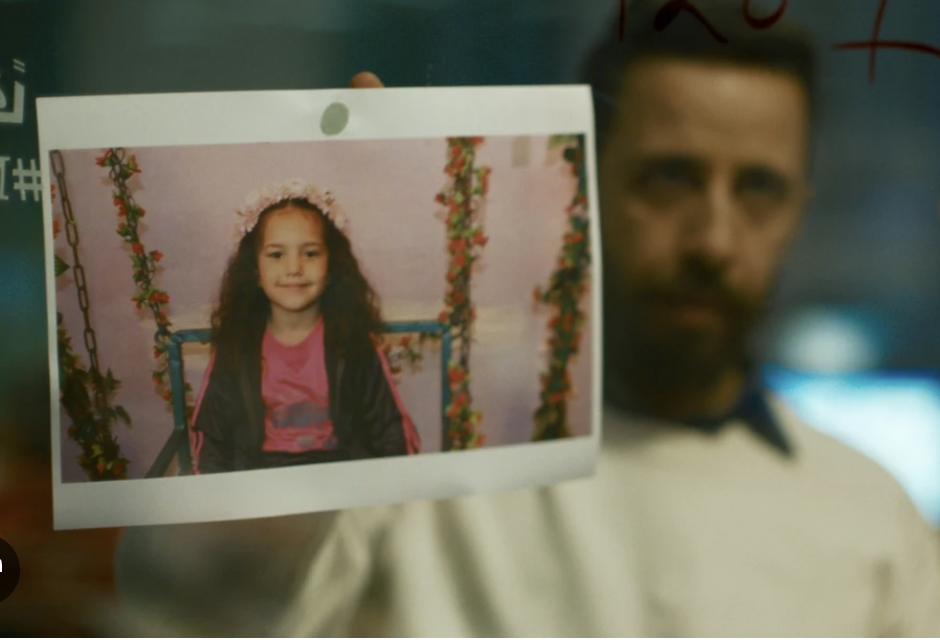
A PHOTOGRAPH OF HIND RAJAB FROM THE VOICE OF HIND RAJAB, FILM STILL COURTESY OF WILLA
How does that make you feel?
At first, I had a lot of conflicting feelings, wanting to be proud of the work, while also holding the weight of what it represents. But I’ve come to realise that if there is any film I want to be travelling with, speaking about, and standing behind, it’s this one. And yes, I do feel something is shifting. To see three Palestinian films shortlisted for Academy Awards in the same year is unprecedented. I think these platforms are slowly beginning to recognise the power of independent cinema, of non-English-language films, and of stories that have too often been marginalised. It’s long overdue.
The Voice of Hind Rajab is in cinemas now.
“Messy, imperfect and full of possibility”: Reni Eddo-Lodge reflects on the early internet of the 90s “Messy, imperfect and full of possibility”: Reni Eddo-Lodge reflects on the early internet of the 90s
“Messy, imperfect and full of possibility”: Reni Eddo-Lodge reflects on the early internet of the 90s
How Chennai’s youth are reclaiming identity through radical hair How Chennai’s youth are reclaiming identity through radical hair
How Chennai’s youth are reclaiming identity through radical hair
“Expect to be challenged”: Brand63Africa’s Eva Omaghomi on taking African design from London Fashion Week to Harrods “Expect to be challenged”: Brand63Africa’s Eva Omaghomi on taking African design from London Fashion Week to Harrods
“Expect to be challenged”: Brand63Africa’s Eva Omaghomi on taking African design from London Fashion Week to Harrods
“I think it was good that everyone else had money but I didn’t.” How scarcity created intimacy and beauty in the work of Jesse Glazzard’s photography “I think it was good that everyone else had money but I didn’t.” How scarcity created intimacy and beauty in the work of Jesse Glazzard’s photography
“I think it was good that everyone else had money but I didn’t.” How scarcity created intimacy and beauty in the work of Jesse Glazzard’s photography
Kaya Scodelario on trailer-made steak meals with Guy Ritchie and returning to the set of The Gentlemen for season two Kaya Scodelario on trailer-made steak meals with Guy Ritchie and returning to the set of The Gentlemen for season two

Kaya Scodelario on trailer-made steak meals with Guy Ritchie and returning to the set of The Gentlemen for season two
What does it really mean to be a supermodel? The defining faces of 90s fashion explain What does it really mean to be a supermodel? The defining faces of 90s fashion explain
What does it really mean to be a supermodel? The defining faces of 90s fashion explain
Sandulela Asanda’s joyful coming of age story, Black Burns Fast, was a standout at BFI Flare: today it premieres on Amazon Prime Sandulela Asanda’s joyful coming of age story, Black Burns Fast, was a standout at BFI Flare: today it premieres on Amazon Prime
Sandulela Asanda’s joyful coming of age story, Black Burns Fast, was a standout at BFI Flare: today it premieres on Amazon Prime
Made in the 90s: two generations of supermodels cover 72’s anniversary issue Made in the 90s: two generations of supermodels cover 72’s anniversary issue