The racial politics of chasing ‘flawless’ skin
From “glass skin” to brightening serums, the pursuit of a flawless complexion has never been more pervasive. Natalie Morris explores how, for women of colour, today’s skincare ideals can carry the weight of much older racial beauty standards.
My bathroom shelf is creaking. The aesthetic of the products is either faux-clinical minimalism, or edible-looking pastels with bubble-writing. Tiny glass bottles with pipettes jostle for space among jars and tubes filled with balms and oils, serums and sprays. I have different routines for morning and evening, multiple-step procedures that elongate each month when I ask my friends, my sister, the internet, which magic potion I should buy next.
I am, vaguely, aware of this as little more than brazen consumerism packaged as selfcare, compulsive consumption half-heartedly relabelled ‘wellness’. I’m aware of the trap inherent to the promise of purchasing youth and beauty – and, by proxy, happiness – but of all the vices of capitalism, this one feels relatively harmless. It even feels good. There is a soothing, almost spiritual, quality to gently applying my daily tinctures and ointments, rubbing circles along my brow, fluttering my fingertips up towards my cheekbones, sweeping my palms over my cheeks. And this addiction feels deliciously virtuous when compared to scalpels and needles and plastic.
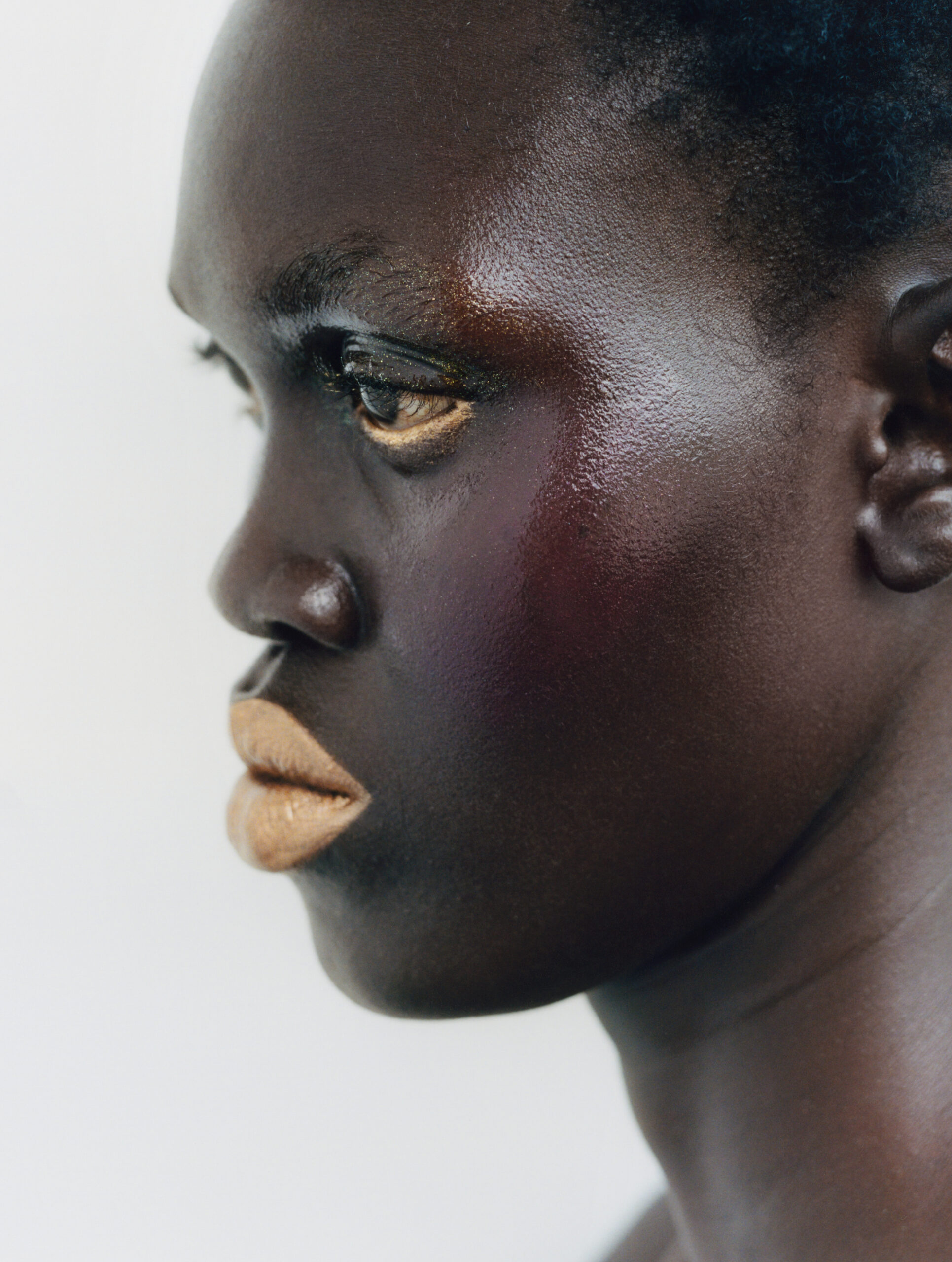
The names of the products (and the results these names suggest) make me feel good too. Glazed, glossy, luminous. Yes, of course I want to glow like the sun. Yes, I want my skin radiant, smooth and bright. Glass-like. Over the last decade or so, language like this has come to dominate the beauty industry. It feels innocuous, but just beneath the effortless dewy finish, lies something more complex. Like every other commodified beauty ideal, the burden of these expectations is not distributed equally. For women of color, this fixation on a ‘flawless’ complexion has become an impossible chase – one that is inextricably linked to the legacy of Eurocentric beauty standards.
“It’s so rare to see Black skin fronting a radiance or glow product campaign,” says Anita Bhagwandas, author of Ugly: Why The World Became Beauty Obsessed and How To Break Free. 15 years working in the luxury beauty space has shown Bhagwandas that skincare’s current buzzwords – ‘brightening’, ‘glow’, ‘radiance’ – are anything but neutral. “Although they definitely signal youthful skin without having to say it overtly, they also function as a euphemism for lighter, less pigmented skin that is all one, even colour,” she argues.
In 2020 Unilever renamed its skin-lightening cream. ‘Fair & Lovely’ became ‘Glow & Lovely’. At the time, writer and activist Poorna Bell said the move was “hugely disappointing”, adding “renaming the products doesn’t mean anything, that’s just colourism by another word.” This one, seemingly small example is emblematic of a broader shift. The old language of colourism – fair, whitening, lightening – is now culturally toxic, so the industry has created a new lexis that is harder to criticise, slipperier, less direct. This is colourism 2.0, and it is more insidious.
This isn’t to suggest all products that promote ‘brightness’, ‘glow’ or ‘glass skin’ are whitening products. It’s not as simple as that. It’s about the accumulative impact on the women encouraged to chase an unattainable ideal. And, to be clear, ‘flawless’ skin is a disastrously impossible standard for all women, but for women with darker complexions there are additional layers of complexity thanks to a long history of racialised beauty standards.
Flawless’ skin is a disastrously impossible standard for all women, but for women with darker complexions there are additional layers of complexity thanks to a long history of racialised beauty standards.
NATALIE MORRIS
What does ‘flawless’ skin actually mean?
What is actually being sold to us under the label of ‘flawlessness’ is youth. Young-looking skin, that is impossibly smooth, unravaged by time or the elements. While eternal youth is clearly unattainable for everyone, ‘flawless’ presents as a universal standard, when in fact the characteristics contained within this ideal – porelessness, evenness, brightness – aren’t racially neutral.
Glossy, dewy, luminous, radiant, translucent, glass. None of these words mean ‘white’. But the cumulative image this language evokes does not align with what I see in the mirror as a woman of colour. My reflection doesn’t align with the dominant imagery that accompanies this language on social media or advertising campaigns either.
“What is considered ‘bright’, ‘clear’ or ‘radiant’ doesn’t always translate in the same way across different skin tones,” says Zeynab Mohamed, beauty writer and author of Face Value. “Darker skin can end up being categorised as ‘bad’ skin simply because it doesn’t behave the same as white skin.”
“Women of colour are women and consumers, at the end of the day, and we’re all looking at and hearing the same messages – but the difference is in how those standards are experienced and the pressure that comes with them.”
Reviewing glass skin products in the Guardian earlier this year, beauty legend Sali Hughes wrote that Erborian’s Glow Moisturiser has “a smidge of pearlescence, but I find that flattering.” I have tried products with “pearlescence” before, and on my brown skin it creates the kind of ghostly sheen I get from cheap sunscreen that never quite rubs in. Anything but flattering.
“The ‘even tone’ ideal was never calibrated with melanin-rich skin in mind,” Bhagwandas tells EE72. “The dermatology research, SPFs, clinical trials, advertising – all of it assumes white skin as the baseline and everyone else as a deviation to correct. So when women of colour try to optimise towards it, we’re chasing a standard that was never built to include us in the first place.”
A review of dermatology trials conducted between 2017 and 2021 found Black participants were underrepresented, while separate research has found darker skin types missing from sunscreen trials and people of colour significantly less visible in cosmetic-procedure research.
Most anti-ageing skincare, Bhagwandas adds, is created for white skin. “The default is to cater to the white consumer first. When we look at general pigmentation correcting products you can find on the high street, those are seldom tested on or work on skin of colour. So you’re often just wasting your money.”
The real cost
For Black and darker-skinned women, the cost of engaging with the beauty industry is not just financial. I think of my bathroom shelf, the bottles glinting with subtle iridescence, jars that promise impossible things. Yes, we are all probably spending too much money on skincare, but the real problem is that we are being taught to interpret normal and healthy behaviours of melanated skin – pigmentation, discolouration, texture – as flaws. It is the result of an aesthetic ideal internalised as a measure of social status, success, and for non-white women specifically, respectability.
“Women of colour experience acts of discrimination daily based on how they look, their hair is described as ‘unruly’ if it’s not straight, they are seen as more aggressive if their skin is darker,” explains Mohamed.
For women of colour, presenting ‘good skin’ can become a form of protective social armour. This rings true for me. I think about the spike in cortisol I feel when I spot a budding breakout, or notice a new frown line, how it can impact my mood, my entire day.
I would like to think about my skin less frequently. I would like to remember that my skin is an organ, that it has a function in keeping me alive. That the small fluctuations in the appearance of its surface are no reflection on who I am as a person, or my worth. For me, this doesn’t mean rejecting skincare entirely – I am intimately attached to my pretty little bottles – but it does mean interrogating more closely the standards that shape what I believe to be beautiful.
For Bhagwandas, it starts with asking who benefits from your dissatisfaction. “But,” she adds, “it’s a hard conscious journey to decolonise our own internal beauty standards when that indoctrination is so ingrained in society, our algorithms and our skincare shelves.”
Back to basics: At Klein, Veronica Leoni does Calvin-core for today Back to basics: At Klein, Veronica Leoni does Calvin-core for today
Back to basics: At Klein, Veronica Leoni does Calvin-core for today
The joy of modernism: Michael Kors makes pragmatism of art The joy of modernism: Michael Kors makes pragmatism of art
The joy of modernism: Michael Kors makes pragmatism of art
An armour of optimism: Tory Burch finds power in opulence An armour of optimism: Tory Burch finds power in opulence
An armour of optimism: Tory Burch finds power in opulence
A prom king returns: Tommy Hilfiger reclaims his preppy American crown A prom king returns: Tommy Hilfiger reclaims his preppy American crown

A prom king returns: Tommy Hilfiger reclaims his preppy American crown
Inside the making of 72’s Made in the 90s covers Inside the making of 72’s Made in the 90s covers

Inside the making of 72’s Made in the 90s covers
Opulence with a sense of soul: Ralph Lauren’s taste for history Opulence with a sense of soul: Ralph Lauren’s taste for history

Opulence with a sense of soul: Ralph Lauren’s taste for history
Casting director Piergiorgio Del Moro on what makes a supermodel Casting director Piergiorgio Del Moro on what makes a supermodel

Casting director Piergiorgio Del Moro on what makes a supermodel
Collina Strada’s Copenhagen Fashion Week debut is a greatest hits remix Collina Strada’s Copenhagen Fashion Week debut is a greatest hits remix