Michaela Yearwood-Dan on the importance of community and finding freedom through art
Ahead of the opening of her solo exhibition at Towner Eastbourne, the British artist talks to curator Dr. Madeleine Haddon about her kaleidoscopic work, filled with color, delicate textures and dreamlike forms.
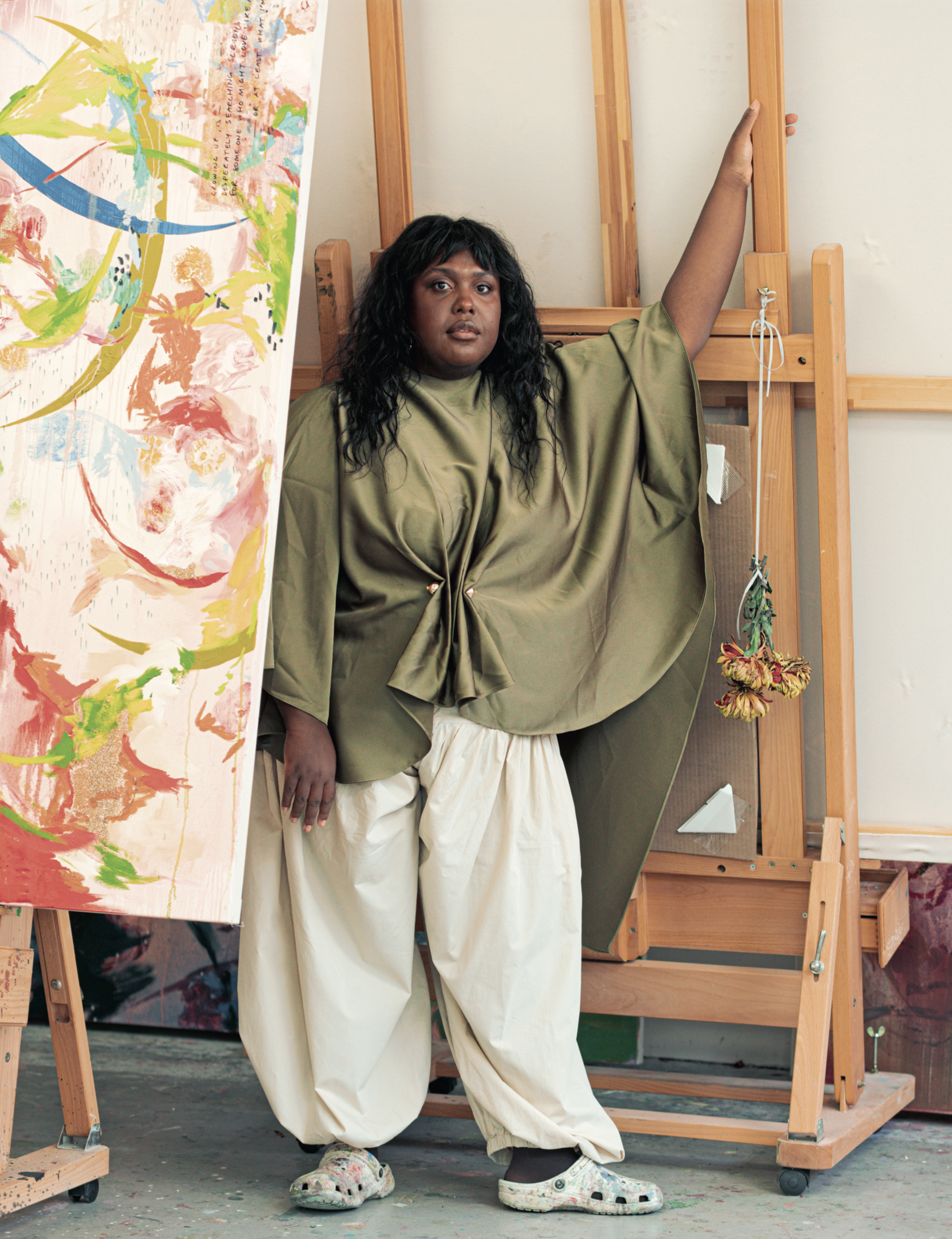
Michaela Yearwood-Dan’s paintings are mesmerizing to behold. Dynamic colors and textures draw me in, and the text interwoven throughout makes me lean closer, bend down, look again. Her paintings are like diaries of Yearwood-Dan’s lived experiences and the more she speaks her truth, the more she is able to connect with others.
Yearwood-Dan and I first met during Accra Cultural Week in 2024, when her work appeared in Keeping Time at Gallery 1957. Earlier this year, I joined one of the famous dinners she hosts in her London studio, where guests were invited to paint together on a canvas she will later develop into a finished work for a show next year with Hauser & Wirth in Los Angeles. I remember the nervousness of making that first mark. For a curator used to looking and thinking, being asked to play was unexpectedly exposing and exhilarating.
That invitation runs through Yearwood-Dan’s practice. In The Practice of Liberation, which opened at the Whitworth in Manchester this year and arrives at Towner in Eastbourne before heading to Arnolfini in Bristol in 2027, paintings come together with ceramics, furniture and sound. Accompanied by her first monograph, the exhibition draws on Yearwood-Dan’s relationship to Catholicism to create a space shaped by her own experience of faith and queerness. Her upcoming exhibition, A Woman of Will at Boesky Gallery in New York, continues that inquiry.
We meet at Mount St. Restaurant on the Friday of Frieze Week in London, just after the Tate has announced its acquisition of her painting Peace Unknown from the fair. Our conversation turns to the emotional force of abstraction, the feminist pleasures of pop music, and what it means to become a woman of will.
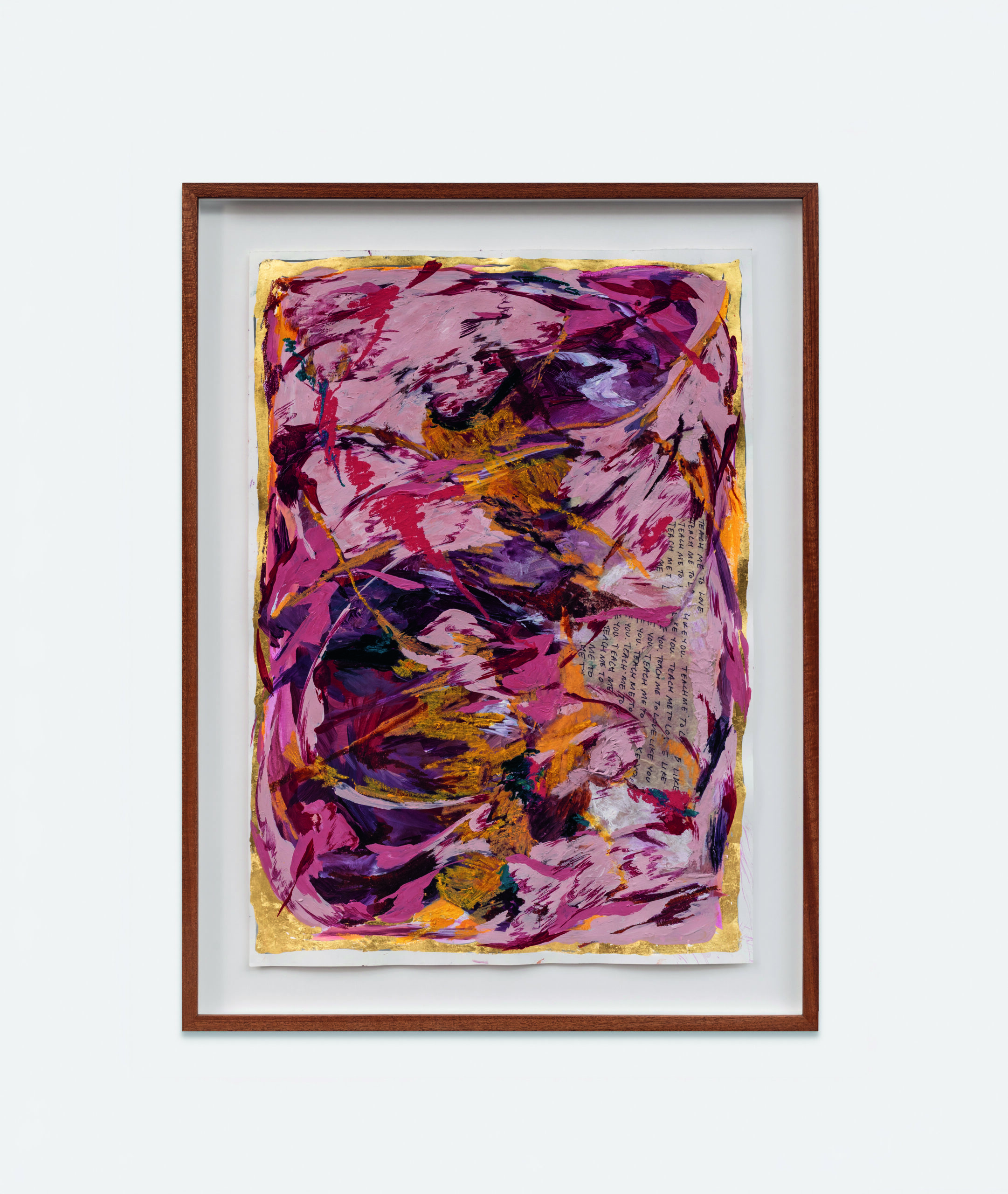
MY HEART CAN ONLY DO SO MUCH FROM THE PRACTICE OF LIBERATION SHOW, 2026.
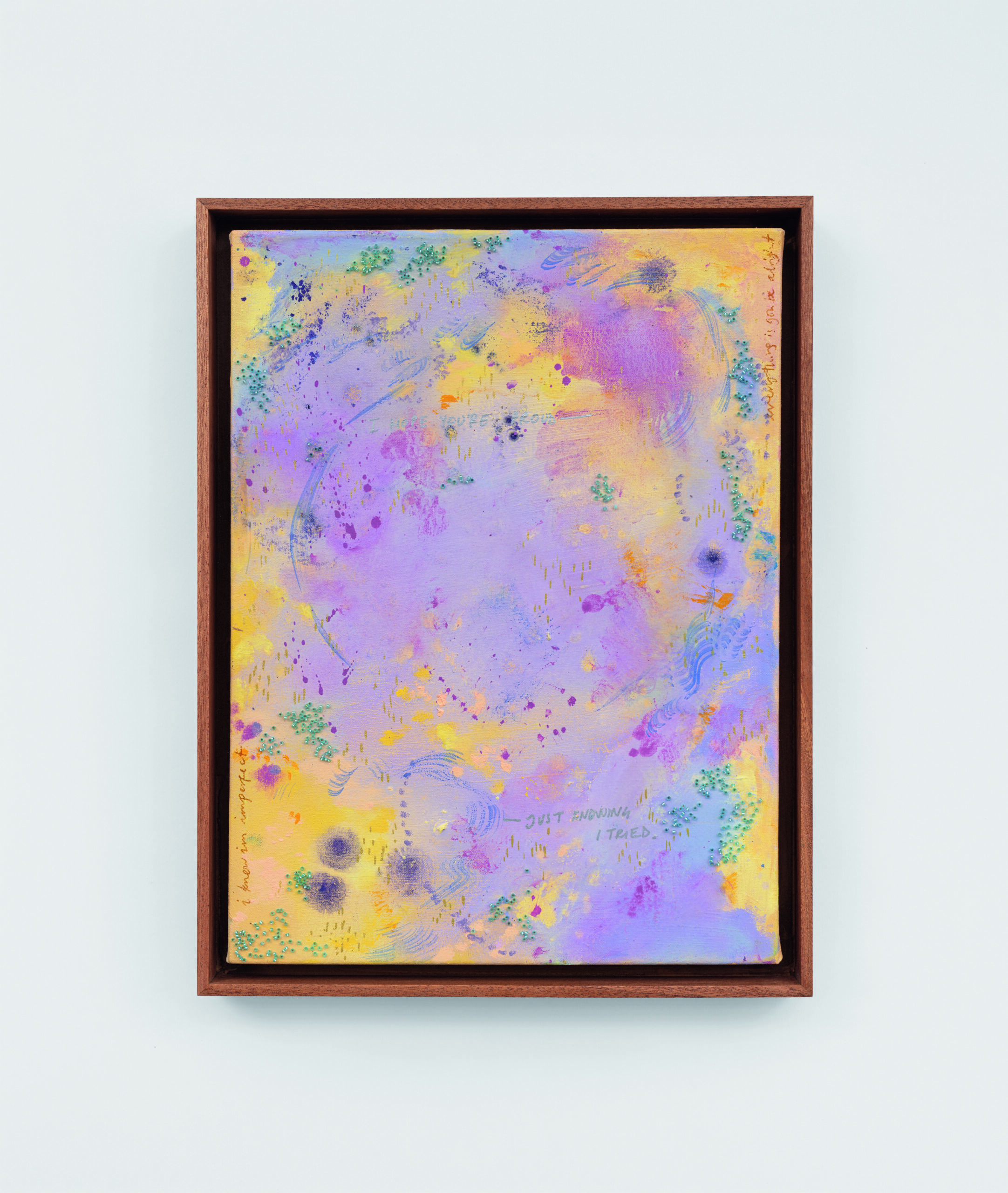
AGAPE VIII FROM A WOMAN OF WILL SHOW, 2026.
Madeleine Haddon: When did painting become something you knew you wanted to pursue?
Michaela Yearwood-Dan: Painting was what I always wanted to do. I remember doing an art foundation during that era of everyone talking about painting being over. Conceptual art was the way forward, so applying to do a painting degree felt risky. It was also the only medium that ever made perfect sense to me, and still does, even though I make ceramics. It still feels like my one true medium.
MH: Which artists made you want to pursue painting and opened your eyes to what it could do?
MYD: I have always loved Chris Ofili. He was the artist who made me see a space for myself within a contemporary art world. I loved Monet and Matisse as well. At school, I really loved the use of color, and the way Matisse’s work aged with him, how it changed as he got older. Chris Ofili, Kara Walker and Lynette Yiadom-Boakye were the people who made me feel I could be part of an art world.
MH: Where did you first encounter their work?
MYD: A teacher showed them to me after realizing I wasn’t going to pursue art because I didn’t see myself within that space. She took it upon herself to introduce me to those artists.
MH: One of the things I love most about your work is how color creates these worlds you feel you could fall into. Most of the artists you’ve mentioned work with the figure. What drew you to abstraction?
MYD: I’m often drawn to figurative work. Those people were really painterly painters: I could see the way they were pushing the medium. I’m always in awe of the way Lynette underpaints, those sharp pops of color coming beneath the figures, and the way Chris can use paper and glitter and all these different things within one painting. Paint as its own expressive language has always interested me.
But I just didn’t want to be responsible for anyone other than me. I was making figurative work and felt a lot of pressure, as a Black woman, a Black queer woman, a Black fat queer woman, to represent that demographic in the correct way. I didn’t want that responsibility. It weighed me down in terms of what I was allowing myself to make and where I was allowing myself to push the work.
With abstraction, I could let go of some of those clear visions of identity and bring forward texts and ideas that weren’t rooted fully in the representation of me and my body. The more authentically I stuck to my own truth, the easier it was for people to connect with the work.
MH: You’ve spoken about creating feelings rather than depictions. How do you know when a painting is doing what you want it to do?
MYD: Sometimes it just has to be done. I work on between three and six works at a time, and they’re quite large, so it’s a cocoon: You’re engulfed by works and switching between them.
Recently, I’ve been pouring paint, moving the canvas, tilting it around, laying it flat and letting movement, gravity and evaporation lay out some of the composition. Those paintings have been harder to know when to finish because they’re more pared back. There’s more space for the viewer to fill and sit within. Getting that delicate balance right has been difficult, but I’ve been enjoying it.
Text often punctuates the ending of a work. Sometimes I know what the title might be from mixing a color palette, but often it’s those last bits of text, those little flicks of oil stick, where it feels like I’m crossing the t’s and dotting the i’s.
MH: Which writers do you find yourself returning to and what do they open up for you?
MYD: bell hooks is the obvious one. I feel like that’s quintessentially a young Black woman learning herself. Alongside that, I would add Nina Simone and Lauryn Hill. They’re not authors, but The Miseducation of Lauryn Hill and MTV Unplugged are very important, seminal texts for creative Black women.
Margaret Atwood’s The Handmaid’s Tale is important to me, and I love her poetry. Toni Morrison, especially her essays and interviews. My first show with Hauser & Wirth, No Time for Despair, was inspired by an essay she wrote for The Nation: this idea that even in times of despair, there isn’t actually time for that. As creative people, we must continue to make, continue to work, continue to be part of the narrative voice of a generation. And Octavia E. Butler.
THE PARTING GLASS FROM THE PRACTICE OF LIBERATION SHOW, 2026.
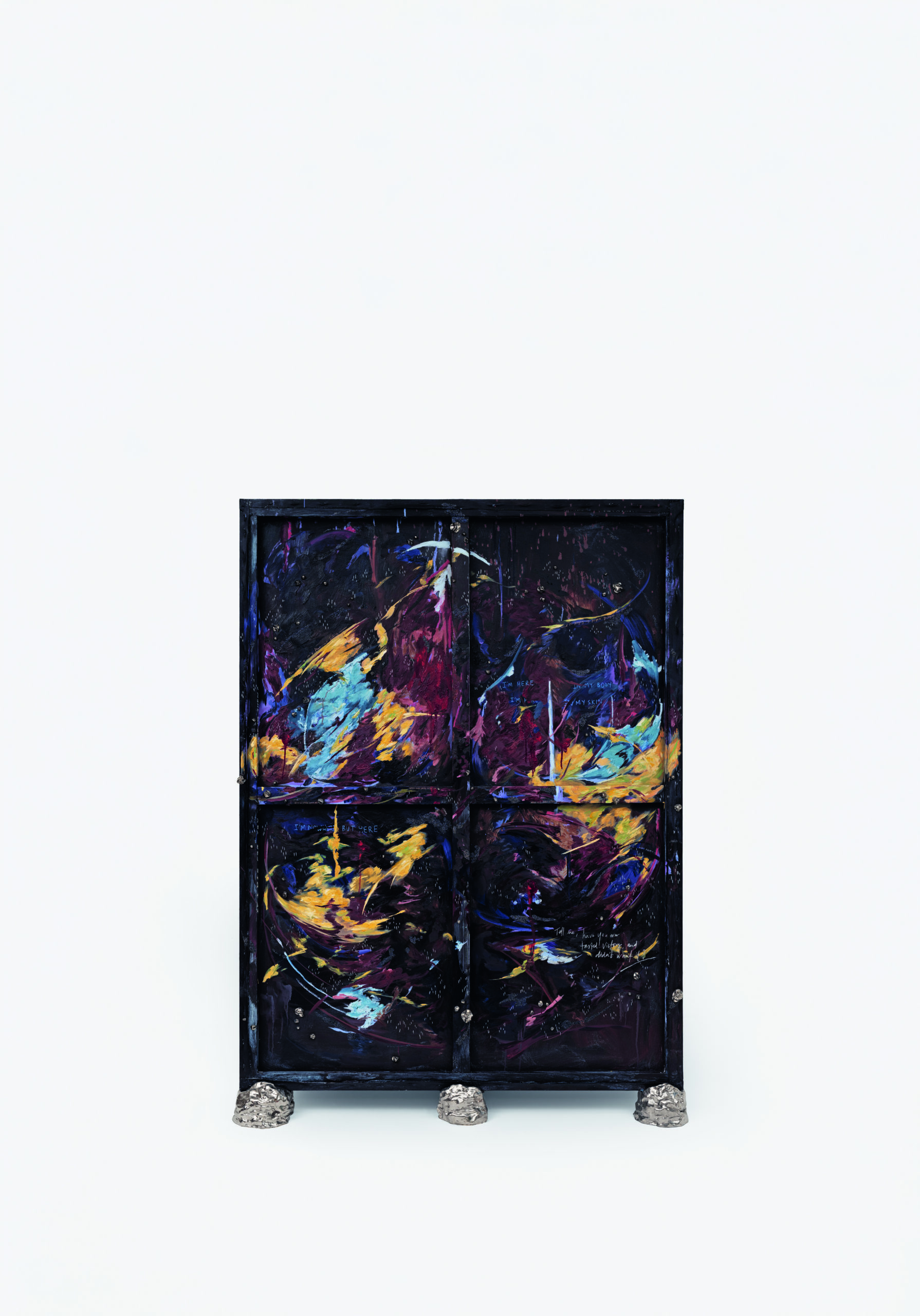
ANOINT ME FROM THE PRACTICE OF LIBERATION SHOW, 2026.
It’s that dance between what you want loudly revealed in the painting and the parts that make the viewer spend time with it. You have to get up close. You have to bend down sometimes. Sometimes the humor is in the front seat; sometimes you have to decipher it. You might have an Oscar Wilde quote next to a Pussycat Dolls lyric.
Michaela Yearwood-Dan
MH: Are those references floating around as you work, or do you begin with a particular text?
MYD: What’s always floating around is lyrics. After drawing from that library of songs, I start to think about the literary references: James Baldwin, Ta-Nehisi Coates, Jeremy O. Harris, Shakespeare, the Bible. I grew up Catholic. I know that book. I wish I didn’t know that book as well as I know that book, but I know that book.
The music comes alongside the visual, then I identify the literary references. My own responses, which are more diaristic, end up in there too. Chatty paintings, like me.
MH: They do feel as though they’re whispering to you, or calling out. Some of the phrases are shouted. Others feel like secrets you have to tease out.
MYD: They’re like diary entries, little snapshots of what I’m thinking. They do what we do as humans: play with that balance of revealing and concealing. You wake up and choose an outfit because you decide how you want to be perceived. Then people get to know what you’re really about, your political beliefs, your humor.
It’s that dance between what you want loudly revealed in the painting and the parts that make the viewer spend time with it. You have to get up close. You have to bend down sometimes. Sometimes the humor is in the front seat; sometimes it’s the thing you have to decipher. You might have an Oscar Wilde quote next to a repurposed Pussycat Dolls lyric.
Someone took a photo of a line that sounds like my voice, “What? Am I not supposed to have an opinion?” but it’s from Christina Aguilera and Lil’ Kim’s “Can’t Hold Us Down”. At 17, I had to write an essay about feminism and chose that song as my text.
MH: That was the feminism I was learning at that age, too.
MYD: Teenage girls completely dictate culture. I say “we” — we’re both beyond teenage girls, but girlhood is forever, right?
MH: How did you want to explore with The Practice of Liberation, and what did you want people to experience?
MYD: For a while, I’d wanted to find a space to talk about my experience with religion. I wanted it rooted in my own experience, which included a lot of bigotry around my queerness. At the same time, I went to an all-girls convent school and we all came out as crazy little feminists because there were no men around. We learned that our voice was the most important in the room because we never had to compete with men. We came out into the world refusing to compete with men to be heard.
I was always questioning. When everyone was doing their confirmations, I refused. I didn’t feel it was right to commit to something, to say I believed in something when I wasn’t sure. I respected that people did believe, but a lot of my friends were doing it because they could get a new outfit for the party. I was like, I can’t commit to this thing for some new clothes.
There have been things I’ve had to liberate myself from around religion, queer identity, self-doubt. That’s an ongoing practice, rooted in self-love and self-expansion. Liberation isn’t something where you wake up one morning and say, “I’m liberated.” Some days, some moments in history we will feel more liberated than others, and then it’s back, and then it’s forward, and then it’s sideways. Like practicing an instrument or a language, it’s not about perfection. It’s about the ongoing movement of practicing.
Aesthetically, I used the Catholic Church as a starting point. When we were installing, I kept referring to church around Christmas, when everyone has left and you’re tidying up the pews. There’s a warmth from people having been in the space. It feels cozy. I wanted all the good feelings of being in church: the sense of unity without someone preaching scripture that condemns other people.
MH: It sounds like creating a new kind of sacred space.
MYD: I think that’s what I wanted to do. What’s been special about doing the show in Manchester is that people kept revisiting it. I’d get messages all the time. People felt a real sense of ownership of the space and the work, which I found very special. I haven’t experienced that in the same way with shows in London or New York, where everyone is trying to see everything.
MH: That also sounds like a testament to how you made people feel: It was somewhere they wanted to return to. How did making this exhibition change your practice or reveal something that you hadn’t expected?
MYD: It’s given me reassurance that the things that feel most important to the way I make will be received if I do them with full conviction. Having places for people to sit, for instance. When you’re asking people to spend time with your work, we live in a society where time consistently feels as though it’s being taken and stolen from us.
How do I gently manipulate you into feeling that this space has invited you in? The benches, plant life, music — those things are linked to the domestic. Then there are these fragments of writing, where it feels almost as though I’m having a conversation with you, or you’re overhearing a conversation I’m having with myself.
MH: The ceramics, benches and sound are created in a language that is an extension of the paintings themselves like you’re being enveloped more and more into the world of the painting. It feels as though you’re building new worlds that extend out from the canvas and that we can inhabit. What do working in these other media allow you to do that painting alone doesn’t?
MYD: Ceramics help me slow down. I’m hand-building, so you can’t build up high until everything below has dried sufficiently. You can’t put things in the kiln until they’ve dried thoroughly. It forces you to slow down and play with these lumps of earth.
I’m 5 foot 5 and the paintings are two meters-plus high. I’m up and moving around them. With ceramics, I’m sitting at a small desk, building these things up. It feels insular and calming.
For the music, I work with my friend Alex Gruz, whose background is in film and television composition. He’s so good at translating a narrative through sound. He gets me to tell him everything I’m thinking about for a show: I go through my mind maps, make playlists, send instruments or hymns I’d like included. He goes away with my research and starts creating, then it’s a back-and-forth.
The process is built on our pre-existing friendship that we’ve cultivated over the past decade. He understands what I’m trying to convey, and I trust his expertise. It was important that the sound for The Practice of Liberation had its own title: Still Waters Rising. It’s its own separate work that sits alongside the paintings.
MH: In The Practice of Liberation, you turn some paintings around to reveal the cross of the stretcher. I’d thought of them as sculptural, but you’re also referring to the crucifix.
MYD: In The Practice of Liberation, the works were shaped around two pivotal Bible stories. The wedding at Cana, where Jesus turns water into wine, represented by six vessels. Their forms are also referenced through Ghanaian baskets, bringing in the history of Christianity’s spread across Africa through colonization. Then there are 14 paintings that reference the stations of the cross. During that story, Jesus falls with the cross three times, so I have three cross-backed paintings leaning against the wall, supported by golden-bronze pedestals that are a nod to Chris Ofili.
MH: Earlier this year, I came to one of your studio dinners, where you invited us to make a painting together. What prompted that?
MYD: It’s interesting watching the trepidation of adults being told: You’ve been invited, you’ll get fed, but now you have to paint together. Some are excited and some hang back because they want what they do to be good. Then everyone relaxes and leans into it.
It’s about inviting people in to play, to be part of a community, to bond and let your inhibitions fall by the wayside. It’s also partly to do with my hatred of the idea of the male genius. When you study art history, there’s this real notion of masculine genius. This is all about human connection. I don’t make work on my own. I have assistants. I can’t make all those tiny earthenware ornaments that go on the paintings: I’d make three paintings a year. I have help. It’s about the village, the community, building and nourishing it.
MH: What struck me at dinner was that you were giving up a sense of authorship as well as control. These paintings will all become part of finished work for your 2027 show with Hauser in Los Angeles.
MYD: We have a log of everyone who was at the dinners and all of the names will be included as contributors. In every single painting, no matter who was at the dinner, there is always an animal, a smiley face, and a stick figure. It’s funny to think about what these paintings say about the human condition.
MH: Your upcoming exhibition at Boesky Gallery in New York is called A Woman of Will. What does that title mean to you and what are you exploring with this new body of work?
MYD: It’s a line from the poem Victoria Adukwei Bulley wrote for my book. It felt like a clear step on from The Practice of Liberation.
The front room has 13 works representing 13 disciples, because Mary Magdalene was a disciple, and a very important one. It’s a quiet show. There’s no sound; not every show needs audio. There are darker colors, warmer tones on the walls, still inviting that idea of domesticity into the space.
There are two benches named after two pop-cultural women of will, Britney and Christina. There’s this idea of willful women always having to be pitted against each other, or the virgin, the mother and the whore, all these ideas of what a woman must be. It’s similar to The Practice of Liberation, with a lean towards a feminist edge. A woman of will is who I wish to exist as — being willful, committed to my convictions.
Björk’s best fashion moments Björk’s best fashion moments
Björk’s best fashion moments
Meet Michelle Adepoju, the designer bringing African craftsmanship to global luxury fashion Meet Michelle Adepoju, the designer bringing African craftsmanship to global luxury fashion
Meet Michelle Adepoju, the designer bringing African craftsmanship to global luxury fashion
Elizaveta Porodina on digging deeper with new book Found Dreams and the creative cosmos she’s created with Ariana Grande Elizaveta Porodina on digging deeper with new book Found Dreams and the creative cosmos she’s created with Ariana Grande
Elizaveta Porodina on digging deeper with new book Found Dreams and the creative cosmos she’s created with Ariana Grande
“I felt like a proper pop star”: Bash Croft on being a ‘faithful’ and the making of his upcoming debut EP “I felt like a proper pop star”: Bash Croft on being a ‘faithful’ and the making of his upcoming debut EP
“I felt like a proper pop star”: Bash Croft on being a ‘faithful’ and the making of his upcoming debut EP
DJ Honey Dijon joins Kristen McMenamy for a new episode of Get Over Here You B**ch DJ Honey Dijon joins Kristen McMenamy for a new episode of Get Over Here You B**ch
DJ Honey Dijon joins Kristen McMenamy for a new episode of Get Over Here You B**ch
Imaan Hammam talks Love Island and being starstruck at the FIFA World Cup Imaan Hammam talks Love Island and being starstruck at the FIFA World Cup
Imaan Hammam talks Love Island and being starstruck at the FIFA World Cup
Gigi Hadid and Paloma Elsesser share the 7 things they love to hate Gigi Hadid and Paloma Elsesser share the 7 things they love to hate
Gigi Hadid and Paloma Elsesser share the 7 things they love to hate
Adwoa Aboah and Emily Ratajkowski tell us 7 things they love 2 hate Adwoa Aboah and Emily Ratajkowski tell us 7 things they love 2 hate