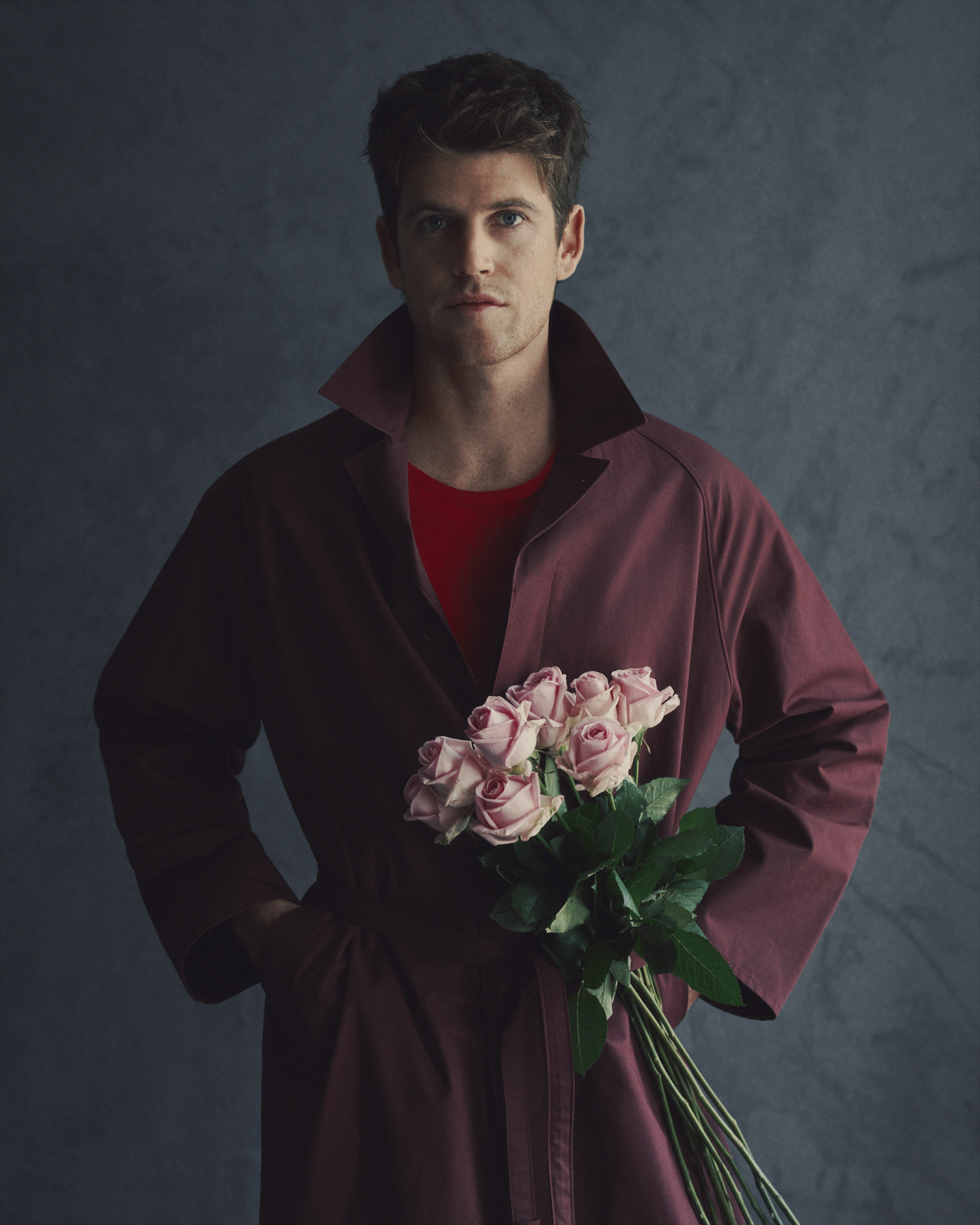
“In the end, love wins”: Miguel Bernardeau on making the year’s most anticipated film, La Bola Negra
STYLING BEN REARDON
TEXT HATTIE COLLINS
As one of the leads in the highly anticipated epic, La Bola Negra, Miguel Bernardeau is part of a new dawn in Spanish cinema.
La Bola Negra is more than a film. It’s a moment. It’s a movement. It’s a turning point. It has the potential to be history making. Directed and co-written by feted Spanish filmmakers, Javier Ambrossi and Javier Calvo, known more informally as Los Javis, this ambitious, 35mm-shot epic is both a love story and a visual and emotional examination of class, sexuality, war, bigotry and intergenerational trauma. It’s also a clarion call of what can happen when we suppress creativity, identity and intellectualism in favor of orthodoxy, patriarchy, capitalism and fascism. The Black Ball, to give it its English title, effortlessly interweaves three time periods: a village near Grenada in 1932, Northern Spain during the Spanish Civil War in 1937 and Madrid in 2017. The interconnected stories each interact with one of Spain’s most celebrated writers, Federico García Lorca, executed by firing squad in 1936, aged 38 for, essentially, being both homosexual and an intellectual.
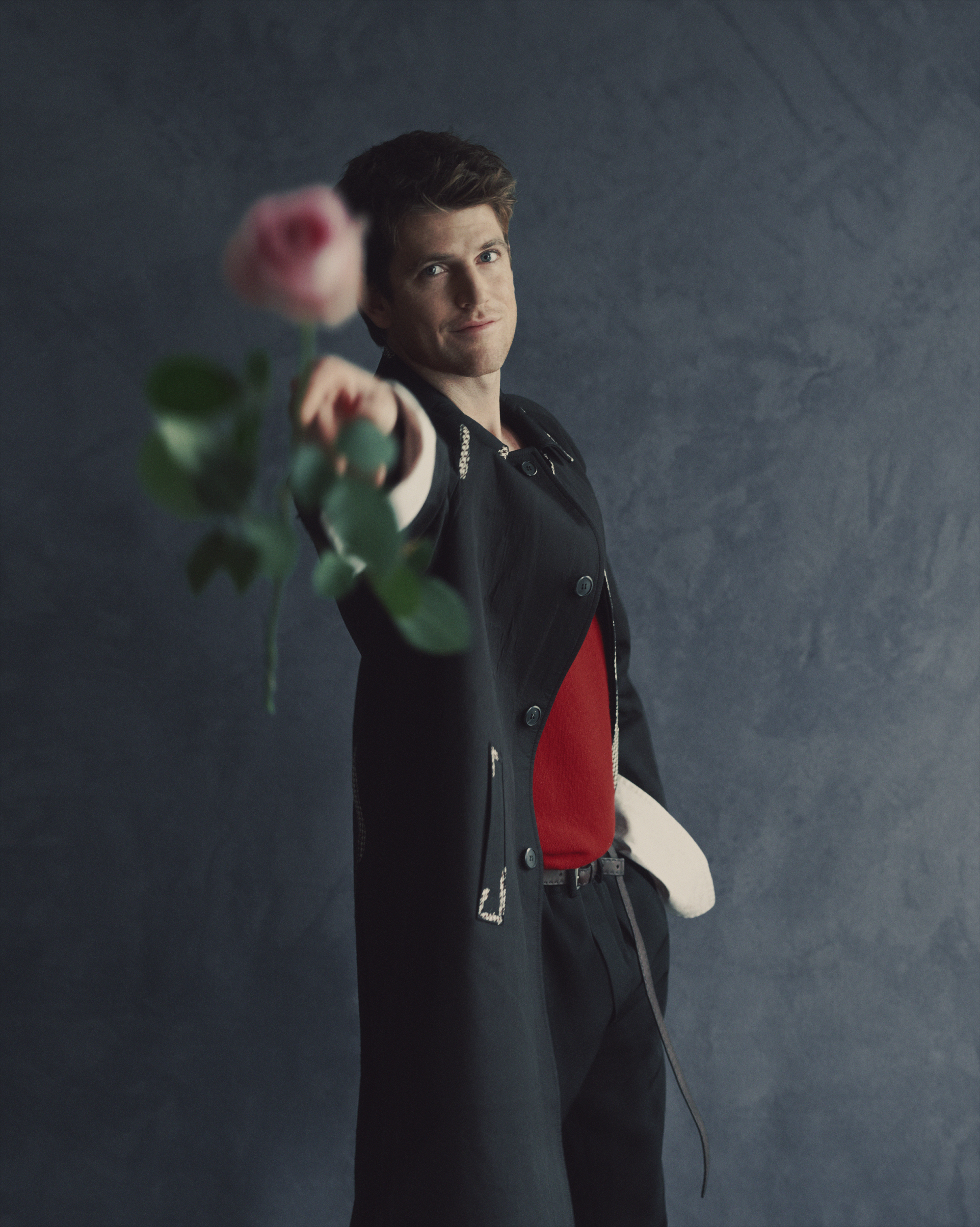
Lorca and the four pages of his unfinished queer play La Bola Negra forms the heart of the vast, impressive piece of storytelling. It is, says Miguel Bernardeau, who plays Lorca’s lover, the footballer, actor and soldier Rafael Rodríguez Rapún, about humanity’s capacity for both creation and destruction. “lt’s about love and death, it’s about a world of possibilities and the art and poetry that is absolutely crushed by the war — the absolute opposite of what Federico stands for,” says Bernardeau via Zoom from Milan airport where he awaits his LA flight. “It’s a movie about love, about passion, about freedom and not having the possibility of freedom; the impossibility of being free to be who you are, to express who you are, or to love who you want to love. I’m very honored to be a part of it.”
The film’s aspirations have been matched by its reception. After its 16-minute standing ovation at Cannes in May, Netflix acquired the rights; it has since won Los Javis Best Director at Cannes (a joint award with Paweł Pawlikowski for similarly brilliant Fatherland) and the People’s Choice award at TIFF. At an industry screening at London’s Picturehouse Central in October, every one of the 341 seats was taken, the audience rapt throughout the two-hour, 39-minute runtime. It’s broken both expectations and box office records: the Oscars are already calling and it recently made $277,500 across just four theatres in New York and LA in October, the second-highest per-screen average in the US for a non-English language film, runner up only to 2019’s Parasite.
Starring the 29 year-old Bernardeau alongside newcomers Guitarricadelafuente, Carlos González and Milo Quifes — and featuring a luminous Penélope Cruz as Nené Romero, a cupletista (cabaret singer), plus an unexpected appearance from Glenn Close as Isabelle, a Lorca historian who learned Spanish for the role — La Bola Negra is one of 2026’s most anticipated releases. The stars and its directors are all adjusting to the attention.
“It’s a little overwhelming at times,” admits Bernardeau, who was born in Valencia and splits his time between Madrid and a small, slow Portuguese fishing town. “Working on the movie has been very cathartic in ways, and very personal. Bringing this movie to the people, promoting it all around the world, has a special feeling; that we’re traveling with a story that we really believe in and that is deeply in our hearts. There’s a beautiful side to it but also, you feel very vulnerable. I’m just a small piece of this movie, but I feel very exposed also because of the work.”
To express yourself how you want, or to love who you want, I think that speaks a lot to people, especially at a time where for half of the world violence is so normalized, and polarization is so instilled in our brains and in our culture.
Miguel Bernardeau
Bernardeau found international acclaim in Spanish high school thriller Elite, which became a sleeper hit during lockdown. He went onto lead Amazon Prime’s Zorro reboot and star in multi-award winning miniseries Querer. Last year, he ran into Los Javis at the Goyas, Spain’s version of the Oscars. The pair — at the time romantically linked, though they’ve since broken up — mentioned they had him in mind for a role in a film they were writing with Alberto Conejero, who had previously written a play about Lorca, his lover Rapun and the surviving four pages of Lorca’s play La Bola Negra. They asked Bernardeau to read various books, including Ian Gibson’s Lorca y el mundo gay (Lorca and the Gay World) before bringing him in to audition.
“I already know their work so I really wanted the part. I read for it and then waited two horrible weeks to hear back.” He was finally invited to read with Spanish singer Guitarricadelafuente (Álvaro Lafuente Calvo), who was making his acting debut. “We read a couple of scenes straight from the script and when I lifted my head, Los Javis and Alvaro’s manager were very emotional. They just… offered me the part!” As well as connecting with Guitarrica – “it wasn’t difficult for me to fall in love with him and to really go through what the character goes through with him because he’s a great artist” – he also responded to Rafael and the brutal period that the film explores. “It’s a really important time in our country’s history.” Rafael, a wounded soldier, is captured during the Civil War; Guitarrica’s Sebastián is tasked with guarding him. “Our relationship developed as the relationship that we had personally developed. It was beautiful.”
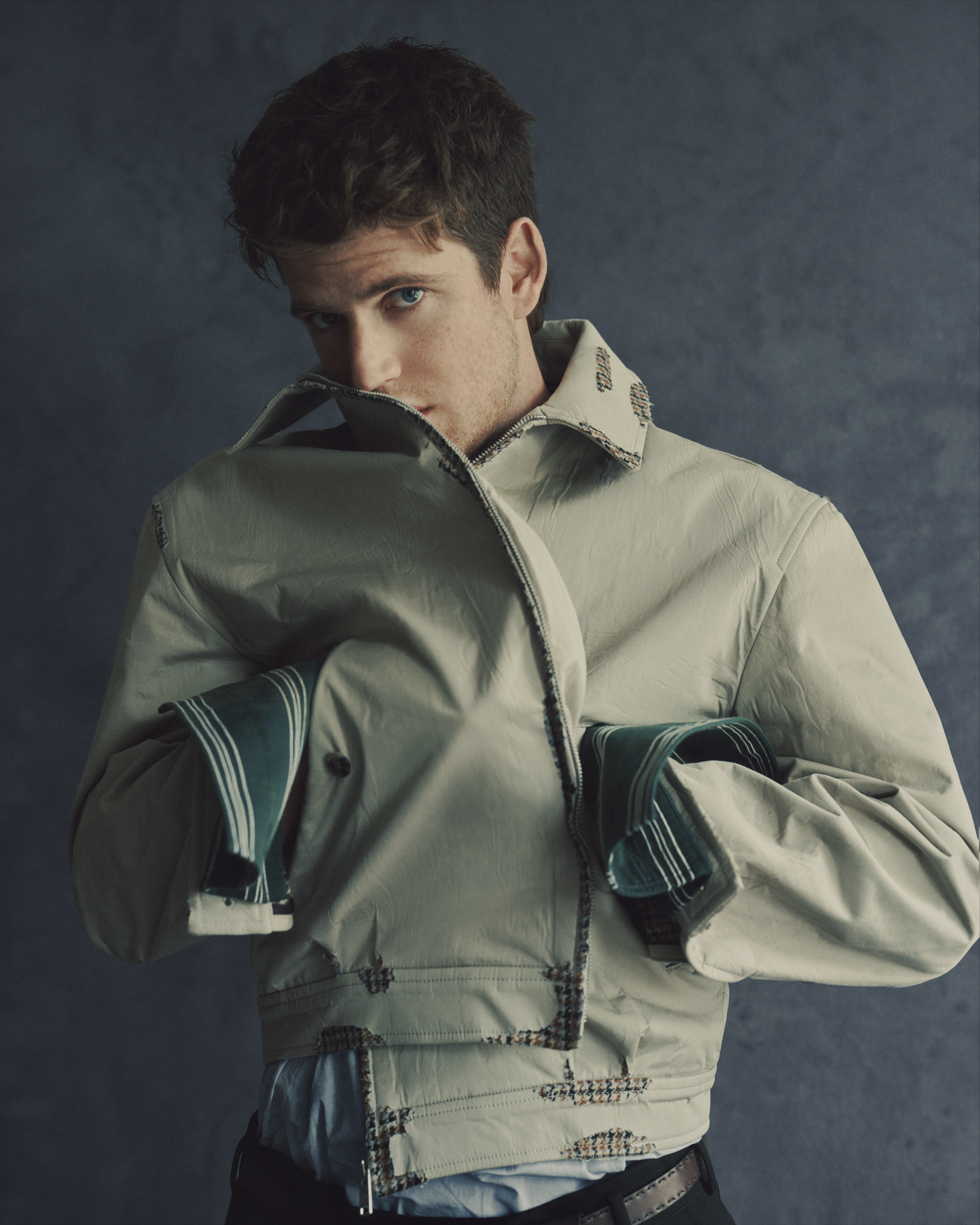
It’s a movie about love, about passion, about freedom and not having the possibility of freedom; the impossibility of being free to be who you are, to express who you are, or to love who you want to love.
Miguel Bernardeau
Bernardeau prepared for the role by working with acclaimed acting coach Corazza and by surrendering himself to the vision of La Bola Negra’s creators. “Los Javis are amazing acting directors. You feel like you’re in very safe hands, that you can take risks and you feel free between the very specific boundaries that they create. They’re confident in their talent and they make you feel sure of what they want. You feel free to jump into the unknown.”
The scale of the finished film only became clear to Bernardeau when he saw it on the big screen at Cannes. “You need to understand, I shot a different movie than the one I was in, in a way. I shot a movie in a small, beautiful, incredible room, but with a lot of intimacy and in a very personal way. We were alone in that room for a long time. So when I watched it, and I saw that epicness of the movie, of the war, of also those two different timelines that I didn’t know anything about more than what I read in the script, it was incredible: to feel that you’re part of something very big.” The final scenes Bernardeau worked on remain memorable. “It was the most special day of my career as an actor. It was the scene with Federico: finally, I get to see Federico. It was very emotional to sit down with him. My family came to watch that last scene, so it was very, very emotional.”
Like many Spanish kids, Bernardeau encountered Lorca’s writing at school: he studied La casa de Bernarda Alba (The House of Bernada Alba), Poet in New York, and the fantastic, fatalistic, feminist and low-key queer gut punch Blood Wedding that was foundational for a young me in the nineties.” Rafael, though, was less familiar to Bernardeau. “I don’t think many people knew him much, although he was known here in Spain. People from the north especially go to his grave and have a deep appreciation of him. But a lot of people don’t know him. I think it’s beautiful, because one of his lines in the movie is, ‘Nobody disappears forever, nobody.’” Bringing Rafael’s story to cinema ensures that he will be remembered.
The act of reclamation speaks to a wider shift in Spanish culture. The country has been slow to confront its complex history, through mainstream cinema. Even Pedro Almodóvar, who serves as producer on the film, only recently tackled the Spanish Civil War and the legacy of Franco’s dictatorship with 2021’s Parallel Mothers. Does Bernardeau see the film as part of a broader reckoning with the past? “Yeah, I think so. It’s also a line in the movie: most of our more expert historians are not from Spain. It’s a rare and incredible thing, but it is true. I think we’re starting to trust that our own story — our histories, our individualities — are interesting and compelling to the world. Or we’re learning to trust that again. It’s happened before, but there’s a new generation carrying this idea forward.”
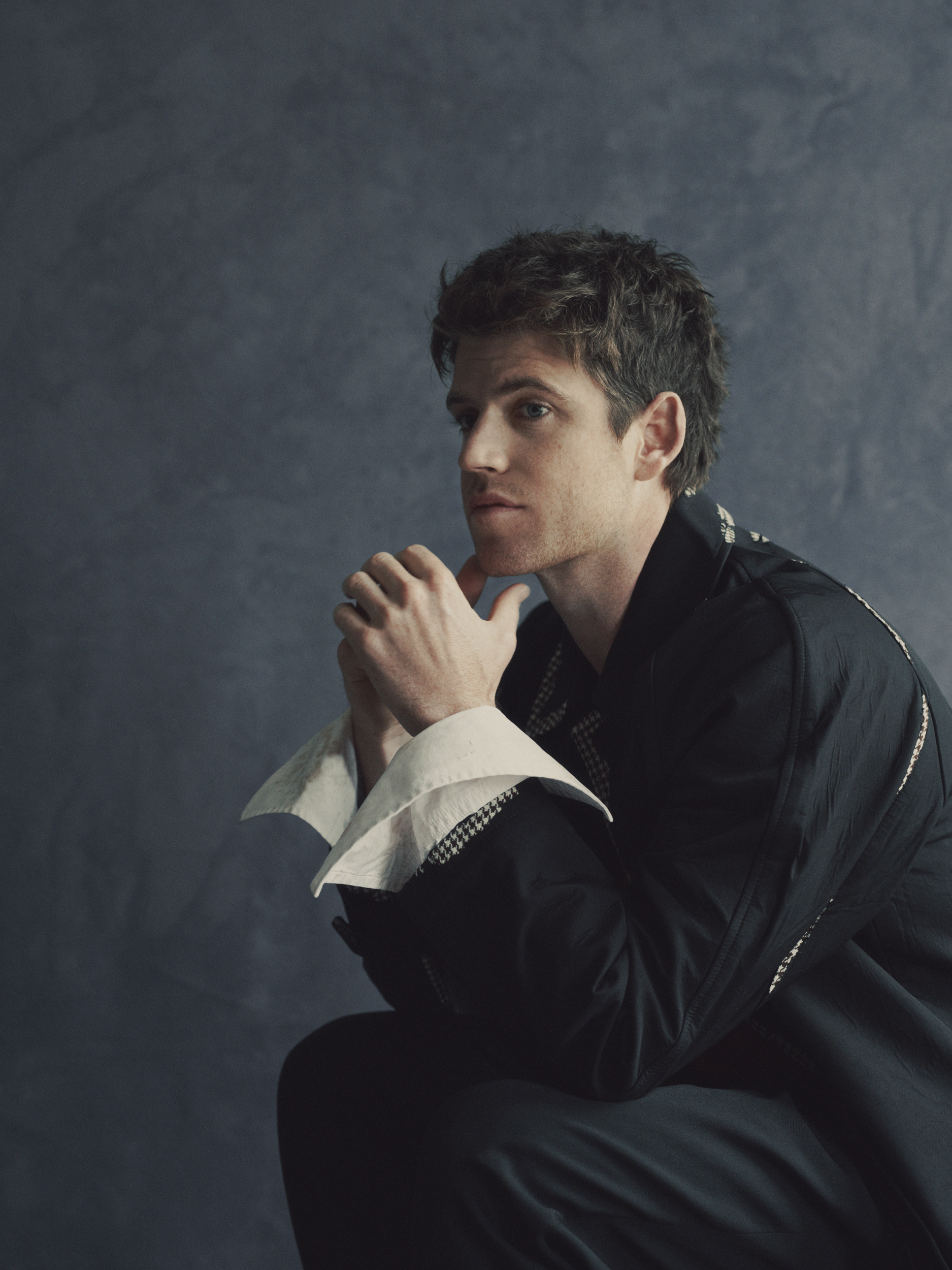
The film’s success is significant to Spain’s current cultural standing – Almodóvar, Rosalía, Los Javis, Penélope Cruz – which feels to be on the brink of something. He also namechecks Rodrigo Sorogoyen, Alauda Ruiz de Azúa and Carla Simón. “We have great directors in Spain that are pushing our own industry to create a lot of power here. I think it’s a great time for our industry. And at the same time, I’m not surprised. I’ve always trusted our talent here. And you can see that in Penélope, Los Javis, who are the clear references for us, and which I’m very grateful to have. Now I can follow somebody’s path, the way they did it. They’re carrying our culture in a very proud way and that fills my heart.”
Penélope’s part in the film is brief but pivotal. “I think it’s really compelling for the audience to have the relief, the spectacle, of watching Nené Romero after watching intense war scenes. Penélope does an amazing character arc during her scenes, where she shows the roughness of war, but also the fantasy of possibilities. It’s the fantasy of possibility, and the war is the opposite. I think it’s completely iconic.”
To truly appreciate La Bola Negra, you need to see it. It’s a confronting, confounding, engrossing cinematic experience and one that requires being seen on the big screen. For all of its specificity, the film’s themes are universal — and particularly poignant. “I think people are responding to a movie that feels very personal and very local, but at the same time very universal,” says Bernardeau. “It speaks about the impossibility of not being able to be who you are. To express yourself how you want, or to love who you want, because of the times that are happening in your country; our country. I think that speaks a lot to people, especially at a time where for half of the world violence is so normalized, and polarization is so instilled in our brains and in our culture.”
Like the best filmmaking, it reminds us that through art, we can survive even the darkest moments in history. “Two young men from different sides of the war who can communicate and, in the end, love wins,” says Bernardeau. “Love wins through poetry, and through their sexuality, and through their possibilities, and through theater. I think that speaks to a lot of people at these times. My hope is that La Bola Negra inspires younger generations. My hope is that people remember Lorca and Rafael and see something of themselves in this story.” Long after the credits roll.
PHOTOGRAPHY MATT HEALY
STYLING BEN REARDON
PHOTOGRAPHY ASSISTANT JENNA SMITH
STYLING ASSISTANTS OLIVIA NUTTON, IONE WILLIAMS-MARR
Meet Michelle Adepoju, the designer bringing African craftsmanship to global luxury fashion Meet Michelle Adepoju, the designer bringing African craftsmanship to global luxury fashion

Meet Michelle Adepoju, the designer bringing African craftsmanship to global luxury fashion
Elizaveta Porodina on digging deeper with new book Found Dreams and the creative cosmos she’s created with Ariana Grande Elizaveta Porodina on digging deeper with new book Found Dreams and the creative cosmos she’s created with Ariana Grande
Elizaveta Porodina on digging deeper with new book Found Dreams and the creative cosmos she’s created with Ariana Grande
“I felt like a proper pop star”: Bash Croft on being a ‘faithful’ and the making of his upcoming debut EP “I felt like a proper pop star”: Bash Croft on being a ‘faithful’ and the making of his upcoming debut EP
“I felt like a proper pop star”: Bash Croft on being a ‘faithful’ and the making of his upcoming debut EP
DJ Honey Dijon joins Kristen McMenamy for a new episode of Get Over Here You B**ch DJ Honey Dijon joins Kristen McMenamy for a new episode of Get Over Here You B**ch
DJ Honey Dijon joins Kristen McMenamy for a new episode of Get Over Here You B**ch
Imaan Hammam talks Love Island and being starstruck at the FIFA World Cup Imaan Hammam talks Love Island and being starstruck at the FIFA World Cup

Imaan Hammam talks Love Island and being starstruck at the FIFA World Cup
Gigi Hadid and Paloma Elsesser share the 7 things they love to hate Gigi Hadid and Paloma Elsesser share the 7 things they love to hate
Gigi Hadid and Paloma Elsesser share the 7 things they love to hate
Adwoa Aboah and Emily Ratajkowski tell us 7 things they love 2 hate Adwoa Aboah and Emily Ratajkowski tell us 7 things they love 2 hate
Adwoa Aboah and Emily Ratajkowski tell us 7 things they love 2 hate
“I’m just a girl from Manchester and I opened Prada”: Anok Yai talks identity and belonging with Edward Enninful “I’m just a girl from Manchester and I opened Prada”: Anok Yai talks identity and belonging with Edward Enninful