He’s had Central Cee, Dave, and A$AP Rocky in his studio. Now, Nigerian artist Slawn is inviting you
The London-based creative set up shop at Mayfair’s Saatchi Yates gallery, inviting his friends, collaborators and the general public to enjoy the chaos and community behind his masterpieces.
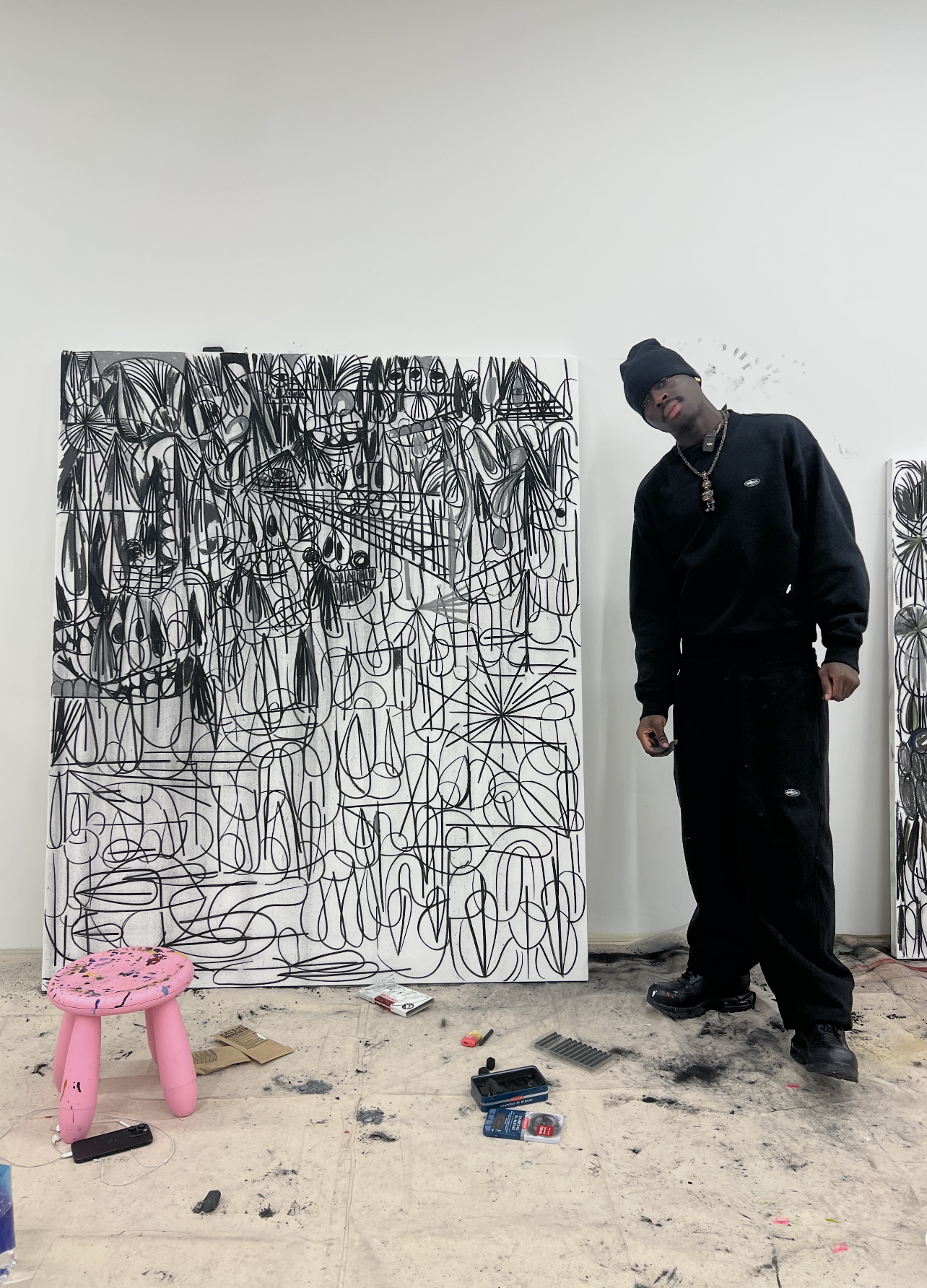
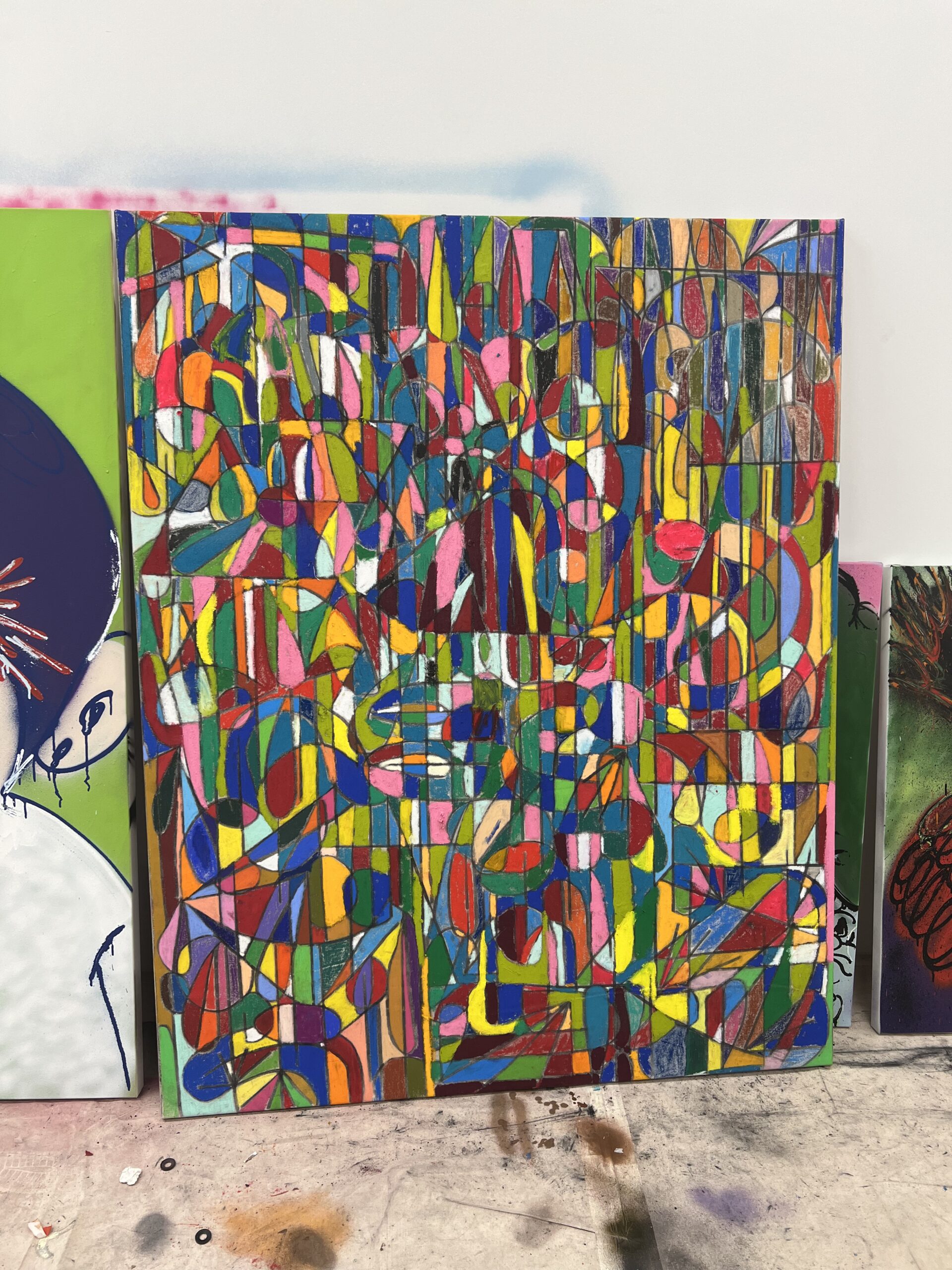
Slawn is his own biggest critic. “I’m working on this piece. It’s called Dreadful,” the Nigerian artist says as we meet him at his latest gallery opening in London’s Saatchi Yates. To the onlooker, there’s no need for such self-deprecation. The giant canvas he’s labouring over is a visual feast, each haphazard stroke of jet black charcoal lacquered on with intention. It’s the perfect example of the work that, at the age of 25, has cemented him as the face of the UK’s contemporary art scene.
Slawn – full name Olaolu Akeredolu-Ale – had his start as a skater, employed at Nigeria’s first skate company WAFFLESNCREAM. He’d go on to found skate and streetwear collective Motherlan before his move to the UK in 2018. The “great, wild, and free-spirited” skater Andy Roy served as his inspiration, offering him an ethos that still shapes his approach to work and life today. “I don’t think a lot of my creative influence comes from artists. It comes from people that are just living their fucking lives [like Andy]. I try to emulate that. Not just in the way I work, but how I live as well. If I don’t, then I’m not being true to myself. I feel like people have a good sense of whether someone isn’t being themselves.”
I don’t think a lot of my creative influence comes from artists. It comes from people that are just living their fucking lives [like Andy Roy]. I try to emulate that. Not just in the way I work, but how I live as well
SLAWN
Various figureheads of global culture have proven besotted by his authenticity; the proof is in his Instagram comment section. Rapper Skepta notes that his work is “insane” and photographer and creative virtuoso Gabriel Moses simply comments “certi”. Elsewhere across his social media page, Naomi Campbell, Unknown T and A$AP Rocky have shown their admiration. But, while others are quick to shower him in praise, he’s still reluctant to acknowledge his own genius. “With this art thing, I think I’m spoiled. I try to branch out, do different things and then it doesn’t work, and, like a big fat baby, I start getting upset,” he says with frustration, still wielding a piece of charcoal as he scribbles and scrawls across Dreadful. “Now I’m upset because it’s not working,” he says of the piece.
His self-deprecation has bled into his brand, with the artist now notorious for claiming himself to be everything but that. His history-making move as the youngest person to design the BRIT Award statue proves otherwise, as he joins Vivienne Westwood, Peter Blake, and Tracey Emin in that honour. Even his work, currently housed at a gallery that’s welcomed world-renowned creatives such as Marina Abramović, David Hockney, Jenny Saville, Peter Doig, Francis Bacon, and Cecily Brown, should be reason enough to prompt a change in his outlook. “Yeah, it’s definitely changing,” he confirms. “But I still don’t want to call myself an artist. I don’t call myself one because I’m not trying to disrespect artists, especially those people who go to school to really perfect and hone their experiences,” he says before shrugging, “I’m just doing what I know how to do.”
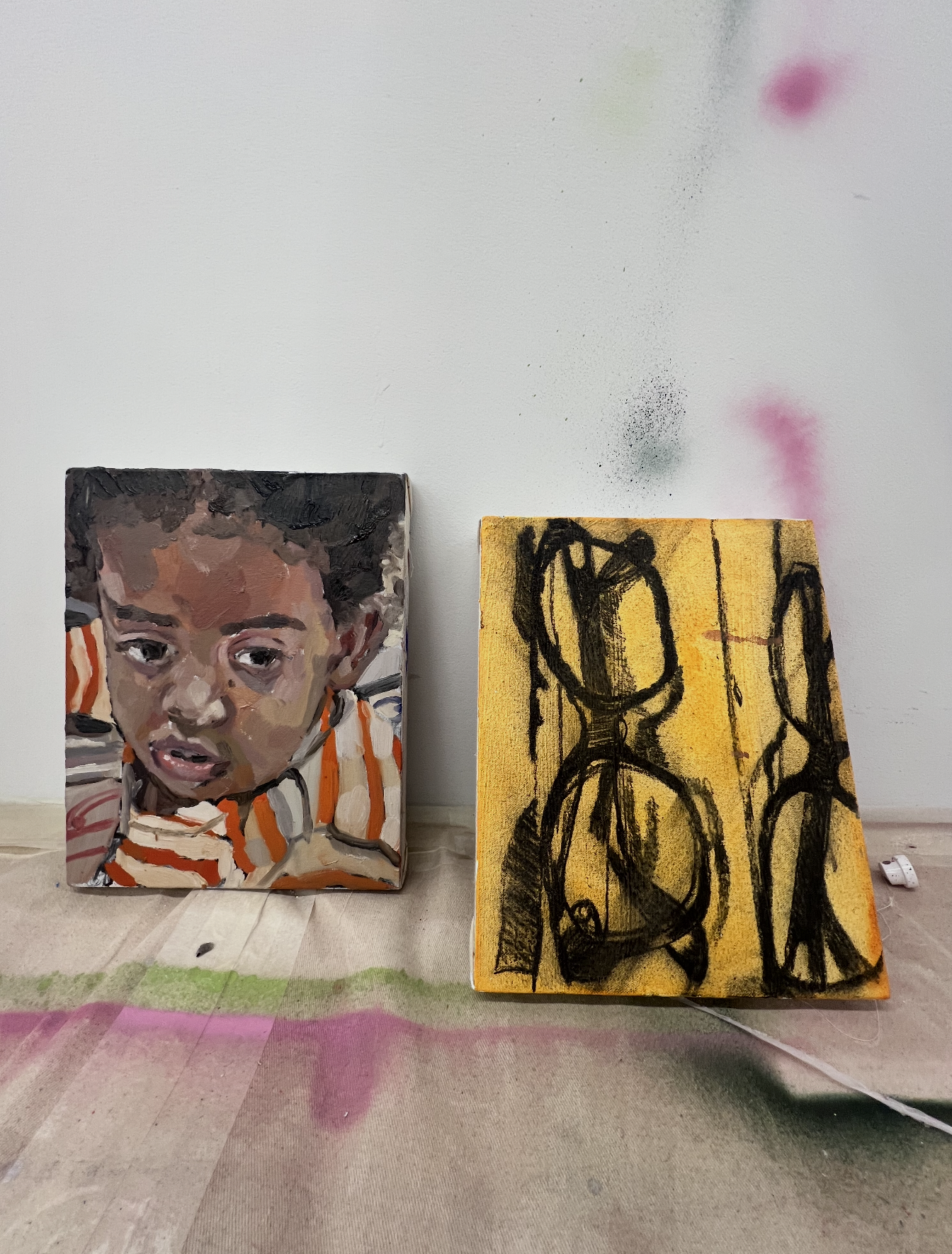
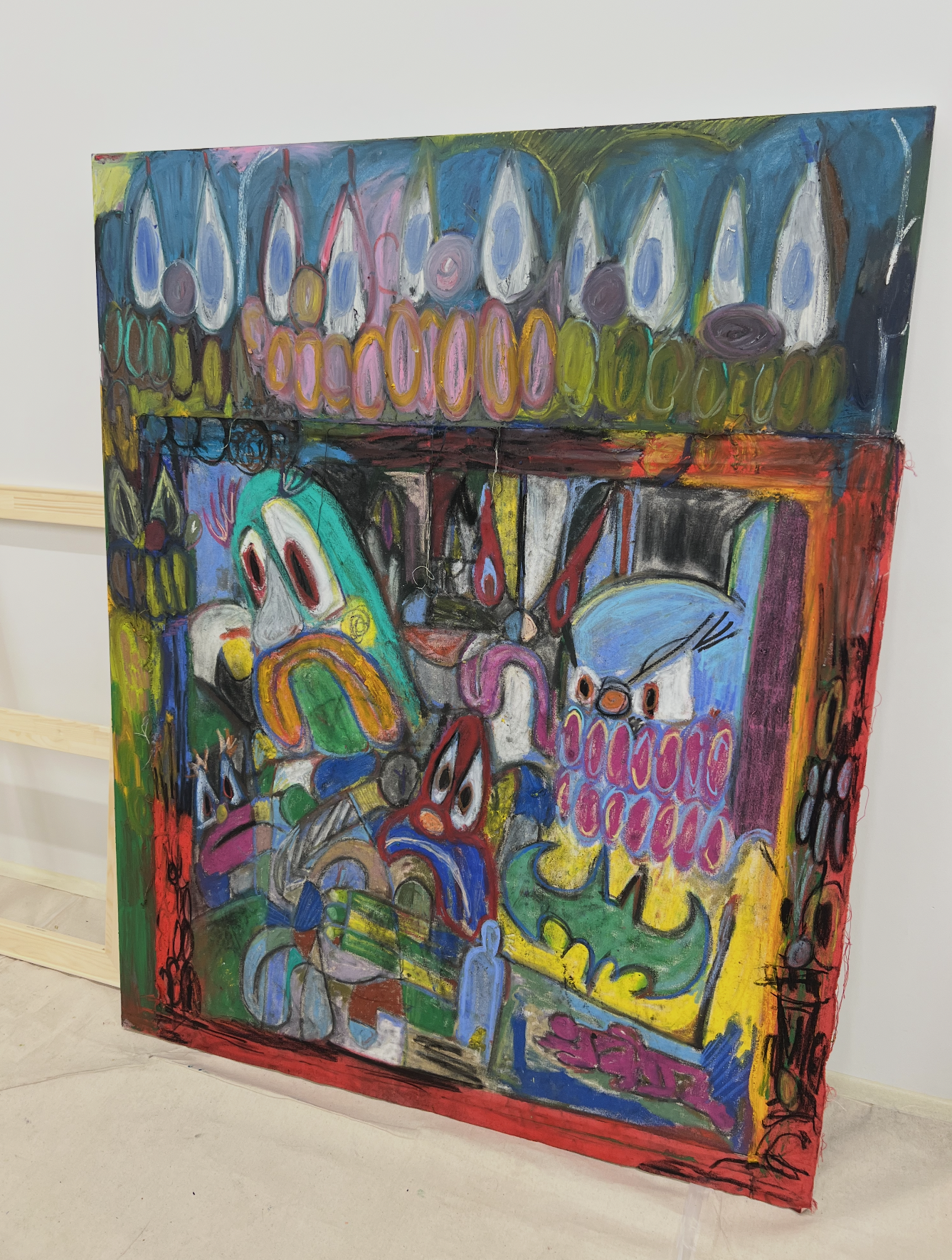
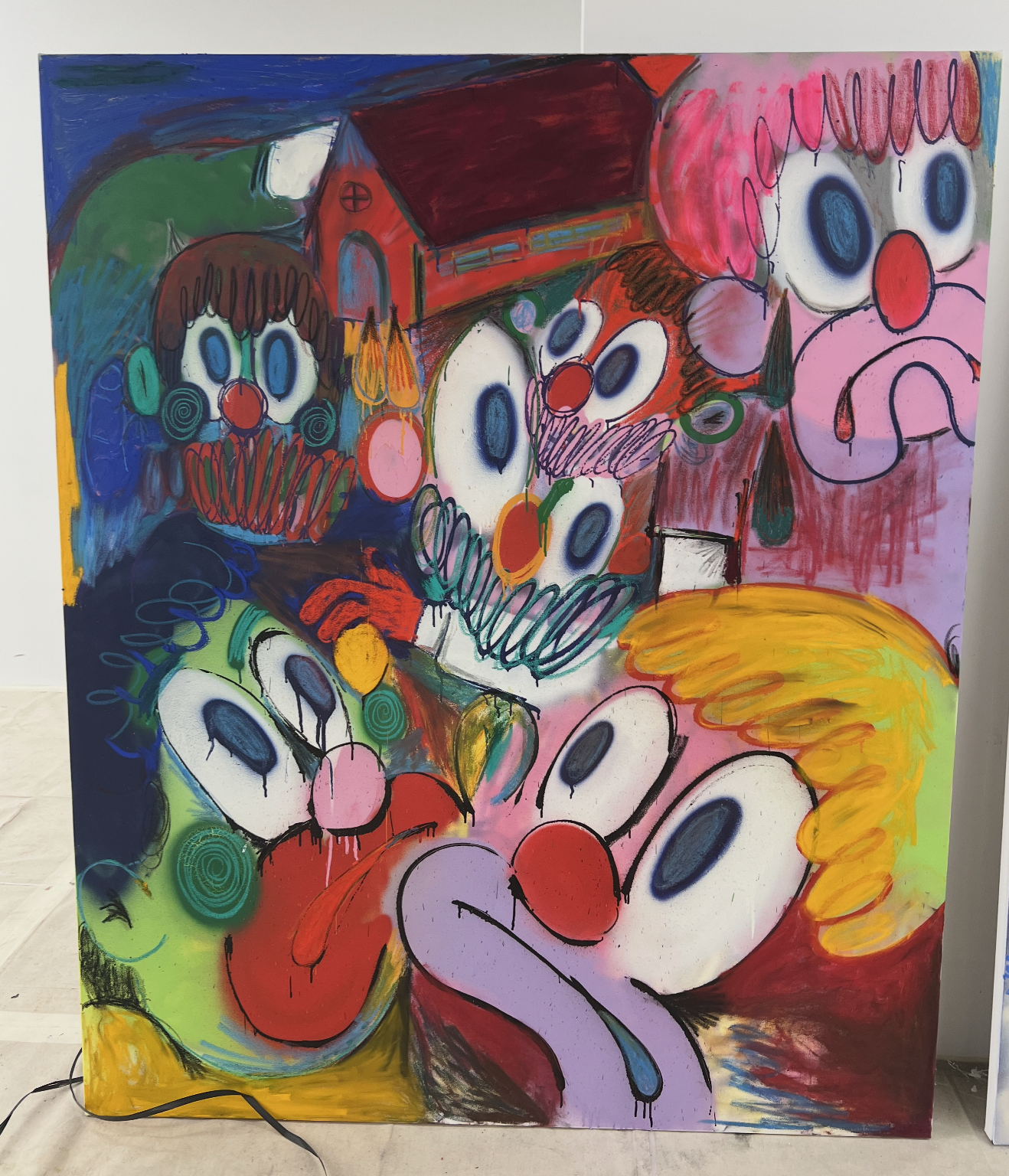
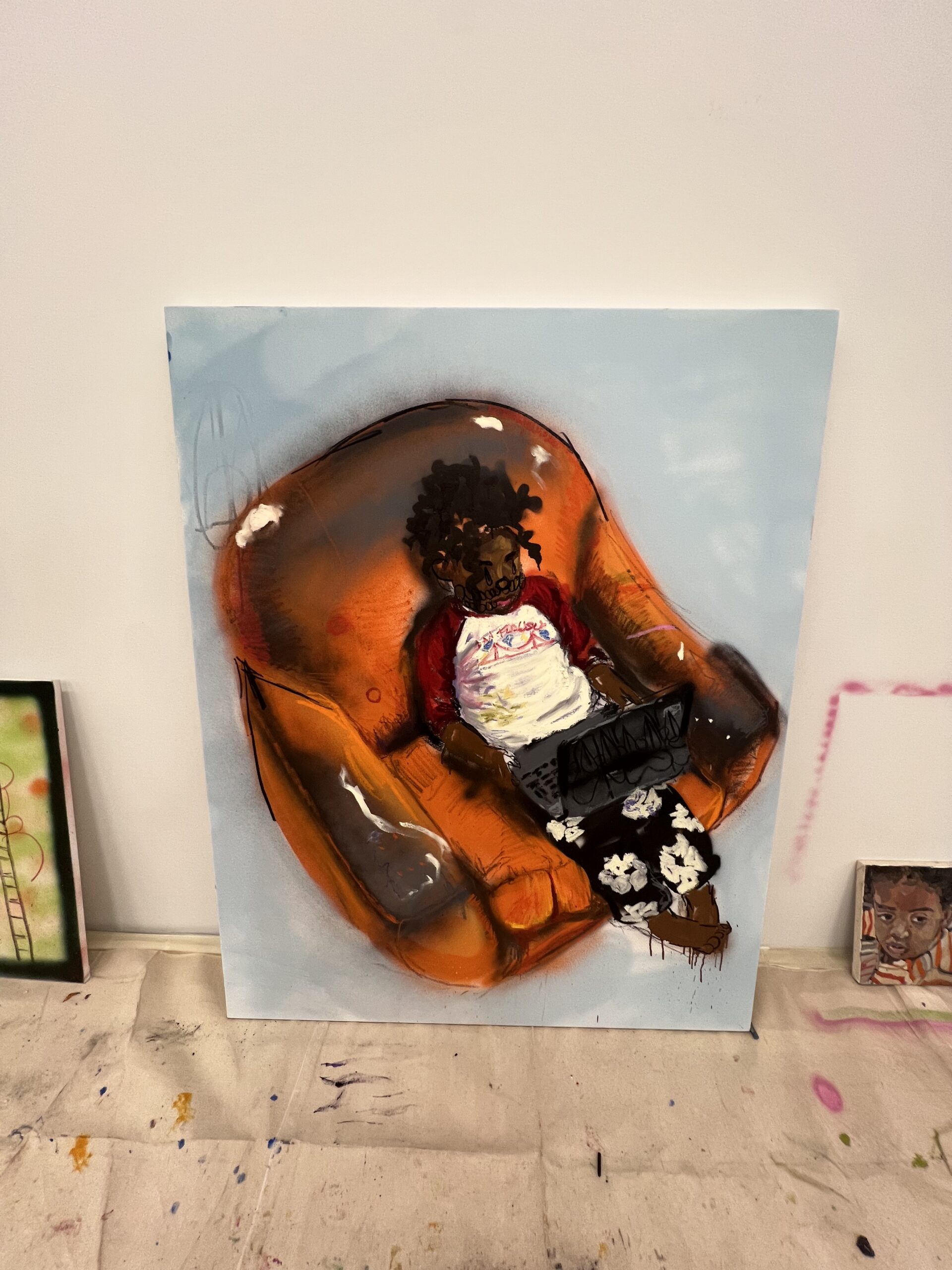
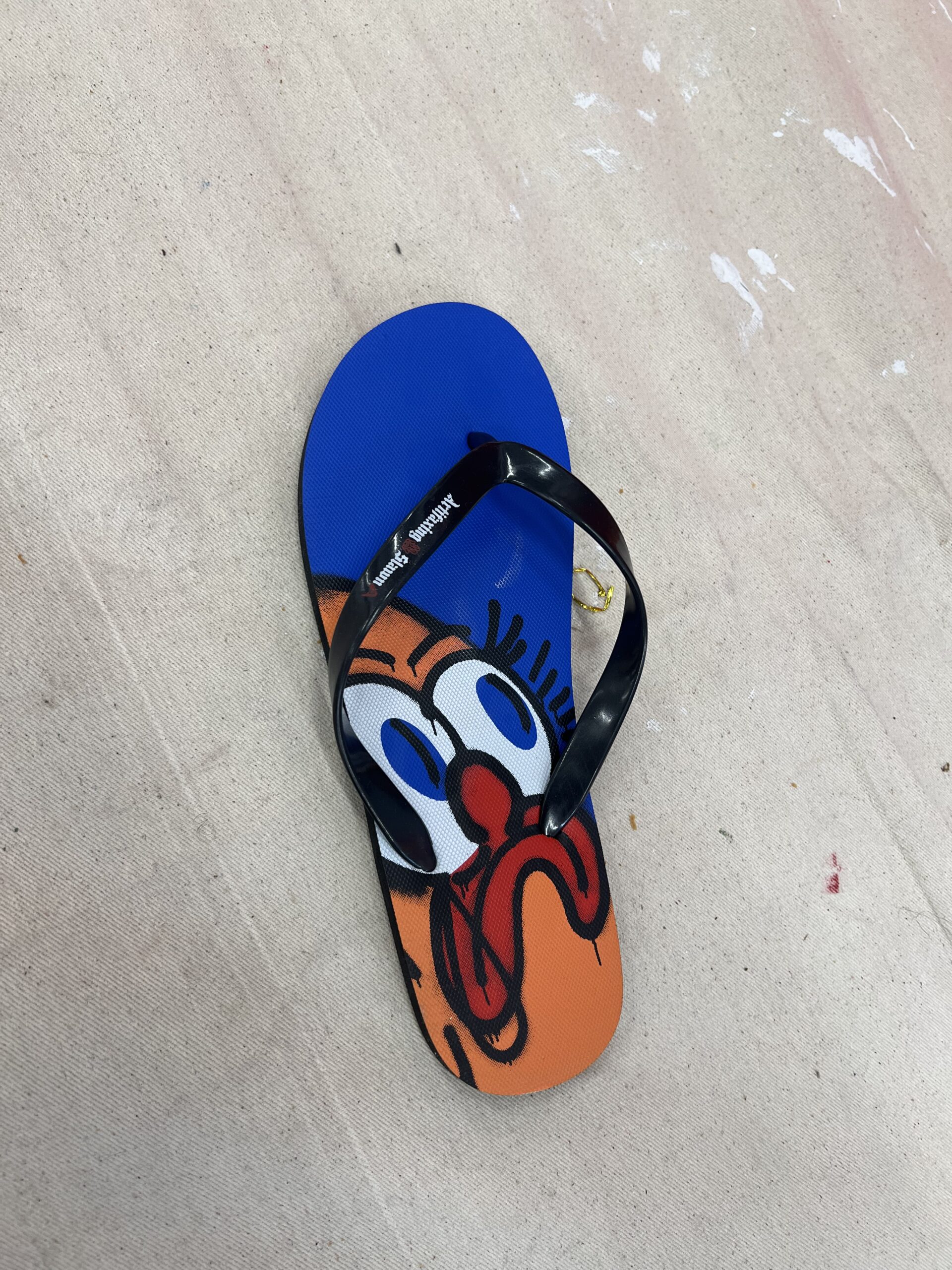
The Saatchi Yates exhibition is a clear indication of Slawn’s free-thinking, individualistic approach to his work. Chaos and collaboration are in abundance inthe working studio-turned-gallery, open until the 22nd of February. “I grew up in a chaotic household, so I thrive in chaos and around nonsense,” he comments on the setup, which, at the time of visiting, is complete with multiple canvases featuring his signature caricatures, paintings of his sons Beau and Baby, and a graffitied skateboard ramp. The room is full of people going about their day; Zoom calls are being taken, and others are recording an album in a shed-turned-studio tucked in the corner of the room. The beauty of the space is that masterpieces blossom before your very eyes, and the trials and tribulations behind the art hanging from the gallery walls play out in real time. “You know what, I might just leave Dreadful like this. There’s something about how unfinished it is [that I like]… Let me get Corey…” he says, pausing the interview and striding across the gallery to a group of collaborators. He returns with his friend, and they study the piece carefully. Shortly after, artist Teoni Hinds is beckoned over to offer her opinion. “I’ve got real artists here,” he says with a smile. After flipping the piece upside down, and a considered back and fourth, the group collectively decides more needs to be done.
“It really changes the dynamic of the battle between me and the work,” Slawn says of the importance of collaboration in his creative endeavours. “It helps so much. People are like, ‘When I paint, I don’t want to talk to people.’ I’m not that kind of person. I need to speak to people, and I need to interact with people so that I can fucking time travel and be done with it, basically.” Outside of the gallery, he continues to ask for the opinions of his nearest and dearest. “[I send my work to] my friend Clint [the founder of Corteiz], and I used to send work to Virgil [Abloh]. I have friends that I’ll go and talk to when I want to hear, ‘Oh, yeah, that’s sick.’ And then I have friends I text and say, ‘Okay, I’m on the verge of discovering something really serious here [and I need an honest opinion].’ V would always be honest.”
[Collaboration] really changes the dynamic of the battle between me and my work. It helps so much. People are like, ‘When I paint, I don’t want to talk to people.’ I’m not that kind of person. I need to speak to people, and I need to interact with people so that I can fucking time travel and be done with it, basically.
SLAWN
Beyond his core group of collaborators, music also informs his process. His stack of records littered across the gallery includes a melting pot of artists. Lola Young, King Sunny Adé, Nirvana, Metallica and Playboi Carti’s I Am Music all feature. He’s even inviting some of them into his space. “[Musical artist] Blackhaine was in here and his process was just so raw, and I was like, ‘Yeah, I need to treat my art like this sometimes,’ so it was good to learn from.”
He’s even hoping that his son Beau, who visits the gallery occasionally, will pick up a trick or two. “I’d love for my son to be a musician. But, not a rapper. I’d want him to learn the guitar really well or be in a band,” he says. “I’d like for him and his friends to go through their journey, and maybe one of them leaves the band, or let’s say one of them gets bigger than the rest of them. He’d have to deal with those emotions of seeing his friend do well and just having to be happy for him. [These are] essential things that are not taught; they’re something you have to learn. If you go through it properly, your time will come. It’s character building.” If the group of friends surrounding his dad are anything to go by, it sounds like Beau is on the fast track to success.


Archie Madekwe is just getting started Archie Madekwe is just getting started
Archie Madekwe is just getting started
Out with the Snake, in with the Fire Horse Out with the Snake, in with the Fire Horse
Out with the Snake, in with the Fire Horse
Inside The Perfect Neighbor, how Geeta Gandbhir turned documentary into a catalyst for change Inside The Perfect Neighbor, how Geeta Gandbhir turned documentary into a catalyst for change
Inside The Perfect Neighbor, how Geeta Gandbhir turned documentary into a catalyst for change
‘Girl, I’m chillin!’ Eve on her overdue Grammy win, enduring legacy and embracing all things ‘woo woo’ ‘Girl, I’m chillin!’ Eve on her overdue Grammy win, enduring legacy and embracing all things ‘woo woo’

‘Girl, I’m chillin!’ Eve on her overdue Grammy win, enduring legacy and embracing all things ‘woo woo’
From South Korea to London, Antwerp, and beyond, these are the must-see exhibitions of 2026 From South Korea to London, Antwerp, and beyond, these are the must-see exhibitions of 2026
From South Korea to London, Antwerp, and beyond, these are the must-see exhibitions of 2026
Holiday Club’s Bisoye Babalola is opening doors for the next generation of creative talent Holiday Club’s Bisoye Babalola is opening doors for the next generation of creative talent
Holiday Club’s Bisoye Babalola is opening doors for the next generation of creative talent
On representation and morality: what do we want from Black women on screen? On representation and morality: what do we want from Black women on screen?
On representation and morality: what do we want from Black women on screen?
“A child should never be put in a position where they have to beg for survival.” Saja Kilani on The Voice of Hind Rajab “A child should never be put in a position where they have to beg for survival.” Saja Kilani on The Voice of Hind Rajab