Do you have to be online to be relevant?
As Gen Z’s “posting zero” philosophy gains momentum and AI reshapes creative output, the creative industry finds itself at a moment of reckoning. Is stepping away from the algorithm an act of rebellion, or a luxury few can afford? Roisin Lanigan investigates.
You can have your lunch delivered by a drone, or get to your appointment in a car without a driver. In just a few short years, AI has transformed itself from its primitive and glitchy origins; now it can doctor a photograph almost imperceptibly, or diagnose your illnesses, or even comfort you through a mental health crisis. Technology, in other words, has never been so ubiquitous, so sinister, so deeply embedded in every aspect of our day to day lives.
Most, if not all creatives working today will have spent most, if not all of their lives surrounded by, and interacting with, various models of technology. Unsurprisingly, constant pressure to be online isn’t making us happy. In fact, it’s making us miserable and less inspired, ruining our attention spans and forming addiction pathways to doomscrolling and gloom. A report from the World Health Organisation found that one in 10 teenagers struggled to control their social media use, and over a third (36%) were in constant online contact with other people – which sounds nice enough, until you consider how difficult you currently find it to reply to your own WhatsApp messages. We’re constantly online, in other words, even when we don’t want to be. But you already knew all that. Little wonder then, that people are beginning to get sick of it.
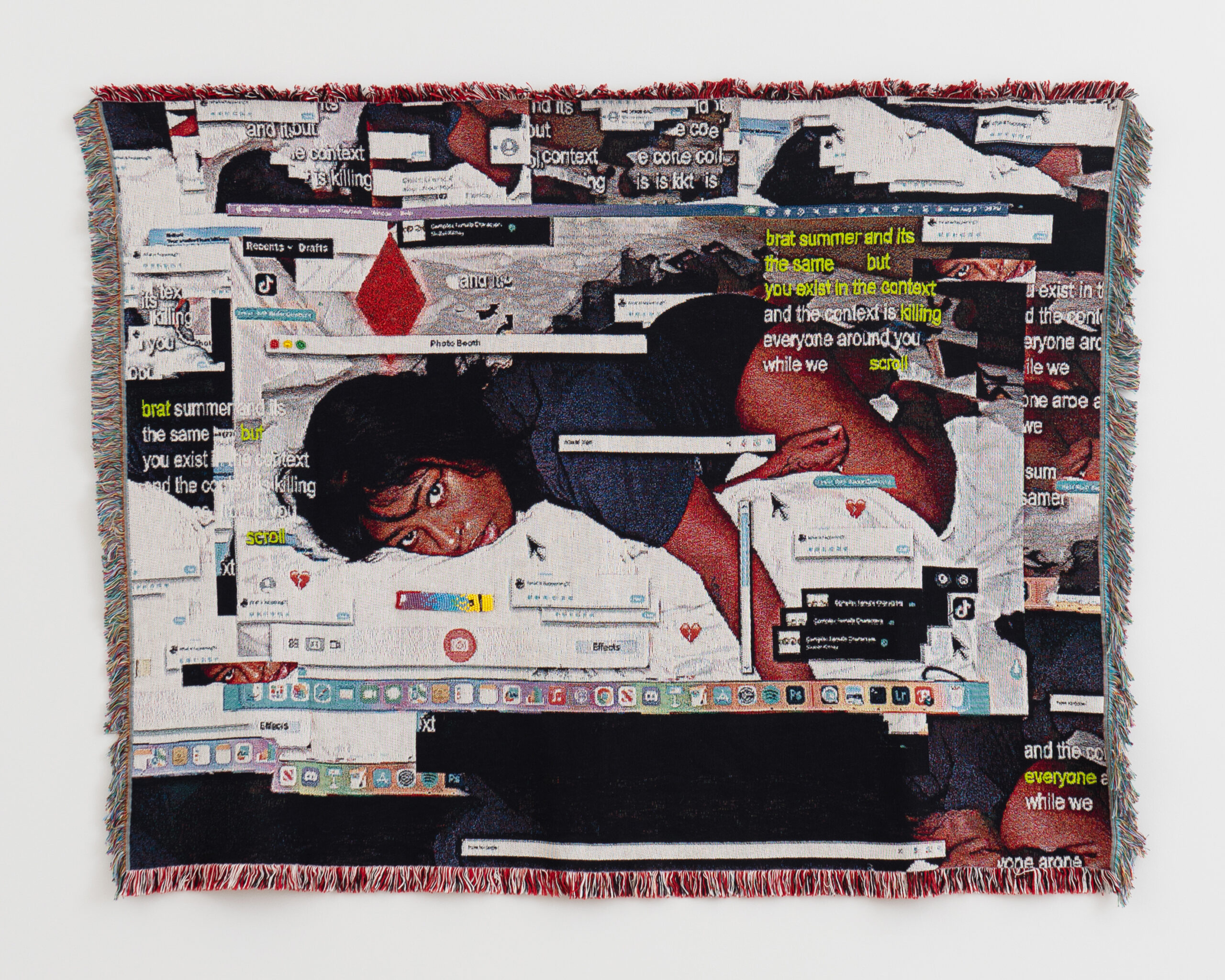
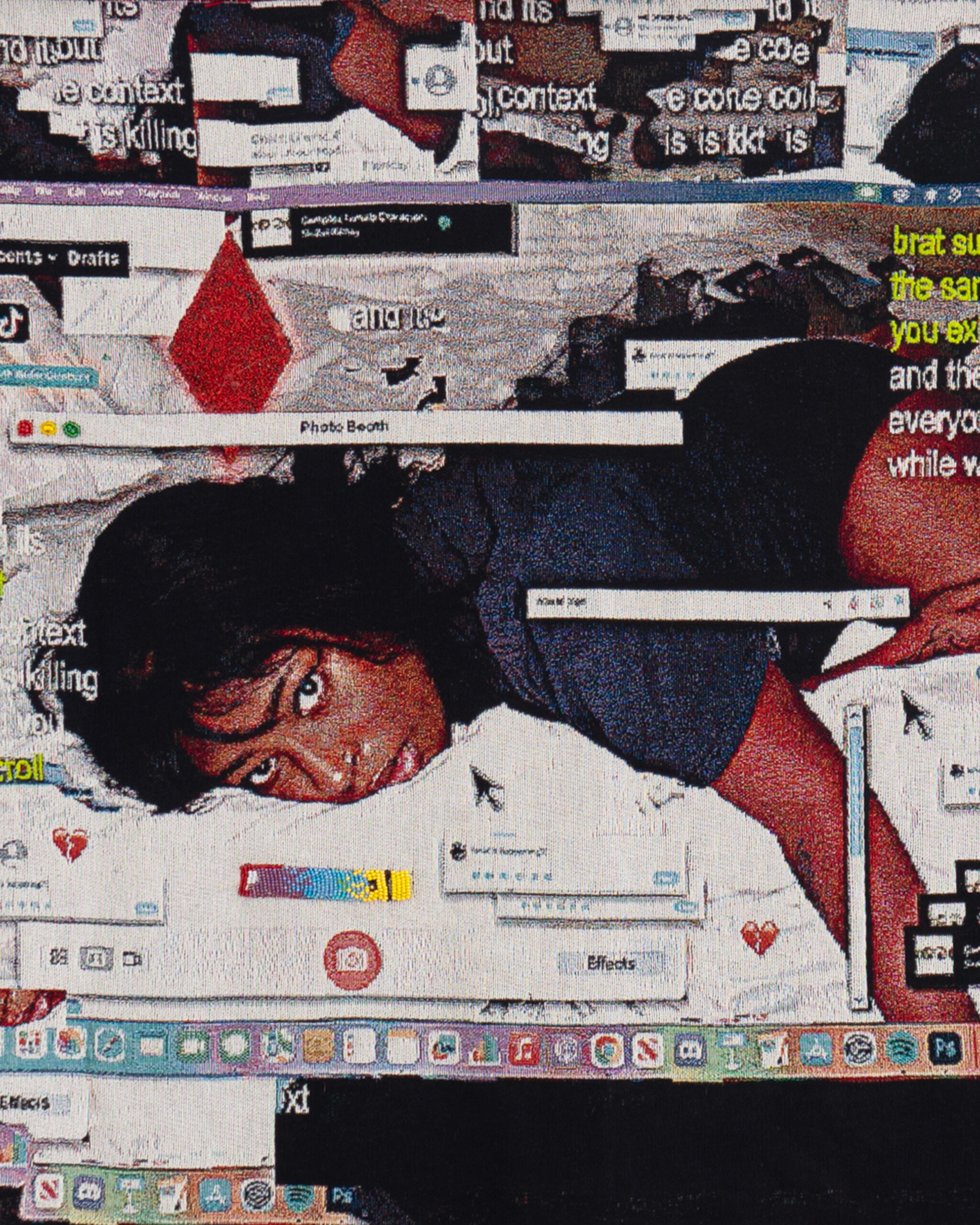
QUALEASHA WOOD, BED ROT, 2024, WOVEN JACQUARD, GLASS SEED BEADS AND HAND EMBROIDERY, 139.7 x 177.8 cm, 55 x 70 in. COURTESY THE ARTIST AND PIPPY HOULDSWORTH GALLERY, LONDON
Social media usage has fallen by as much as 10% in the past few years, driven mainly by Gen Z, who are embracing a “posting zero” mentality and using their profiles as time capsules or artifacts rather than actively using them.
Roisin Lanigan
As plenty of reports continue to reveal, Zoomers are logging off in huge numbers, particularly turning their backs on both social media and dating app culture. Social media usage has fallen by as much as 10% in the past few years, driven mainly by Gen Z, who are embracing a “posting zero” mentality and using their profiles as time capsules or artifacts rather than actively using them. As a millennial, I am semi-immune to this urge. I still remember a time before social media, when the internet was in its infancy and restricted to a single “computer room” in the home. The online world was a discreet and finite concept, a place you could go to and leave rather than being attached to at all times. Millennial creative work, I think, reflects this, a kind of ‘tech as novelty’ overhang, while Gen Z art is increasingly defined by the push and pull emanating from the all-encompassing and increasingly threatening internet universe.
At 24 years old, Briony Godivala is among this cohort, although her work tentatively explores the relationship between art and technology rather than dismissing it entirely. A performance artist based in Glasgow, Briony’s most recent year-long project saw her blend her body, umbilical cord-like, to the internet machine. Named The Inked Link, the piece saw Godivala tattoo a QR code on her body, which gave anyone with access to the code the ability to upload and vote on whatever appeared on the corresponding web link for 24 years. The project, for which she had to be constantly connected to the URL, updating the link and cataloguing the most popular submissions every week, was meant to reflect the internet as it is today: an overload of information, community, control and morphing identity in the face of vastness and uncertainty. Unsurprisingly, it got pretty overwhelming at times.
“It got to the point where I was planning to leave social media entirely when the project ended”, Godivala says. “The links got increasingly hellish. I would be jump-scared by videos of suicide, shootings and graphic sex.” For a week in November, her site, controlled by her own body, displayed advertisements for a man who uploaded videos of him shitting into bags, which he then sold online. “It got to the point where I didn’t want to open it alone. But by the end of the project I think these people got bored, and it got taken over by mainly wholesome content; nostalgia, charity and creativity.”
By this point though, Godivala was exhausted by the scope of the project and the extremities of the uploads. Since finishing The Inked Link last month she hasn’t left social media – although she says she has learned that recording herself speaking to camera is not something she enjoys.
“I’ve been thinking a lot about making it in a more analog way”, Godivala says now the project is over. “But my work for a while has been intertwined with technology. Working with social media specifically is something I’ll maybe avoid in the future. The project in my comment section is often reluctantly accepted as ‘performance art’ and mainly described as a ‘social experiment’ or ‘attention-seeking’. I think working more analogue, or at least with an inclusion of physical media, could be a way to increase understanding on why I created the project in the first place, rather than ‘chasing instagram clout’.
“Though I wish it would be accepted as it is, as collaborative conceptual work made using social media, maybe the problem is that ‘social media art’ conflicts against the mystery and elitism of the classic art world. But that is an ongoing issue of accessibility.”
Godivala raises an important point – I think the real issue is not total separation from technology itself, as much as it is the implication of creating a two tier system of use. After all, for all its faults technology has improved access to various industries and communities, particularly in the arts, where it’s helped remove the historical gatekeeping boundaries that once existed around ‘networking’ and accessing job opportunities. If you don’t need to rely on the internet for those things though – if you already know who you need to know, and have the means to travel where you need to travel in real, corporeal form rather than on the grid – then why wouldn’t you log off? And why wouldn’t that create a situation where those who can take themselves offline, widening the gap that already exists in the creative industries, particularly in the UK, where only 8% of creatives are from working class backgrounds, a decade long nadir.
It feels cynical to suggest this, but perhaps there is a balance; an ability to sit somewhere between reclaiming power back from the tech oligarchs who have unprecedented access to our lives and personal data, and, on the other hand, creating yourself a luddite ivory tower where you can disengage entirely from the horrible things appearing on your iPhone screen. Today’s new generation of creatives have to learn to bridge that gap – but it’s something they’ve been doing, anyway, since COVID made that decision for them.
Philip Clarke, Course Leader in Fashion Communications, first joined CSM in 2019. Back then, pre-pandemic, the focus of creative education was offline – in writing for print, film photography, craft. “Then all that shifted”, Clarke says. “It forced students to think about what they could do in their bedrooms, or on their computers.” During COVID at least, technology worked to improve accessibility in a historically inaccessible industry. The days of students with physical sketchbooks and expensive equipment were gone – now everything is done and stored digitally. Some CSM final projects don’t require students to spend any money at all.
As the impact of the pandemic has faded though, a hybrid online approach hasn’t. And AI has complicated things even further. Partially this has forced a change in teaching styles (which remain face to face) and academic assessments – which have moved towards a more PhD, viva inspired model, with an interview portion so tutors can make sure the content is being properly understood. “It’s forced the students to think critically about AI”, Philip notes. “You need to be critical with AI because it’s so easy to take it at face value, either the information it’s giving you or the material it generates. You need that extra, meta-cognitive layer where you’re actually questioning the process and thinking about how to adapt it and disrupt it to create something that is less generic.”
You need to be critical with AI because it’s so easy to take it at face value, either the information it’s giving you or the material it generates. You need that extra, meta-cognitive layer where you’re actually questioning the process and thinking about how to adapt it and disrupt it to create something that is
less generic.”
Philip Clarke, Course Leader in Fashion CommunicationS CSM
All the same, AI has killed off some of the careers CSM Fashion Communication students once hoped to graduate into, particularly in fashion journalism. And educators have had to change how they work with industry partners, who have existing expectations of students in terms of real world skills, outside of the internet. Yet, Clarke notes, with or without technology, trends in graduate employment have always waxed and waned. “There was a real moment where everyone wanted to be a stylist, and I think often work placements kill that idea. People go out in the world and realise how hard a slog it is, and it puts them off.”
Although there are Zoomers currently studying at CSM who side-step social media completely and pursue a more analogue, old-school approach, this isn’t necessarily encouraged by their course leaders. “Some don’t go on Instagram much or don’t post and they have to be nudged towards keeping themselves out there”, says Clarke. Others, still, put themselves through university while making money – and platforms – as influencers.
The answer is complicated, but it’s inevitable: technology isn’t going away, and only a few of us can afford to disengage with it entirely, and so we have to learn to live and work with it. Although much of the creative industries’ focus in the past few years has been on the jobs AI will replace (journalism is particularly vulnerable to this, as are artists, who are increasingly reporting that their work is being scraped and copied by AI models) some people, whether optimists or realists, believe that it can lead to job creations at the same time (albeit not for already laid off journalists).
Although it might stick in our teeth to consider this, it’s already happening whether we like it or not. Last year alone, 83% of creatives reported that they had already been integrating AI with their processes, learning to work alongside the robots rather than against them. “It’s natural for artists to want to explore new tools as we get them, whether in art practice or promotion”, says Briony Godivala. “The nature of social media is constant self promotion, but that’s part of an artist’s job anyway. My work isn’t about technology but more about engaging with people – technology is a tool to reach audiences and participants that wouldn’t previously have been possible.”
The thing that most technology chatter misses – both from the evangelists and the haters – is that AI has its limitations. It can only replicate what it already knows from humans, and relies on humans to teach it how to act, think, feel and predict
Roisin Lanigan
The thing that most technology chatter misses – both from the evangelists and the haters – is that AI has its limitations. It can only replicate what it already knows from humans, and relies on humans to teach it how to act, think, feel and predict. “Current research predicts that AI models trained on their own input will eventually collapse”, says one UN report by Ben Zhao, a computer science professor from the University of Chicago. Zhao points out that, despite our fears of being replaced by technology, it’s technology, not human creativity, that is limited by a lack of subjectivity and the ability to make things which are new and innovative rather than copies of what we already have.
“I remember when I started teaching 20 years ago, people were using the internet in crude ways”, says Philip Clarke. “There was a suggestion we could push back. We banned students from doing online research, and said no one could use their phone in class… But it didn’t really affect creativity, or the ability to innovate.” Tech in the creative industries didn’t go away then, and it won’t now either. However depressing it may seem, our opportunity to push back is limited – our opportunity to reflect on our own values, and our own role in the process, however, is still up for grabs.
“I know I will be making art till the day I die” Tracey Emin takes to the Tate “I know I will be making art till the day I die” Tracey Emin takes to the Tate
“I know I will be making art till the day I die” Tracey Emin takes to the Tate
From Sinners to One Battle After Another: Meet this year’s BAFTA EE Rising Star nominees From Sinners to One Battle After Another: Meet this year’s BAFTA EE Rising Star nominees
From Sinners to One Battle After Another: Meet this year’s BAFTA EE Rising Star nominees
“I wanted to honour Palestinian humanity, because the world so rarely gets to see it.” “I wanted to honour Palestinian humanity, because the world so rarely gets to see it.”
“I wanted to honour Palestinian humanity, because the world so rarely gets to see it.”
He’s had Central Cee, Dave, and A$AP Rocky in his studio. Now, Nigerian artist Slawn is inviting you. He’s had Central Cee, Dave, and A$AP Rocky in his studio. Now, Nigerian artist Slawn is inviting you.
He’s had Central Cee, Dave, and A$AP Rocky in his studio. Now, Nigerian artist Slawn is inviting you.
Archie Madekwe is just getting started Archie Madekwe is just getting started
Archie Madekwe is just getting started
Out with the Snake, in with the Fire Horse Out with the Snake, in with the Fire Horse
Out with the Snake, in with the Fire Horse
Inside The Perfect Neighbor, how Geeta Gandbhir turned documentary into a catalyst for change Inside The Perfect Neighbor, how Geeta Gandbhir turned documentary into a catalyst for change
Inside The Perfect Neighbor, how Geeta Gandbhir turned documentary into a catalyst for change
‘Girl, I’m chillin!’ Eve on her overdue Grammy win, enduring legacy and embracing all things ‘woo woo’ ‘Girl, I’m chillin!’ Eve on her overdue Grammy win, enduring legacy and embracing all things ‘woo woo’