Aitch on making a Netflix documentary, scaling Africa’s highest mountain and Down’s Syndrome awareness
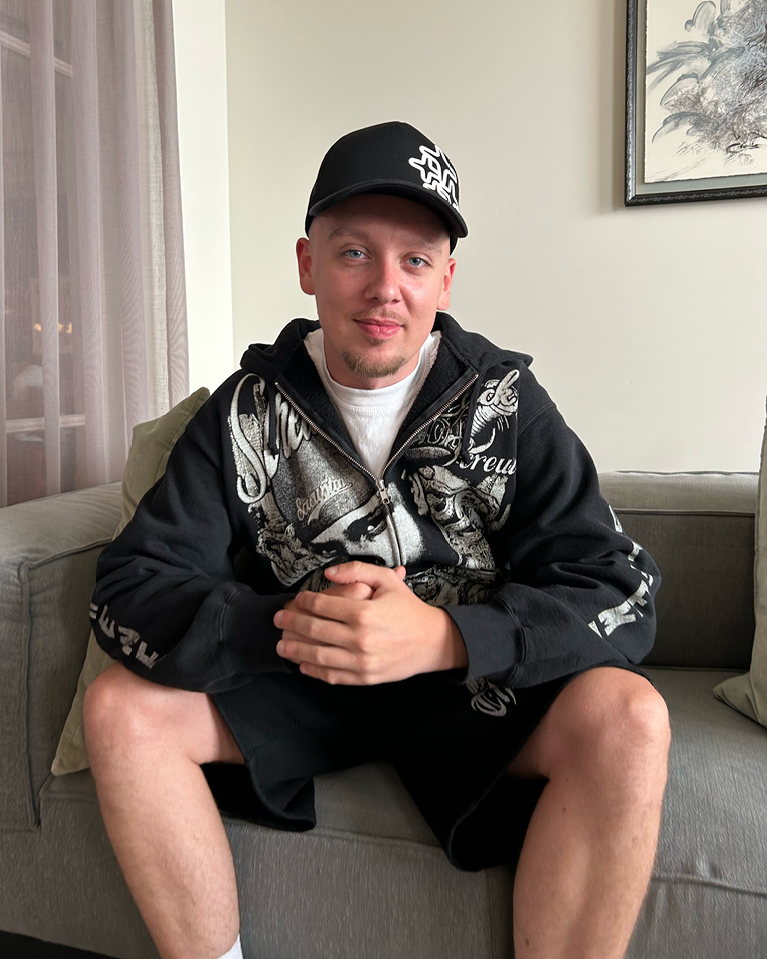
The Manchester-born rapper releases his new Netflix documentary Aitch: Don’t Be Afraid, capturing his hike to the summit of Mount Kilimanjaro in honor of his sister Gracie.
Manchester rapper Aitch is living a double life. You may know the 26-year-old Mancunian rapper for his cheeky lyrics and earworming flows, which have landed him a 2023 BRIT Award for Best Hip-Hop/Grime/Rap Act, and collaborations with AJ Tracey, Stormzy and Ed Sheeran. His new single Ring My Bell, which is currently creeping towards TikTok virality and charting in the UK, is proof that Aitch – full name Harrison James Armstrong – plans to keep the hits coming.
But when he’s not on stage or in the studio, he’s an avid activist for Down’s Syndrome awareness and brother to Gracie, who has the genetic condition. After a string of money-raising stunts, including a 15,000ft skydive, Aitch has attempted his most daring feat yet: climbing Africa’s highest mountain, Kilimanjaro. Joined by his father and closest friends, Aitch set off on a six-day expedition in extreme conditions and at dizzying altitudes (the summit is 19,341 feet high) for the charity.
He returned with more than £160,000 raised for the Down’s Syndrome Association – a charity for which he’s an official ambassador – and enough footage for what would become his new Netflix documentary, Aitch: Don’t Be Afraid. Delving into the charitable work and life of Aitch and his family, expect tears, tremendous displays of bravery and enduring love upon first watch.
Ahead of the documentary’s release, which is now streaming on Netflix, Aitch joined EE72 to talk about why the world could do with a little more kindness, the lessons Gracie has taught him, and the personal revelations informing the future of his rap career.
The documentary is incredible. How did it come about?
We didn’t even plan to make a documentary. It just so happens that one of my friends, who was climbing the mountain with me, is also my videographer. Not too long before we went he was like, ‘Should I bring my camera?’ Fair play to him, he was a soldier and held his camera from the top to the bottom of the mountain. When we got back and put all the footage together, we were like, ‘Well, this needs to be seen,’ so that’s when the Netflix conversation started happening.
The footage seemed like it was captured for a documentary.
Secret little bit of information: all the interviews in the documentary happened after the fact. So, even though it seemed like a documentary, really and truly, all of those parts were filmed weeks and even months after we got back. It was just eight days of footage of us walking up a mountain to begin with.
Physically, that must have been difficult for him?
100%. But you know what he said? He literally said that if he didn’t have the camera on him, he wouldn’t have made it to the top. He just kept thinking, ‘Get the footage.’
Give him a raise! You did all this for the Down’s Syndrome Association, which is a cause very close to your heart. Why did climbing Kilimanjaro feel like the right way to bring some awareness to this cause?
Long story short, the year before we did Kilimanjaro, we did a skydive. We raised a good amount of money; about 60 grand. About a year later, my dad turned around and said, ‘Shall we just go and climb Kilimanjaro for the charity?’ And I was like, ‘Yeah, go on then. Why not?’ I wasn’t too clued up on Kilimanjaro. I’d heard about it and knew it was a mountain, but I didn’t know the details. I signed up for something I didn’t know the severity of, I suppose. Personally, I’ll do anything to raise money for that charity. Dad’s put us in a bad position now because there’s only so many places you can go after this.
Personally, I’ll do anything to raise money for that charity. Dad’s put us in a bad position now because there’s only so many places you can go after [climbing Mount Kilimanjaro].
AITCH
Does your dad love extreme sports?
It does sound like it, but no, not before this. It’s a bit of a random one, but I think, at the end of the day, we’re in a position where we’ll do anything to raise money. So, bring it on.
Have you watched the documentary back and, if so, how was it to relive the experience?
I’ve not seen the version of the documentary on Netflix yet, and I’m not planning to until it comes out…I want to have the same experience as everyone else, so I’m excited for the premiere. So many things happened. I salute the editor because there’s so much to throw in there. You want to keep it entertaining, but you also need to keep the message clear. We didn’t want it to be some sob story either.
Will Gracie watch the documentary for the first time at the premiere?
Yeah, she’s just gassed. I don’t think she realised it was going on Netflix until literally two days ago. At first she thought it was just footage of us on the mountain and she didn’t realise she was in it. Now she’s walking about like she’s Princess Diana or something. She’s going mad.
I don’t think [my sister] realised this was going on Netflix until literally two days ago. At first she thought it was just footage of us on the mountain and she didn’t realise she was in it. Now she’s walking about like she’s Princess Diana or something.
AITCH
She’s the star of the show, no offence. Was the thought of Gracie what got you through the tough moments on the mountain?
It’s funny because Gracie knew we were going to climb a mountain for the Down’s Syndrome Association, but she doesn’t actually understand what that money can do for people. She almost thought that we were going on a bit of a holiday to climb a mountain. So it was funny when my dad was motivating me by saying stuff like, ‘Think about your sister.’ In the back of my mind, I’m like, ‘This little bastard doesn’t even give a fuck.’ [Laughs]
What are some of the biggest things that you’ve learnt from Gracie?
No one was born evil or with certain opinions. You get moulded into things. Gracie is the pinnacle of the human form. She hasn’t got a bad word to say about anyone. It always vibes. She appreciates little things. Gracie is those motivational Instagram videos you see when you’re scrolling. As humans, we’ve evolved to always have a problem or always be angry at something. If there were a blueprint for how people should be, it would be more like her. People say ignorance is bliss, and obviously Gracie doesn’t know the ins and outs of everything that’s going on in the world. But that’s probably a fucking good thing. I saw a post the other day; I don’t know how real it was. It was like, ‘Doctors might be able to stop people being born with Down’s Syndrome’ or something like that, and it was posted as if it was a good thing. I was like, ‘Are you fucking mad? We need more people with Down’s Syndrome.’ I also understand why certain people wouldn’t understand that; I’m saying it from a firsthand experience. Anyone who has ever met Gracie thinks she’s the GOAT. She’s unforgettable. Don’t get me wrong, there are obviously things my mum and dad have gone through, with her being her, which might not be stereotypically ideal. But my mum and dad wouldn’t change anything for the world, and I know that for a fact.
What do you want viewers at home to take away from this documentary?
I want everyone to be nice. I could put a full stop on the end of that, really. Someone who watches the documentary is going to have a kid one day, and they are going to have Down’s Syndrome. It’s just going to happen, isn’t it? I want to change their mindset from ‘Oh, shit,’ to ‘Oh, yes!’ People don’t like things that are different or the unknown. If I can make this known, so that more people know how to approach the subject better, then that’s my job done.
First and foremost, we know you as a musician, but your charity work is becoming a huge part of your identity. Would you say the amazing work you’ve done has impacted how you view yourself as a musician?
Massively, you know. I think it’s opened my mind a little bit. I have also realised who my audience is by doing things away from rap music. It doesn’t mean I’m going to be out here watching my mouth. I’ve still got a bit of a potty mouth. But I’m aware of my audience. If, instead of my new single Ring My Bell, I dropped a song that was about driving fast cars and living some mad rock-star life, I don’t think my audience would relate to it in the same way. I came into the rap game with a bit of a small mindset. This is horrible for me to admit, but sometimes I feel obligated to hold my watch up in a picture and do a bit of flexing. I might post a picture like that on Instagram thinking it justifies something in my head. It might not even get lots of likes. Then I’ll go and post a picture about the documentary for my sister, and it blows everything out of the water. It’s like, ‘This is what my people want to see from me.’
“Messy, imperfect and full of possibility”: Reni Eddo-Lodge reflects on the early internet of the 90s “Messy, imperfect and full of possibility”: Reni Eddo-Lodge reflects on the early internet of the 90s
“Messy, imperfect and full of possibility”: Reni Eddo-Lodge reflects on the early internet of the 90s
How Chennai’s youth are reclaiming identity through radical hair How Chennai’s youth are reclaiming identity through radical hair
How Chennai’s youth are reclaiming identity through radical hair
“Expect to be challenged”: Brand63Africa’s Eva Omaghomi on taking African design from London Fashion Week to Harrods “Expect to be challenged”: Brand63Africa’s Eva Omaghomi on taking African design from London Fashion Week to Harrods
“Expect to be challenged”: Brand63Africa’s Eva Omaghomi on taking African design from London Fashion Week to Harrods
“I think it was good that everyone else had money but I didn’t.” How scarcity created intimacy and beauty in the work of Jesse Glazzard’s photography “I think it was good that everyone else had money but I didn’t.” How scarcity created intimacy and beauty in the work of Jesse Glazzard’s photography
“I think it was good that everyone else had money but I didn’t.” How scarcity created intimacy and beauty in the work of Jesse Glazzard’s photography
Kaya Scodelario on trailer-made steak meals with Guy Ritchie and returning to the set of The Gentlemen for season two Kaya Scodelario on trailer-made steak meals with Guy Ritchie and returning to the set of The Gentlemen for season two

Kaya Scodelario on trailer-made steak meals with Guy Ritchie and returning to the set of The Gentlemen for season two
What does it really mean to be a supermodel? The defining faces of 90s fashion explain What does it really mean to be a supermodel? The defining faces of 90s fashion explain
What does it really mean to be a supermodel? The defining faces of 90s fashion explain
Sandulela Asanda’s joyful coming of age story, Black Burns Fast, was a standout at BFI Flare: today it premieres on Amazon Prime Sandulela Asanda’s joyful coming of age story, Black Burns Fast, was a standout at BFI Flare: today it premieres on Amazon Prime
Sandulela Asanda’s joyful coming of age story, Black Burns Fast, was a standout at BFI Flare: today it premieres on Amazon Prime
Made in the 90s: two generations of supermodels cover 72’s anniversary issue Made in the 90s: two generations of supermodels cover 72’s anniversary issue