Growing up together
Three sets of siblings on the power of sibling bonds
By Alessandra Godinha
Friend, rival, cheerleader, running buddy, sounding board, admirer – siblings can be all these things to each other, and more. From childhood stable mates to adults who continue to grow together, three families tell stories of the special relationships they have with their siblings.
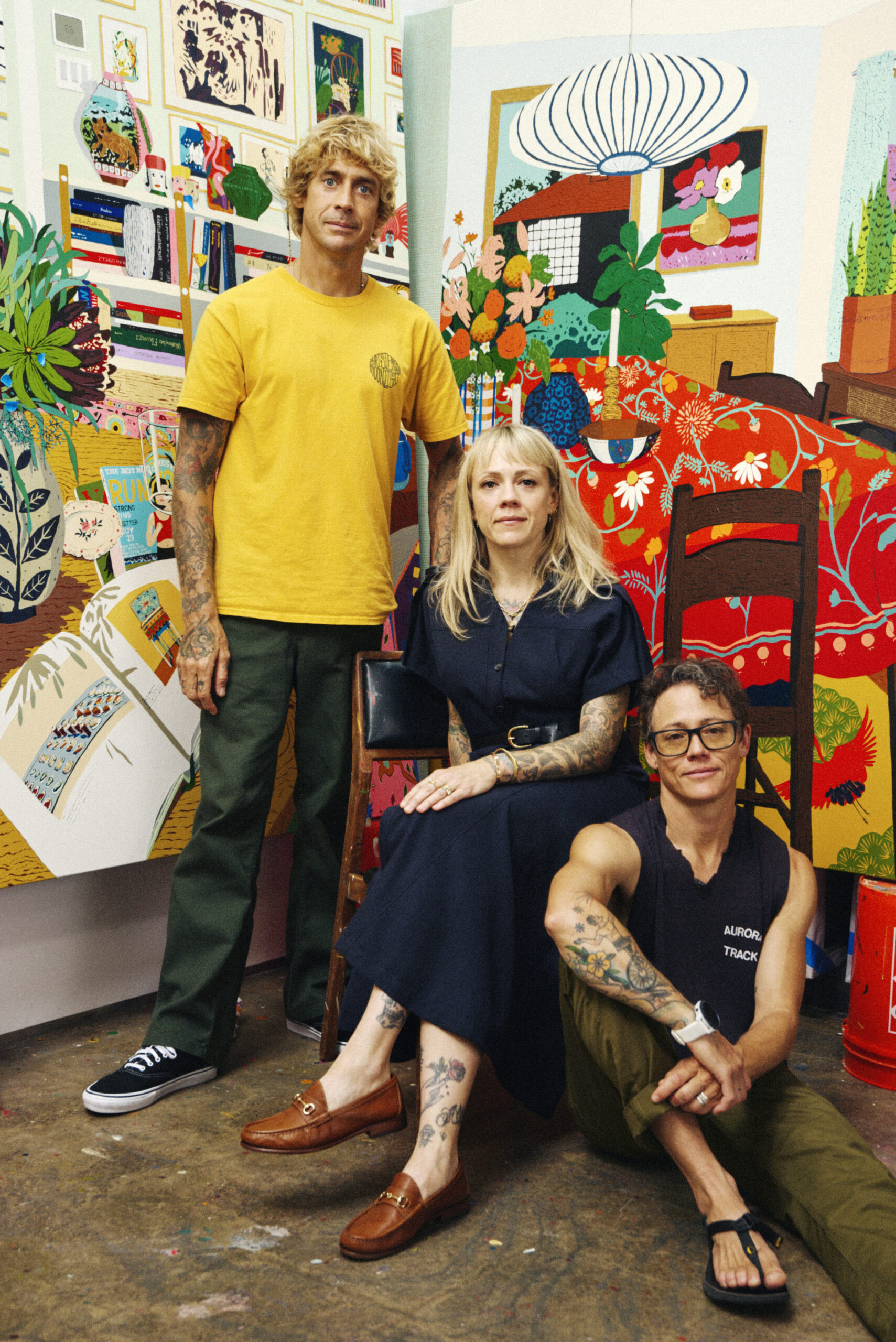
Tolstoy said that happy families are all alike, but what about the super high-performing ones? On an acid-bright Saturday morning on the east side of Los Angeles, the siblings Pecis — James Pecis, Hilary Pecis and Elliot Magic Paynter — all three trim, tattooed and full of kinetic energy, have been up for hours. Hilary and Elliot have already run 16 miles, going out for a 5 am jog around the perimeter of Griffith Park and then racing each other home to Hilary’s place in Eagle Rock to see who would get the first shower (answer: Elliot). James has been up since 4 am (“coffee and emails”), as he is most mornings.
“I think we’re all a bit extreme,” admits James. “We are, I don’t want to say, over-achievers… but we get intense. Our family is really intense.” The youngest sibling, Elliot Magic, hops over to gently offer an alternative take: “I like to say that we have a lust for life. We’re also insanely competitive.”
Although they talk every day, it is far from every day that this tight-knit clan gets together. In fact, this morning, assembled at Hilary’s light-filled painting studio for a family portrait, is the first time they’ve all three been in the same place at the same time in over six years.
I’m pretty sure we are all each other’s
biggest fans.
Elliot Pecis
James, who bounces between Costa Rica, New York, LA and Paris, is known as much for his laid-back laconic style and tousled surfer-guy appeal as for his undeniable talent with hair. One of fashion’s most in-demand editorial hairstylists, he has masterminded the looks backstage at shows from Chanel to Thom Browne, styled magazine covers for Hailey Bieber, Billie Eilish, and Scarlet Johansson and campaigns for Chloé, MAC and Marc Jacobs. Last year, he and his wife, Kim Norcott, launched Blu & Green, a toxin- and plastic-free haircare brand inspired by the beach clean-ups they were doing at their home base on the Nicoya Peninsula.
His older sister, Hilary, an artist based in Los Angeles, has seen her career take off over the last few years, with her graphic, color-drenched landscapes and interior scenes compared to the work of David Hockney and Jonas Wood, and now in the permanent collections of the National Gallery of Art, LACMA, SFMOMA and the Museum of Fine Art Boston. Works in progress for upcoming global art fairs line her studio’s walls, as do towering blank canvases earmarked for her solo show at the David Kordansky Gallery in LA next May. While all three Pecises are creatively gifted, Hilary has an effortless talent that James describes as shooting out of her fingertips. When her work started gaining acclaim, she and James started a competition to see who would get the most magazine covers. James is definitely winning, but, “I do have one!” hollers Hilary. “There’s a transition happening here,” teases James. “We have a really rare last name — super-rare — and a year or two ago, all of a sudden when you Google ‘Pecis,’ she comes up first!”
The youngest sibling, Elliot, who neatly sidestepped the above when they took their wife’s surname, is an extreme athlete who campaigns for non-binary representation in marathons and teaches middle school science in Taos, New Mexico. They are toying with running an ultra-marathon, and once biked from Key West to San Diego just to prove that they could. “I just keep moving,” they shrug. Elliot and Hilary have run nine marathons together and are currently training for the California International Marathon in December, where they’ll run from Folsom Dam to the state capital in Sacramento. The siblings come by their aptitude for pushing their physical limits honestly: Their mother, at 74, can still hold a two-minute plank.
The Pecises grew up in Redding, California, in the state’s northernmost reaches. They were self-starting kids who would BMX-bike themselves everywhere they wanted to go. Their mother was a social worker, and their father was a narcotics agent whose attire would change from a “dirtbag handlebar mustache” to a more government-gig-appropriate suit and tie, depending on the day. “He had a bag with a million dollars in cash in it once,” Elliot says. “He had a racquetball case with a machine gun in it,” James adds. “There was a short time where we had an electric blue Firebird, and I was mortified,” recalls Hilary. “People did not drive Firebirds there.”
“There’s something really nice about siblings,” she reflects. Especially ones who innately understand the instinct to constantly level up, or compete, even if it’s just against oneself. “It’s hard sometimes to celebrate your achievements, and to know who to celebrate with.” James agrees: “If I win an award, or get a cover, I know she’ll understand. None of my friends can say that without sounding like I’m bragging.” Elliot smiles. “We are all each other’s biggest fans, I’m pretty sure.”
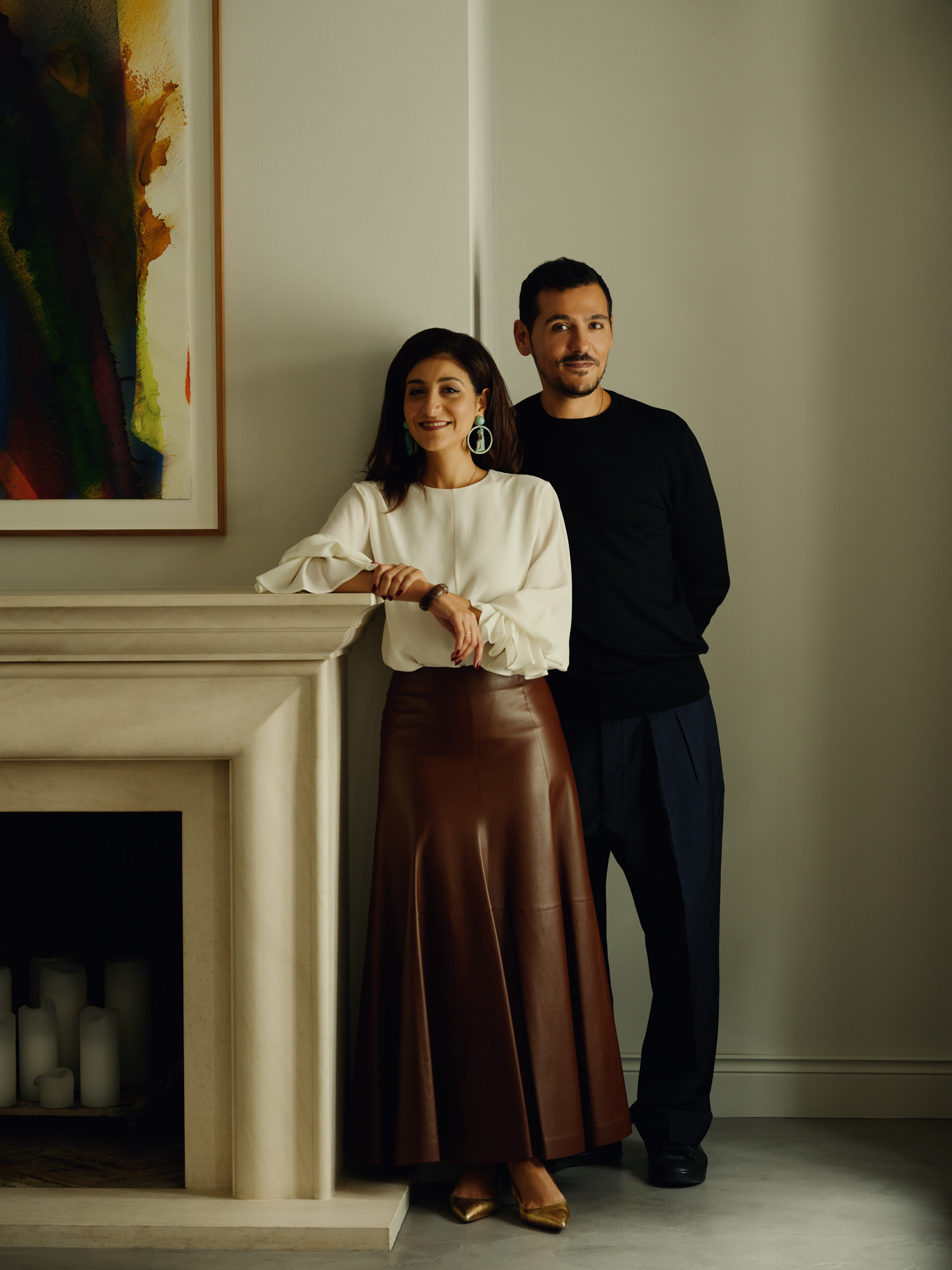
PHOTOGRAPHY ROBERT RIEGER, FEATURING TAREK SHAMMA AND YASMIN HEMMERLE
TAREK SHAMMA AND YASMIN HEMMERLE
By Rachel Garrahan
Tarek Shamma and Yasmin Hemmerle grew up in a close-knit family in Cairo where the influence of their art-loving maternal grandfather set them on the creative paths they are still pursuing today.
Shamma, is a rising star architect who trained in London at Zaha Hadid and David Chipperfield before establishing his own studio in 2015. After 20 years in Europe, he is based back in Cairo, having made a name for himself with elegant projects combining artisanal craftsmanship and imaginative whimsy for the likes of Christian Louboutin. Hemmerle, 42, runs the eponymous jewelry house with her husband, Christian, creating bold contemporary pieces that blend rare gemstones and unexpected materials such as iron and wood. The 130-year-old family jeweler’s one-of-a-kind creations are made in Munich each year, are sought after by art collectors and sit in the permanent collections of the V&A and The Met.
Before the toppling of King Farouk in 1952, the siblings’ grandfather, Mina Sarofim, had been a ‘gentleman farmer’. After the Egyptian Revolution he worked for Unesco in France and later opened, together with their mother and aunt, an art gallery in Cairo supporting contemporary local artists. “He was very aware of the privilege of his own education and he wanted to help others,” says Shamma who also admired Sarofim’s egalitarian approach to collecting. “He never differentiated between art with a capital A and the decorative arts.” Not only that but their grandfather himself was always creating, whether it be designing jewelry for their grandmother, or collages and paintings made up of found objects.
“One day we were driving in Cairo and all of a sudden he tells the driver to stop and he picks up this massive tire from the street that was totally flat,” Hemmerle recalls with a smile. The resulting artwork hangs today in the siblings’ aunt’s home in Switzerland, just as his other work is displayed in their own homes. “He was always doing something, and it was always about aesthetics and making. That had a huge influence on Yasmin and I growing up,” says Shamma.
Despite this, Hemmerle initially had no ambition to establish a creative career. She followed her brother to London for university, he at the Architectural Association School of Architecture, she at the European Business School. It was there that she met her husband and, after doing an internship with Messika in Paris, realized her aesthetic leanings could blossom in jewelry. “I realized I’ve always loved it and I’ve always been surrounded by it,’ she says. ‘I’ve also always wanted to work with my husband so I think it was the combination of the two.”
Hemmerle credits her grandfather with her appreciation today for the found objects that make their way into Hemmerle jewelry, such as a 19th century agate Medusa cameo or a pair of unexpectedly beautiful speckled beach pebbles. Shamma is the same. His work is characterized by a sensitivity to location, history and craft. La Folie, the three-story ‘party tower’ he created for Louboutin in the hideaway Portuguese resort of Melides features local handmade tiles and exterior walls rendered with local sand so that the building effectively disappears into the landscape. Shamma’s meticulous design, furniture and interior detailing for the elegant 50-meter Yalla Nile river boat incorporates thousands of years of Egyptian history and craft including Pharaonic, Coptic, Islamic and modern. “Everything is so well thought-out, it’s exquisitely beautiful,” says Hemmerle, who herself has commissioned her brother to design elements of the Hemmerle atelier. The admiration is mutual. “What I love about Hemmerle’s work is that they first find interesting materials, interesting stories, and they work from there. It’s much more powerful than working with a preconceived design,” says Shamma.
Despite constantly traveling for work, they pair speak every day. “We are blessed to both have clients who appreciate the care that goes into making something that shows the trace of the human hand,” says Shamma. “It’s precisely that object’s imperfections that give it soul and make it beautiful.” Their grandfather would undoubtedly agree.
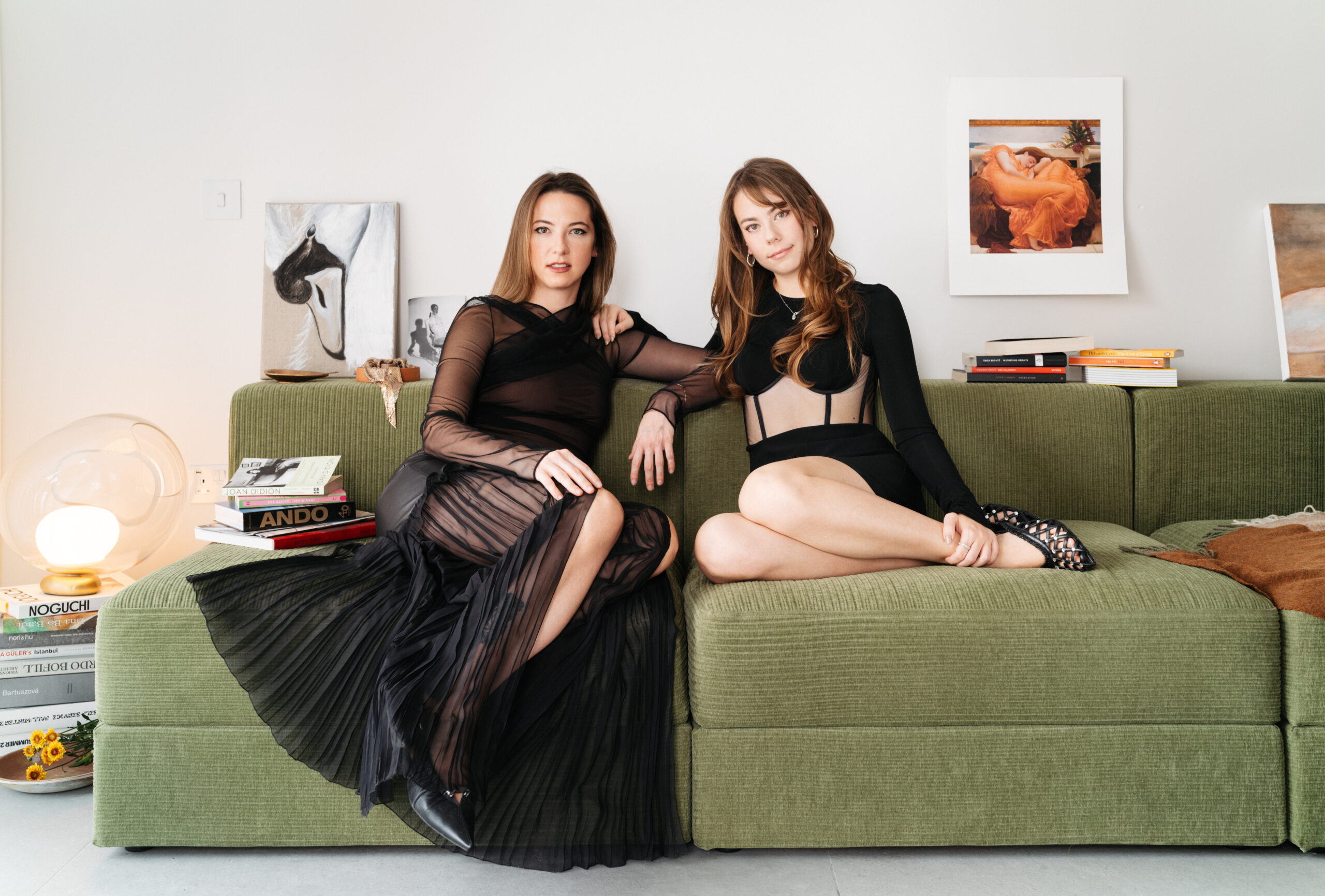
PHOTOGRAPHY LEWIS RONALD, FEATURING NENSI AND SINDI DOJAKA
THE DOJAKA SISTERS
BY TISH WEINSTOCK
Despite being born seven years apart, Nensi and Sindi Dojaka share the kind of bond you only really see with twins; a witchy synergy that allows them to finish each other’s sentences and even once saw them independently, almost telepathically, preoccupied with the same subject: swans. “It was totally random,” says Nensi, the older of the two. “I’d been looking at this photograph of a swan by Francesca Woodman,” interjects Sindi. “And I’d had this image of a woman giving birth to a swan in my head,” adds Nensi, “And so we both started painting pictures of swans. They even look good together color-wise.” While this kind of psychic energy may seem unusual given their age gap, when you consider their mirror-image upbringing, it all begins to make sense.
Born in Albania, they both went to the same school; were taught by the same teachers; were proficient in maths (“we’re quite nerdy,” jokes Sindi) and yet had keen creative sensibilities (“although, I think maths can be quite creative,” says Nensi); and both moved to London at the age of 16.
Despite being encouraged to pursue architecture by her parents, Nensi found herself drawn to fashion. In 2019, she emerged with an MA from Central Saint Martins and began showing as part of the Fashion East incubator. Celebrated for her feminine aesthetic and architectural designs — lots of intricate strap-work and cut-out detailing — within a year, her work was being worn by Dua Lipa, Rihanna, and Bella Hadid. In 2021, she was awarded the LVMH prize and today remains a staple of London’s creative scene.
Torn between science and the arts, Sindi, however, decided to pursue architecture. Graduating from the Architectural Association in June this year, she is currently working on getting her license. “I am still exploring different styles,” she says. “Every site, every context, needs a different approach.”
For me, sisterhood is about alliance and reliance. She’s the first person I go to for everything. There is no one I trust more.
Nensi Dojaka
Aside from career paths, they also differ in temperament. “I am very rational and pragmatic,” says Sindi. “Whereas I am much more emotional,” adds Nensi. Which is precisely why they work so well together. In fact, earlier this year, they collaborated on a special pop-up space in Harrods. “It felt very organic and easy, we trust each other to do our own thing,” says Nensi. “I always know what Nensi is looking for,” adds Sindi. “Working together feels like another level of sisterhood.”
Humor is another cornerstone of their relationship. While a lot of their daily conversations include artistic references, most of what they share is memes. “Although she doesn’t think I’m funny,” says Nensi. “She thinks I’m cringe. “Nensi is funny in her own way,” Sindi laughs. Another defining feature of their relationship is a small cat named Angus, which they take turns hosting at their apartments; they live a four-minute walk away from each other in central London’s King’s Cross.
“For me, sisterhood is about alliance and reliance,” muses Nensi. “I agree,” says Sindi. “She’s the first person I go to for everything. There is no one I trust more.”
The art of understatement: Jacqueline Rabun and the enduring appeal of minimalism The art of understatement: Jacqueline Rabun and the enduring appeal of minimalism
The art of understatement: Jacqueline Rabun and the enduring appeal of minimalism
A photographer’s love/hate relationship with Seoul A photographer’s love/hate relationship with Seoul
A photographer’s love/hate relationship with Seoul
Tems on why protecting her peace has become her greatest success Tems on why protecting her peace has become her greatest success
Tems on why protecting her peace has become her greatest success
“I’m obsessed with pop music and think I will be forever”: Troye Sivan on new album She’s the Best “I’m obsessed with pop music and think I will be forever”: Troye Sivan on new album She’s the Best
“I’m obsessed with pop music and think I will be forever”: Troye Sivan on new album She’s the Best
Edward Enninful on the enduring impact of the 90s Edward Enninful on the enduring impact of the 90s
Edward Enninful on the enduring impact of the 90s
Topjaw’s Jesse Burgess on Gordon Ramsay, Michelin stars and building a food empire online Topjaw’s Jesse Burgess on Gordon Ramsay, Michelin stars and building a food empire online
Topjaw’s Jesse Burgess on Gordon Ramsay, Michelin stars and building a food empire online
How Lima’s young creatives are using fashion as an act of resistance How Lima’s young creatives are using fashion as an act of resistance

How Lima’s young creatives are using fashion as an act of resistance
Glen Luchford revisits his photographs that captured the spirit of the 90s Glen Luchford revisits his photographs that captured the spirit of the 90s