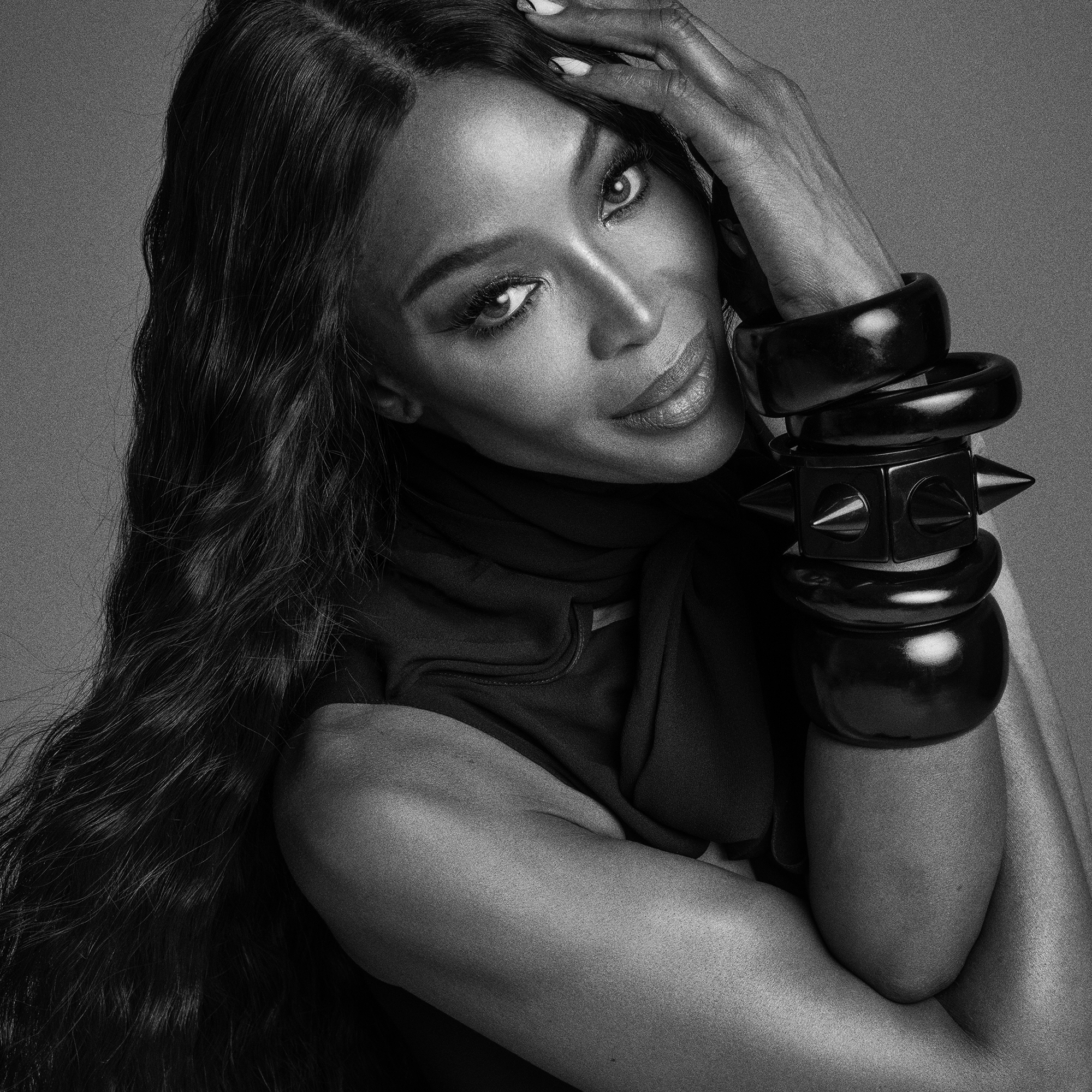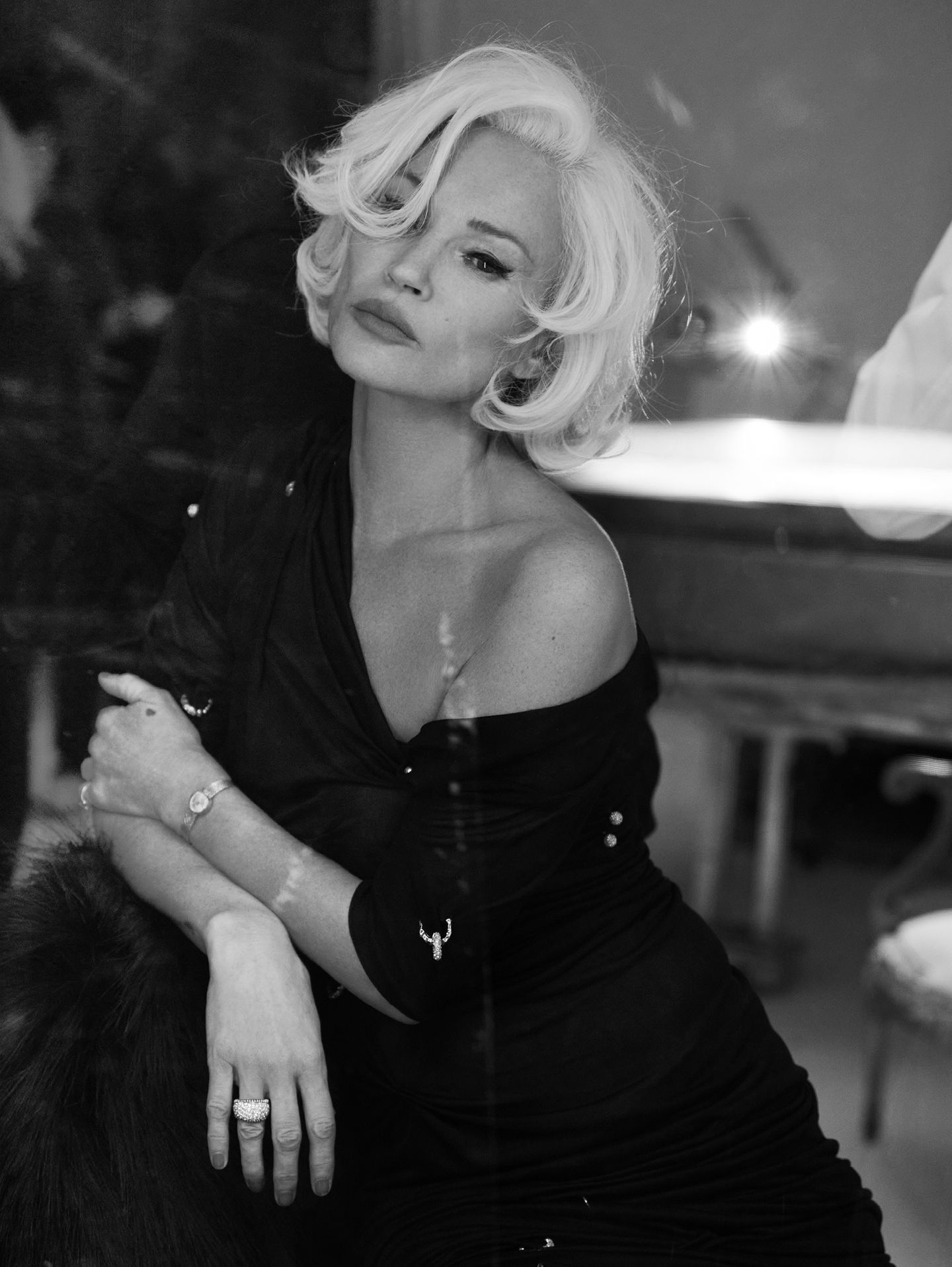
Nearly 40 years on, Kate Moss is still the model of the moment
Photography by Nick Knight
When Demna Gvasalia unveiled his debut collection for Gucci, one moment eclipsed the rest: the return of Kate Moss to the runway. Nearly 40 years after launching her career, the British supermodel’s cultural power is still as magnetic as ever.
Demna Gvasalia’s debut collection for Gucci was one of the most anticipated debuts of the Fall/Winter 2026 season — and it delivered, in no small part, thanks to a certain supermodel’s return to the runway. As with any designer arriving at a storied house, the show revealed much about his vision for its future, not only through the clothes but through the people chosen to wear them. The set unfolded like a museum, complete with Romanesque sculptures and populated by a cast of contemporary archetypes: models of the moment including Anok Yai and Alex Consani, alongside rappers Fakemink and Nettspend and even Canadian football player Gavin Weiss.
Yet, it wasn’t until the final look that the show’s central protagonist appeared. Down the spotlit runway slinked Kate Moss, like a Fellini heroine, in a shimmering black backless gown revealing a jewel-encrusted double-G thong. The look nodded to the sex, sequins and unapologetic glamour of Tom Ford’s 1990s Gucci, an aesthetic Moss helped define. Who could forget the blue satin blouse and velvet trousers she wore on the Fall/Winter 1995 runway, later plucked by Madonna for the MTV Video Music Awards? In that moment, the message was unmistakable: if Demna’s Gucci was a museum of the future, Moss — nearly four decades into her career — remained its most compelling living exhibit.
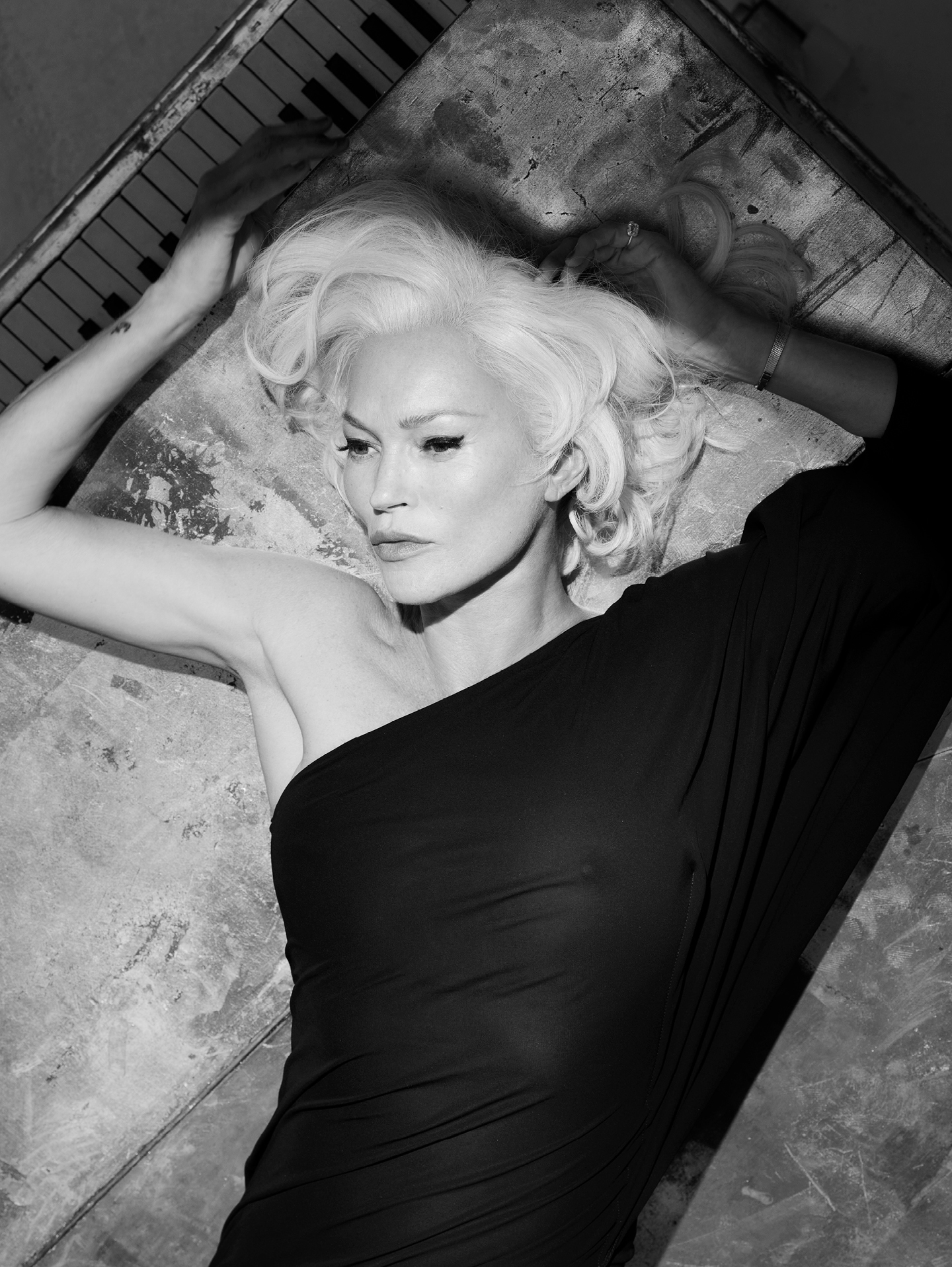
JERSEY DRESS, GUCCI
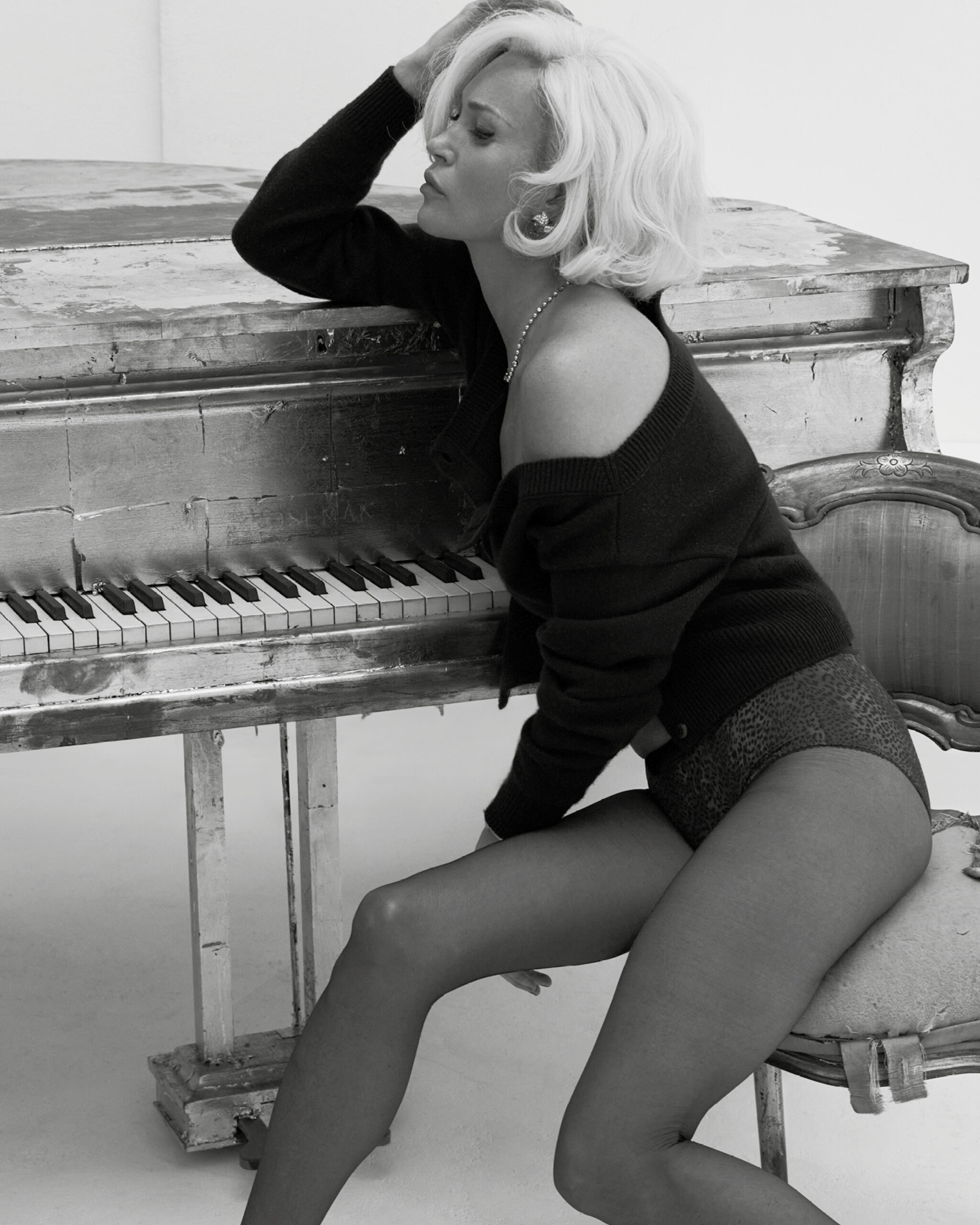
KATE WEARS CASHMERE CARDIGAN, TOM FORD. SYNTHETIC-MIX BRIEFS, FRUITY BOOTY. SHOES, KATE’S OWN. PLATINUM, GOLD AND DIAMOND NECKLACE, JESSICA MCCORMACK. PLATINUM, GOLD, BLUE ZIRCON AND DIAMOND EARRINGS, TIFFANY & CO. TIGHTS, STYLIST’S OWN
Moss’s presence was not confined to Gucci this season. During Paris Fashion Week she appeared front row at Tom Ford, now under the creative direction of Haider Ackermann, and at Saint Laurent, houses with which she has long been associated. Outside the Ritz, her unofficial home in the French capital, photographers still gather in the hope of catching a glimpse of her, rarely dressed head-to-toe in one designer look but in an assemblage of archival and contemporary pieces.
Born in Croydon in 1974 to a travel-agent father and a barmaid mother, Moss rose from far beyond fashion’s traditional centres to build one of the most prolific careers in its history. She has appeared on the cover of British Vogue around 40 times — five of them under the editorship of EE72 founder Edward Enninful — and fronted thousands of campaigns, most notably for Calvin Klein’s Obsession perfume, which made her a household name. On the runway she has demonstrated rare versatility. Few models can embody the savage beauty of Alexander McQueen, the exuberant theatricality of John Galliano, the serene restraint of Jil Sander, the rebellious spirit of Vivienne Westwood or the conceptual artistry of Rei Kawakubo. As her longtime friend and collaborator Sam McKnight puts it: “If you go to fashion shows now and look at the mood boards backstage I guarantee there will be at least one picture of Kate Moss pinned up somewhere.”
If you go to fashion shows now and look at the mood boards backstage, I guarantee there will be at least one picture of Kate Moss pinned up somewhere.
Sam McKnight
Beyond modelling, Moss has sat for artists including Chuck Close, Lucian Freud and Marc Quinn, and appeared in music videos for Elton John, Paul McCartney and Marianne Faithfull. In 2016 she established the Kate Moss Agency, mentoring a new generation of talent including her daughter, Lila Moss, alongside male models Louis Baines and Paul Hameline. The bestselling collections she designed for Topshop between 2007 and 2010 continue to surge on resale sites.
So what explains Moss’s extraordinary longevity, especially in an industry defined by constant change?
As the make-up artist Val Garland, who worked with Moss on EE72’s cover story told us over email: “I know her as ‘Kate The Great’ – she always delivers. Icon is too small.” Fellow make-up artist Charlotte Tillbury, who has worked with Kate since the 90s agrees. “Kate is the face of a generation. She’s magnetic, she’s a style icon, but her influence transcends beauty and fashion — she is a tastemaker who has truly shaped culture. Kate has such a unique magnetism on set — there’s a magic that happens when she’s in front of the camera. The way she moves, the way she morphs into character, it’s truly something to behold. She has the most powerful authenticity — there’s only one Kate.”
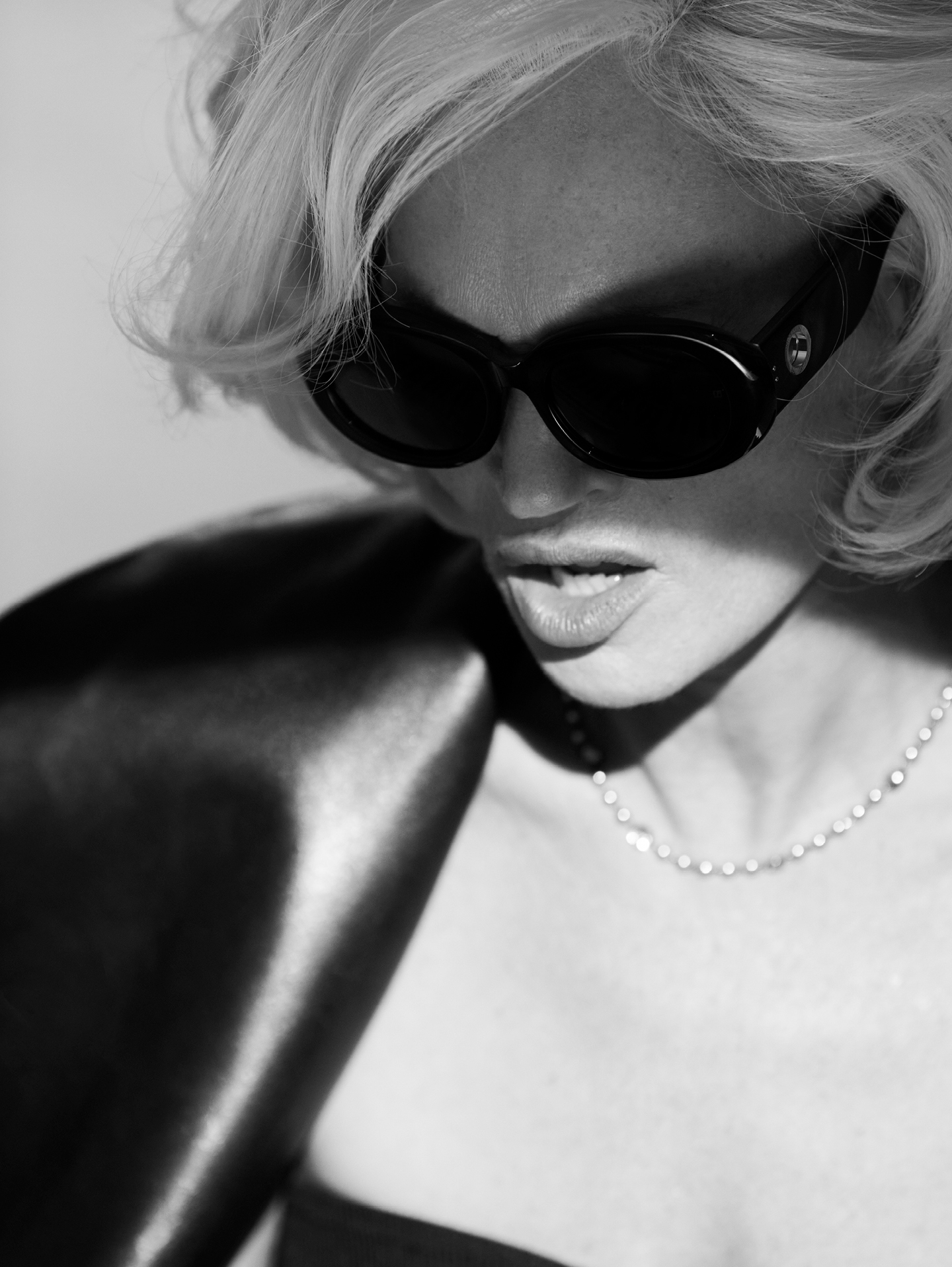
KATE WEARS LEATHER JACKET PHOEBE PHILO. PLATINUM, GOLD AND DIAMOND NECKLACE, JESSICA MCCORMACK. RECYCLED-ACETATE SUNGLASSES, LINDA FARROW
I know her as ‘Kate The Great’ – she always delivers. Icon is too small.
Val Garland
Yet if Moss’s staying power is remarkable, her rise was equally improbable. In 1988, Sarah Doukas, who had co-founded Storm Model Management in London the previous year, first spotted her at New York’s JFK airport, where the then 14-year-old was stranded with her family after their flight from Miami to London was redirected. The terminal was packed with standby passengers scrambling for seats home. “It was chaos,” Doukas recalls. “People everywhere, and my eye zoomed in like a camera amongst all this madness. I just saw this fantastic looking girl sitting on a suitcase.”
At around 5ft 6in, Moss was several inches shorter than the height most agencies demanded at the time. But what caught Doukas’s attention was not just her wide-set eyes, delicate nose and cupid’s-bow mouth — features whose near-mathematical balance recalled the classical “golden ratio” associated with aesthetic harmony since ancient Greece — but something more instinctive. “She was just real, didn’t need make-up,” Doukas says. “She had this positivity that felt like a breath of fresh air… an incredible energy and aura about her.”
From the outset, Moss herself was aware that she did not fit the preordained supermodel mould. “I can’t do pictures with all the other girls when we’re in a line,” she said in a 1992 backstage interview. “I like walking in platforms because they make me taller.” At the time, fashion was still dominated by glamorous, unattainable supermodels, and Moss represented something entirely different.
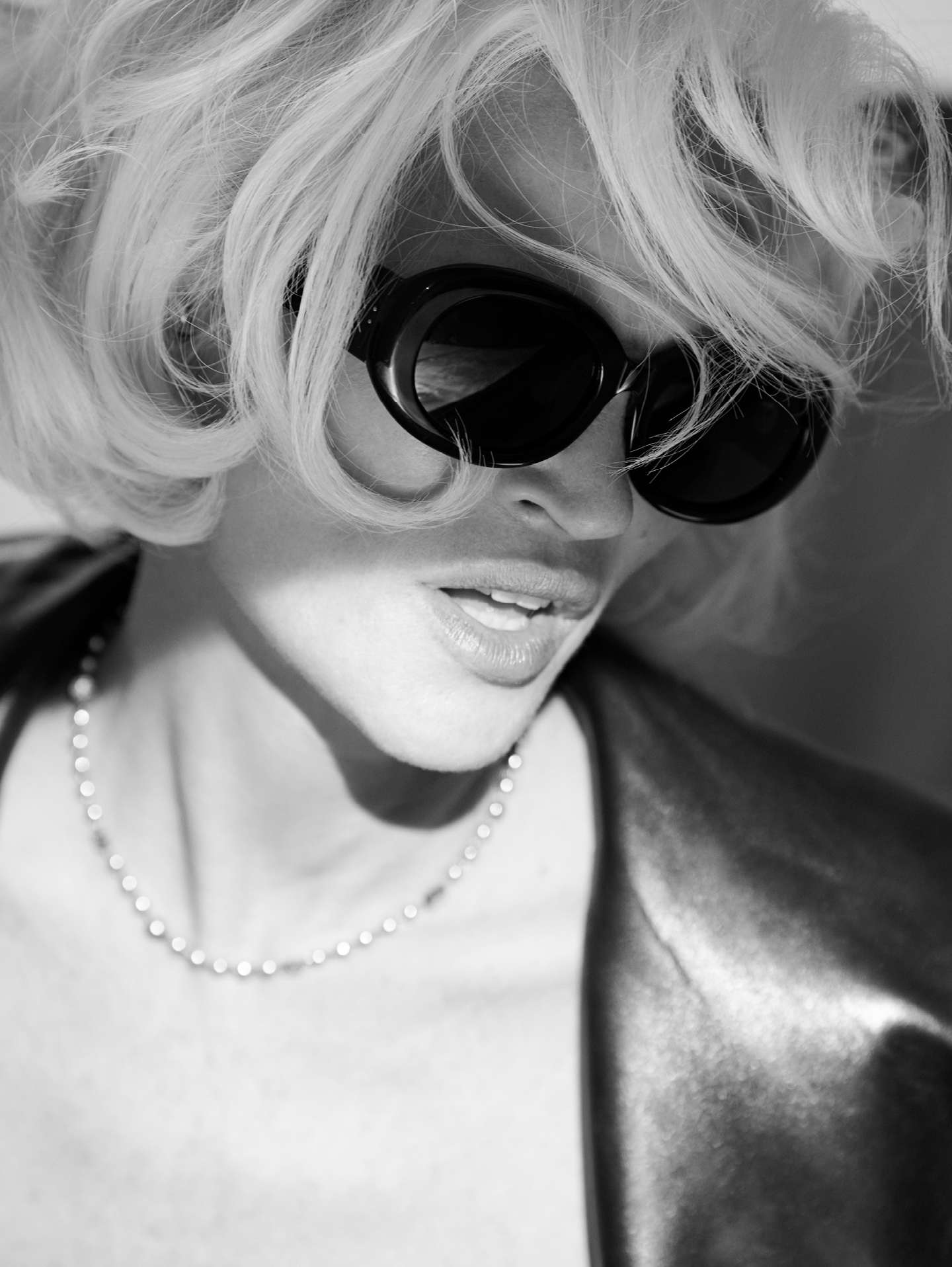
KATE WEARS LEATHER JACKET PHOEBE PHILO. PLATINUM, GOLD AND DIAMOND NECKLACE, JESSICA MCCORMACK. RECYCLED-ACETATE SUNGLASSES, LINDA FARROW

KATE WEARS DRESS AND SHOES, KATE’S OWN. STOLE, VINTAGE
Kate was just real, she didn’t need make-up. She had this positivity that felt like a breath of fresh air… an incredible energy and aura about her.
Sarah Doukas, FOUNDER STORM MODELS
The sartorial rupture Moss created marked the end of the voluminous blowouts, saturated make-up and oversized shoulder pads of the 1980s. In their place came the stripped-back minimalism and bare-faced aesthetic of the early 1990s, crystallised in Corinne Day’s portraits of Moss for the cover of The Face and the equally iconic Obsession campaign lensed by Mario Sorrenti. Calvin Klein had been struggling financially at the time, but by the end of the decade the company had returned to strong profitability — fuelled significantly by those images.
That cultural moment has recently been revisited in Ryan Murphy’s Love Story, which dramatises the romance between John F. Kennedy Jr. and Carolyn Bessette, then a Calvin Klein publicist. Alongside art director Fabien Baron, Bessette persuaded Klein to cast Moss in a daring underwear campaign opposite Mark Wahlberg. In one scene, Klein hesitates, noting that Moss is “cute” but that no one knows who she is. Bessette responds: “She’s almost unknowable. She’s guarded and elusive. She’s not trying to sell you anything or ham it up for the camera. She gives you just enough, because she knows better than to give it all away.”
Although fictionalised, Bessette’s description captures something essential about Moss’s enduring appeal: a sphinx-like trait that has long set her apart in a culture obsessed with exposure. Unlike many of her contemporaries, Moss rarely gives interviews and has largely resisted the pull of personal social media. “Kate’s not vain,” McKnight says. “She’s not looking in the mirror all the time. She’s just in the moment.” That sense of mystery only heightens the impact of her appearances.
The designer Bella Freud reflects on how encounters with Moss retain the power of a first impression. “I remember seeing her in Paris,” she says. “I was looking out of the window of a car and saw this incredibly pretty girl walking down the street with a beautiful young man pushing the hair back from her face. They looked like kids from Badlands.”
When Moss later walked in one of the first shows for Freud’s eponymous label, wearing a denim bikini with fringing that none of the other models had the confidence to wear, that same cinematic quality carried onto the runway. “She walked down the runway so carefree,” Freud recalls. “She had this intensity that never goes away. Moments working with Moss have a kind of memory attached to them. It’s not just an incident, it becomes a happening. She makes things happen for people and brings things to life in a way you never forget.”
Even in the early years of her career, Moss knew the graft it would require to succeed. “People think your success is just a matter of having a pretty face. But it’s easy to be chewed up and spat out. You’ve got to stay ahead of the game to be able to stay in it,” she said in a 1999 interview.
Kate has this intensity that never goes away. Moments working with her have a kind of memory attached to them. She makes things happen for people and brings things to life in a way you never forget
Bella Freud
Moss’s longevity has unsettled one of fashion’s most persistent myths: that models have an expiry date. While the industry has long prized youth, she has continued to appear on runways, campaigns and magazine covers well into her forties. As Freud notes: “Someone who’s interesting doesn’t stop being interesting. Those supermodels from the 90s were so good and they still are. Getting older brings confidence and another dimension to beauty. Kate is such a great model and she’s still got it, so why shouldn’t she work? It would feel strange if she wasn’t working, because she has so much to offer.”
In conversation with those who know Moss, certain themes recur: a voracious appetite for culture, a lust for life, a formidable work ethic and an actress-like ability to slip between characters without ever losing her own inimitable presence. Doukas remembers a teenager engrossed in Jack Kerouac novels. “She was a cultural sponge. I’d find her reciting poetry in the bar at Claridge’s. She read widely and was curious about everything.” For McKnight, Moss contains a paradox. “In many ways she doesn’t really like the camera at all,” he says. “But when she’s performing on set, something happens where the person becomes bigger than themselves.” Only a handful of figures possess that ability, he adds: “Marilyn Monroe could do it. Princess Diana could do it.”
For the viewer, the effect can be almost psychological. “There’s something about her that creates a kind of frisson,” Freud says. “I always remember Lulu de la Falaise saying that you could feel Kate’s fear and her overcoming it, and you were with her. There she is, this little thing, so composed, and you feel this tension. Kate is a great artist in that way.”
The effect Freud describes helps explain why Moss continues to occupy such a singular place in visual culture. Models come and go, trends turn over each season, yet Moss — largely stylistically unchanged, from her tousled hair to her insouciant wardrobe — remains a reference point designers return to again and again. When Demna sent her down the Gucci runway, it was not merely a nostalgic gesture but a reminder of society’s enduring appetite for characters rather than mannequins. Almost 40 years after her discovery at JFK, Moss remains a rarity: a model who can inhabit fashion’s fantasy while remaining unmistakably herself.
The Spring issue of 72 is available here
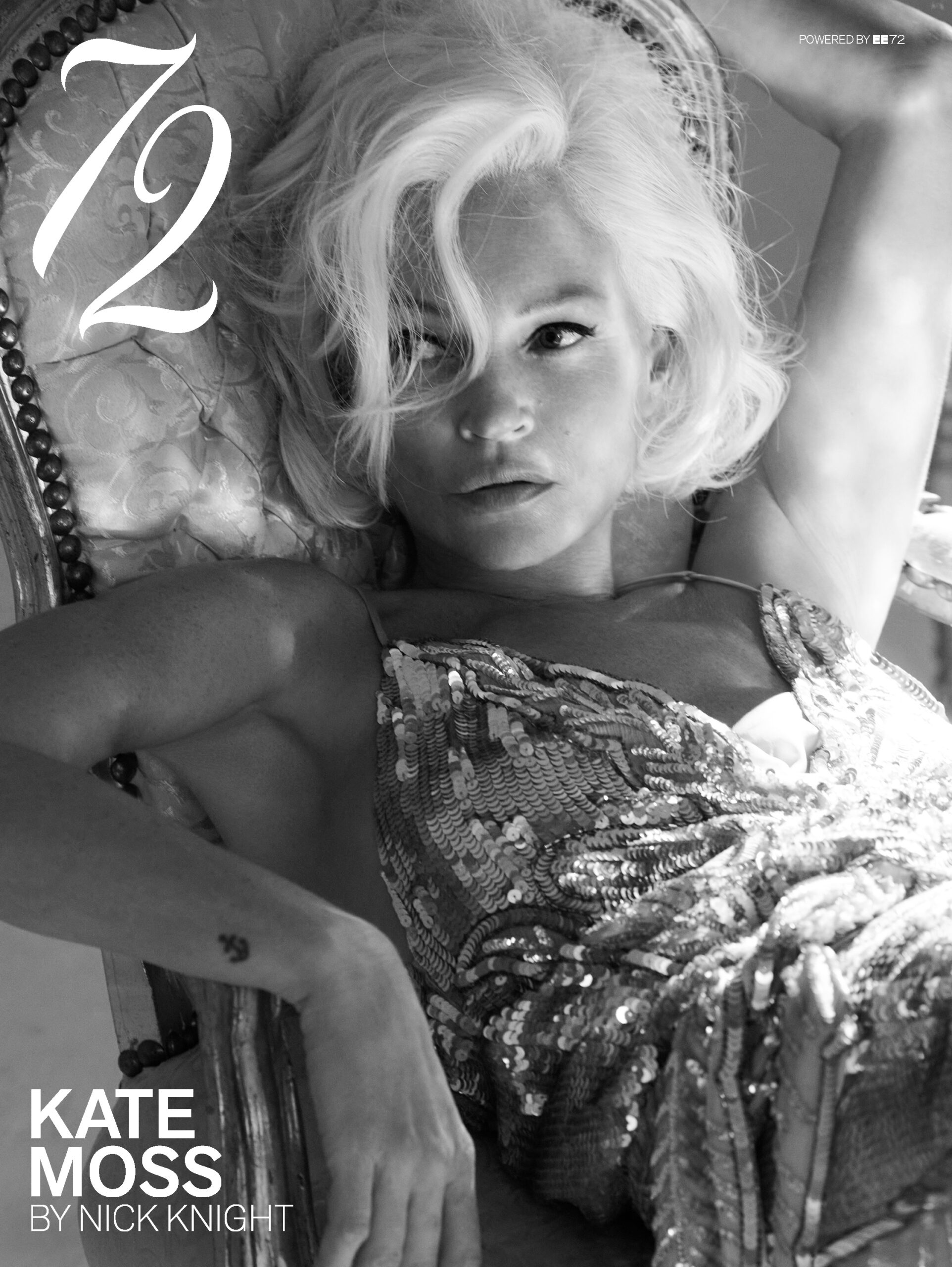
Chief Creative Officer Edward Enninful
Photographer Nick Knight
Hair Stylist Sam McKnight at Premier
Makeup Artist Val Garland at Streeters
Fashion Editor Eniola Dare
Manicurist Adam Slee at Streeters
Set Designer Andrew Tomlinson at Streeters
Creative Consultant Calum Knight
1st Photo Assistant Lara Hughes
Photo Assistant Gil Warner
Photo Intern Oldnightkid Wang
Digi Op Joe Colley
Styling Assistants Justine Domejean
Ella McKierman
Hair Assistant Valerie Benevides
Makeup Assistant Paula Maxwell
Production: Liberte Productions
Executive Producer Kat Davey
Production Team
Alice Carlet
Sidonie Barton
Retouching Epilogue Imaging
Editorial Director Sarah Harris
Chief Visual Officer Alec Maxwell
Ajus Samuel and Jacqui Hooper go big and go bold Ajus Samuel and Jacqui Hooper go big and go bold
Ajus Samuel and Jacqui Hooper go big and go bold
The second album is the hardest. Get ready for fashion’s sophomore season The second album is the hardest. Get ready for fashion’s sophomore season
The second album is the hardest. Get ready for fashion’s sophomore season
The King and I: In memory of the late Giorgio Armani The King and I: In memory of the late Giorgio Armani
The King and I: In memory of the late Giorgio Armani
Boys ‘N’ Bags Boys ‘N’ Bags
Boys ‘N’ Bags
Meet Nina Christen, the footwear designer behind a decade of viral fashion moments Meet Nina Christen, the footwear designer behind a decade of viral fashion moments
Meet Nina Christen, the footwear designer behind a decade of viral fashion moments
Hoyeon Jung looks to the future Hoyeon Jung looks to the future
Hoyeon Jung looks to the future
“Connecting with humanity is the most radical act”: Pierpaolo Piccioli on his debut collection for Balenciaga “Connecting with humanity is the most radical act”: Pierpaolo Piccioli on his debut collection for Balenciaga

“Connecting with humanity is the most radical act”: Pierpaolo Piccioli on his debut collection for Balenciaga
A tribute to British beauty, style and rebellion A tribute to British beauty, style and rebellion