Lubaina Himid brings color and community to the British Pavilion at the Venice Biennale
Photography Trisha Ward
This year, Lubaina Himid CBE RA will represent Britain at the Venice Biennale. Dominique Heyse-Moore meets her at home in Preston ahead of her career-defining moment.
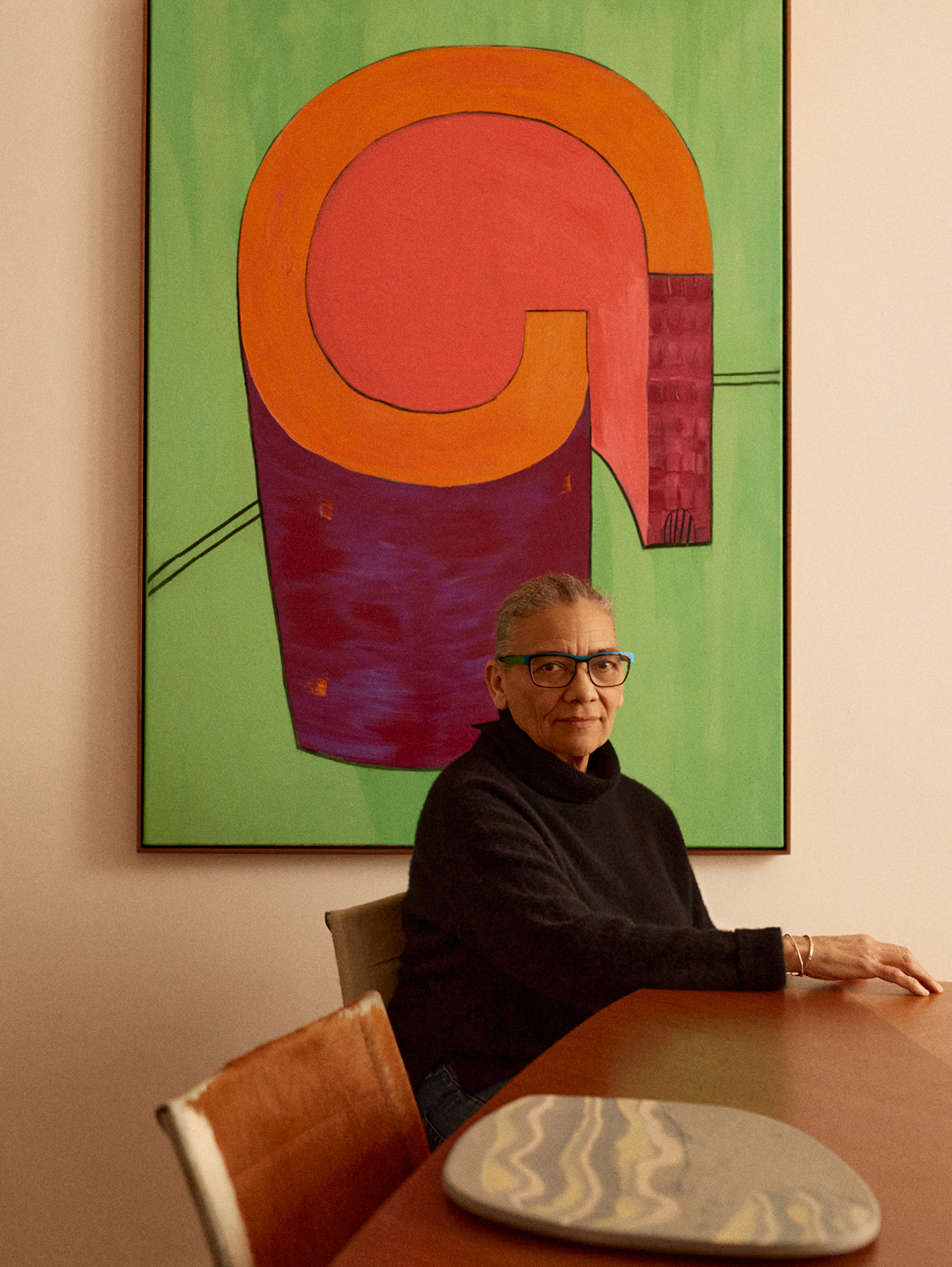
When I ask Lubaina Himid about the significance of transforming the British Pavilion at this year’s Venice Biennale Arte she answers with the pleasure of a person with a plan well realized: “In some ways I always knew it, because I had my eye on it for a very long time.” The neat neoclassical gallery is a gentle climb to the brow of a hill beside the water within the landscaped Giardini, home to the 29 permanent national pavilions of Venice Biennale. In paint, she has long reimagined spaces like this one brimming with the color, poetry, community and hospitality that the building can easily lack.
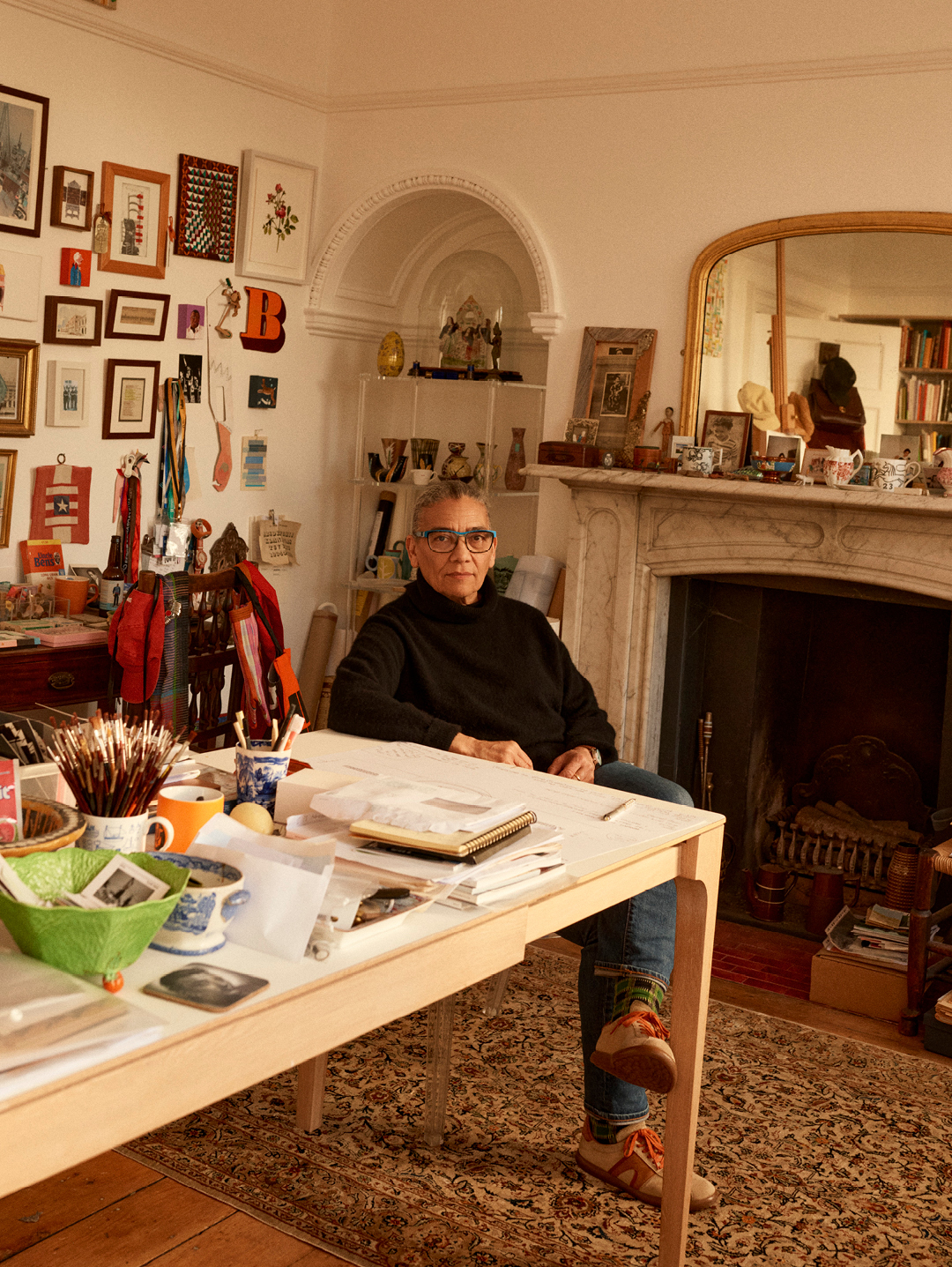
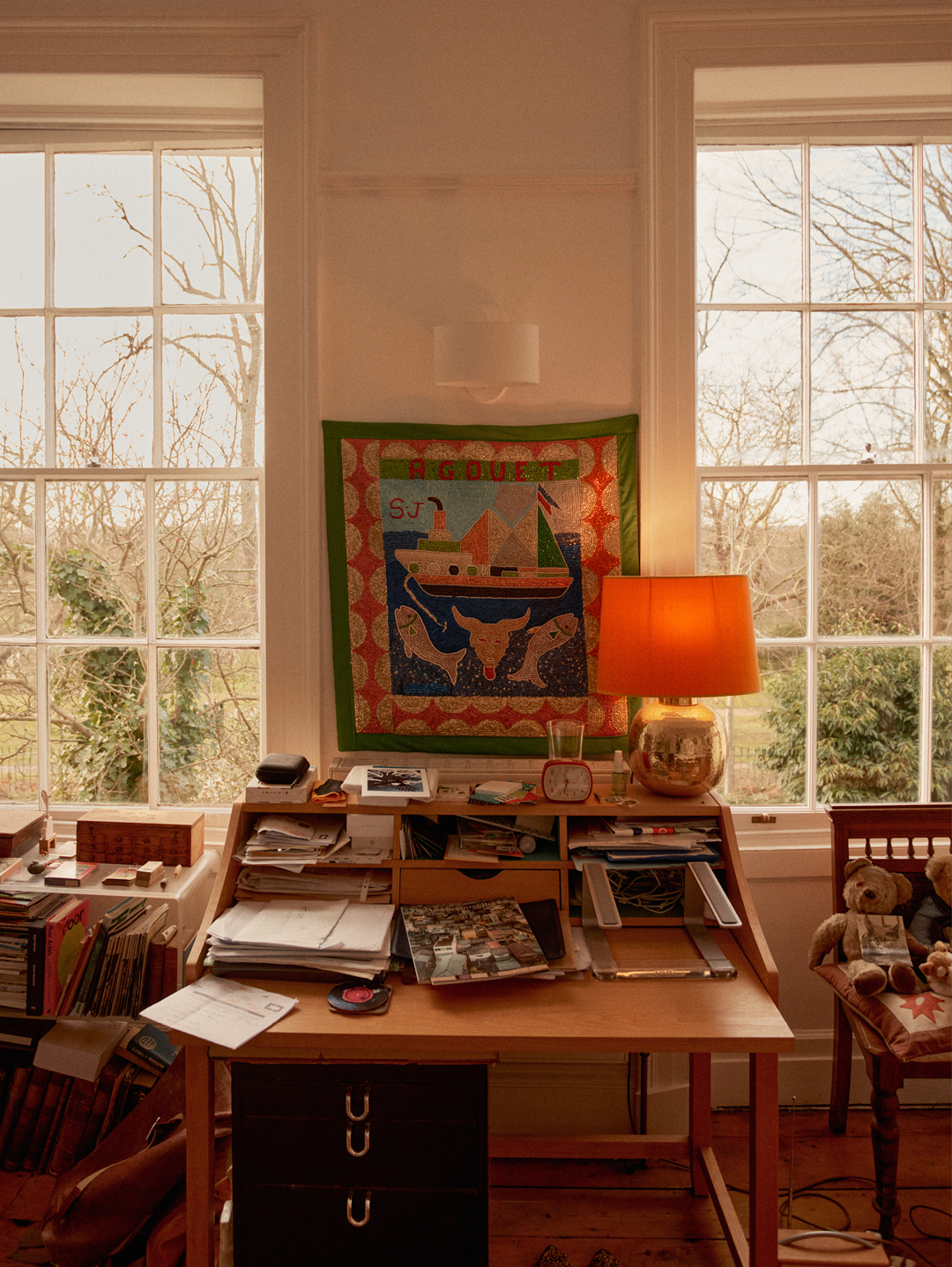
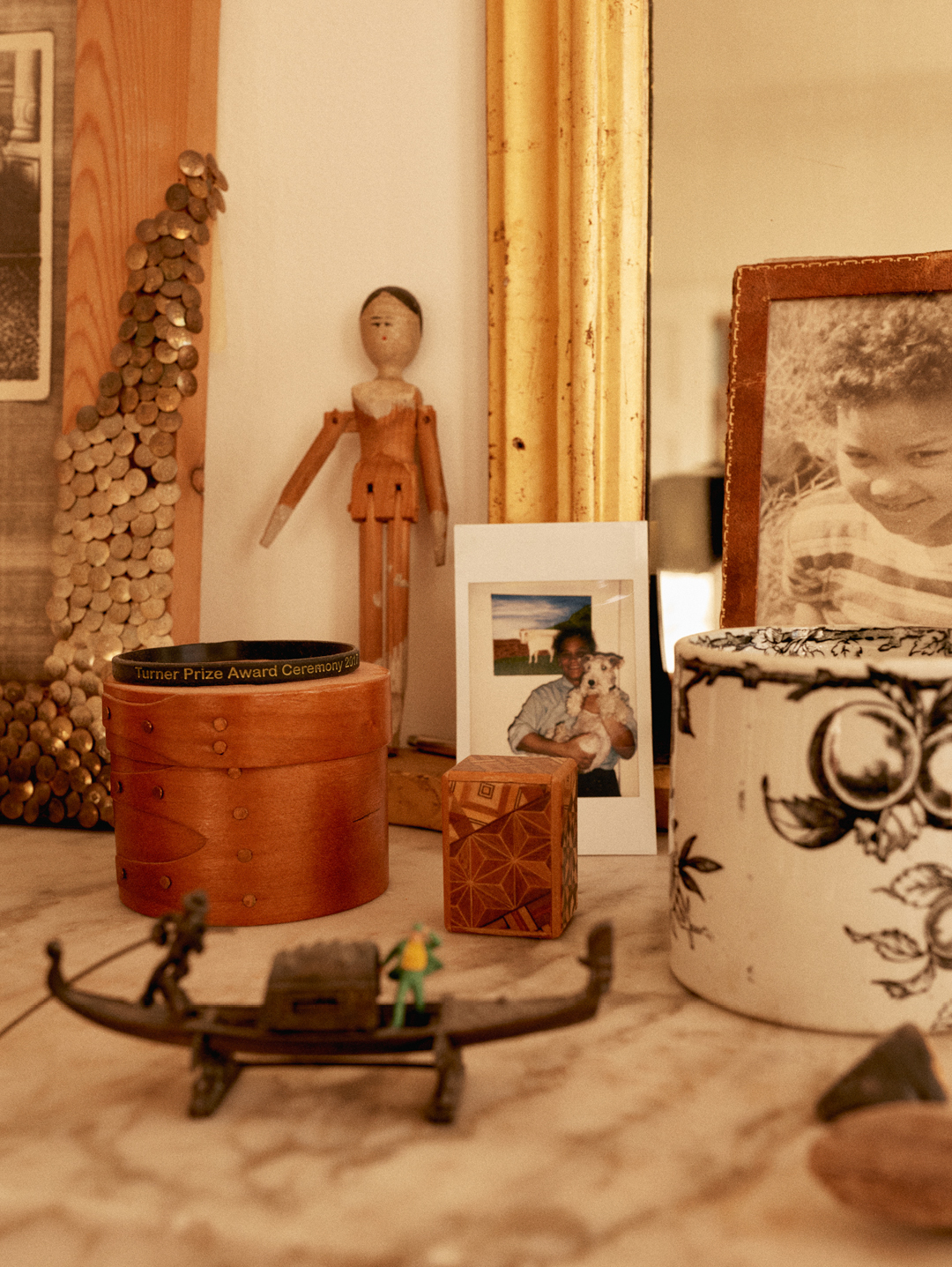
At the very end of 2025, I find the Turner Prize-winning artist just as I have always found her, in person or in photographs: Groomed, shoes polished, everything she is wearing a pleasingly good fit and quality. She is more than ready for what is to come. Her home in Preston has the same feeling, sitting within a Georgian terrace with pleasant flow and proportions, intact front gardens, and the theatricality of a rolling park and the winter sky tumbling down in front of it. “We always know, pretty much 100%, that men built the building. Without having to do any research at all, because there are very few buildings women built in the northern hemisphere. We just didn’t do it.”
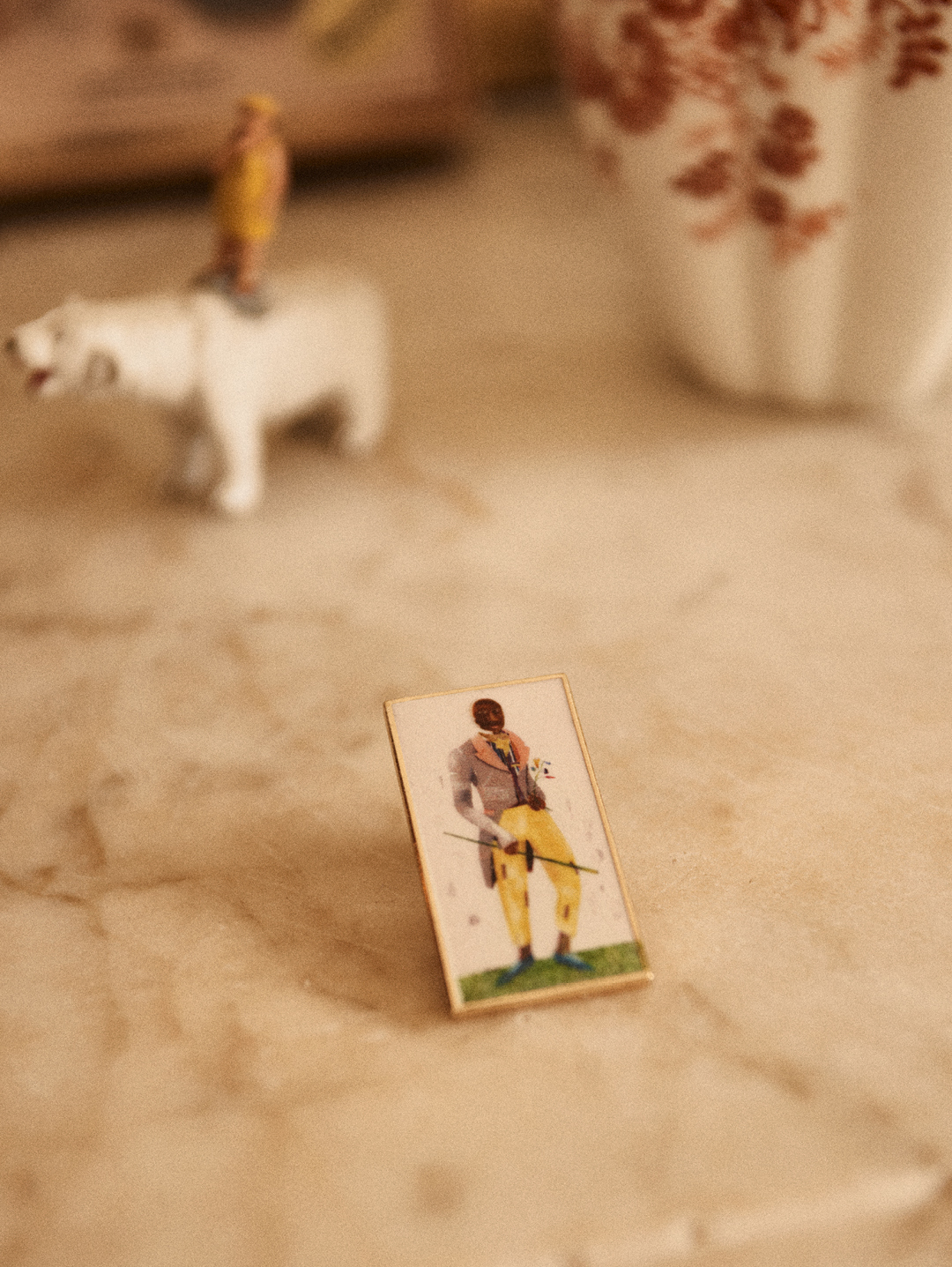
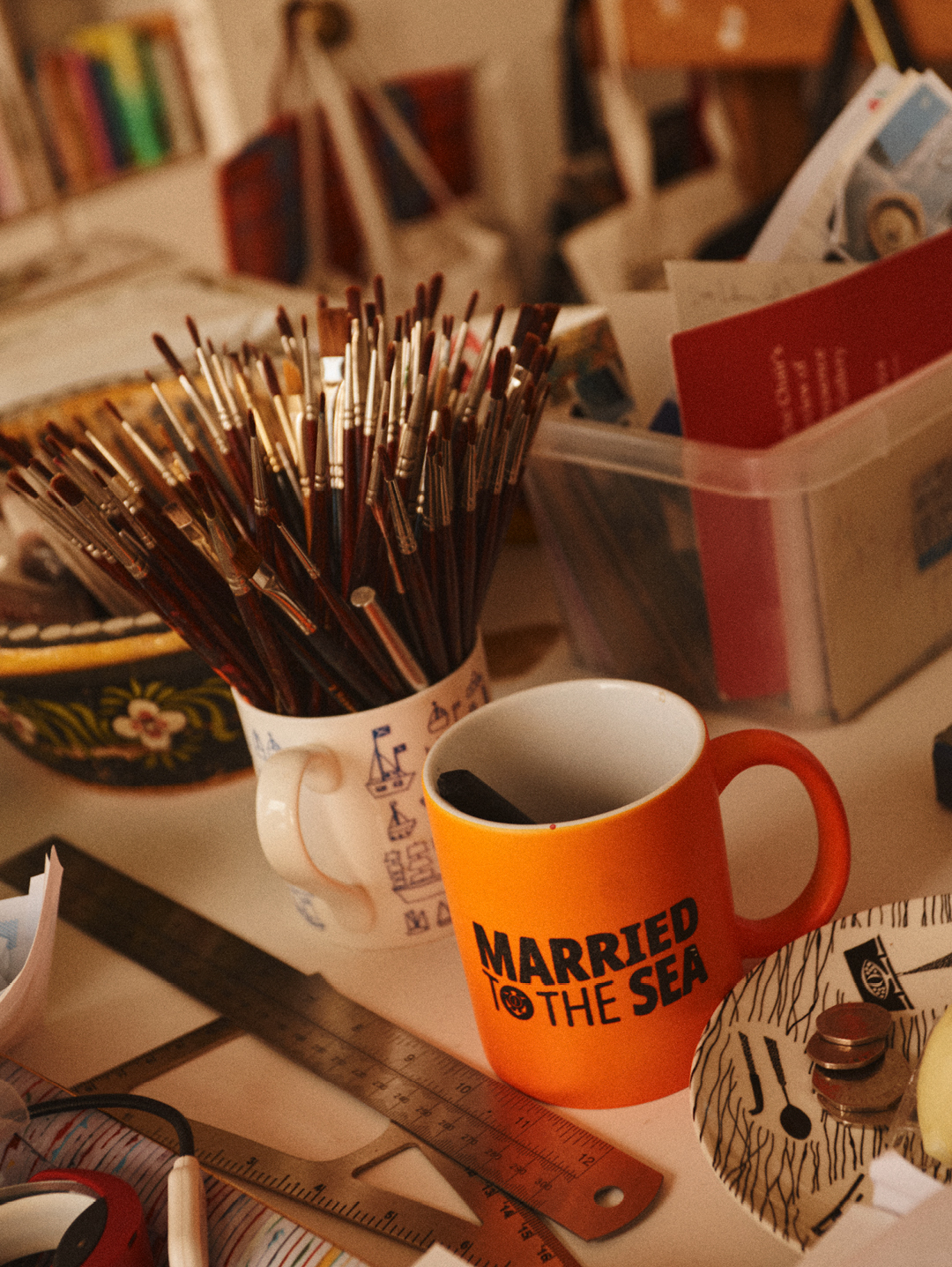
The art she has made, and that others have made, is carefully placed among the well-appointed domestic spaces. She tells me that nearly every room in the house has been an art studio at some point, but not only for Himid. Magda Stawarska-Beavan is a multidisciplinary artist, often working with sound, and she is Himid’s partner and often a collaborator. Most recently they worked together on Another Chance Encounter at Kettle’s Yard, Cambridge, in 2025. The pair are in the process of transforming a similar house directly behind this one, the gardens connecting like the spine of a symmetrical image across an open book, turning it into studios, “whereas this house, [we are] trying more and more to make it like a home.” This kind of beautiful, dynamic space and activity – reimagining, making and designing the world, vistas across water, subtle human interaction, self-fashioning, and natty dressing – is the stuff of her paintings. Her point about clothes and buildings, that we are “all the time having to adapt them or adapt yourself to fit in them,” begins a conversation about how we as women change the spaces, institutions and things designed without our contemporary lives in mind.
“I’ve talked about architecture in the same sort of sentence as I talk about clothes, about whether the building fits you. I think that because many, many buildings are built and designed by men, that often they don’t quite fit me. It’s assumed that I will run my life in a particular way. I will be doing the washing up, looking out of the back window and seeing my children in the garden playing. Making sure they’re all right, giving them outside space while I’m doing chores inside. But that’s not necessarily —well hardly at all — how people, women, live.”
Despite the hospitable ease, this is not a calm moment for the artist: The paintings she has made in the short year since she was invited to fill the British Pavilion at the Venice Biennale are to be collected in the days that follow. They wait, nearly complete, in her large studio elsewhere in Preston. What will be revealed and how they will be configured (considering the dramatic staging of her work to date) is under wraps until the fanfare of the opening days in May. Lubaina Himid is more ready than any artist I can think of. This readiness is not won from a lifetime of recognition, but resourceful graft and activism.
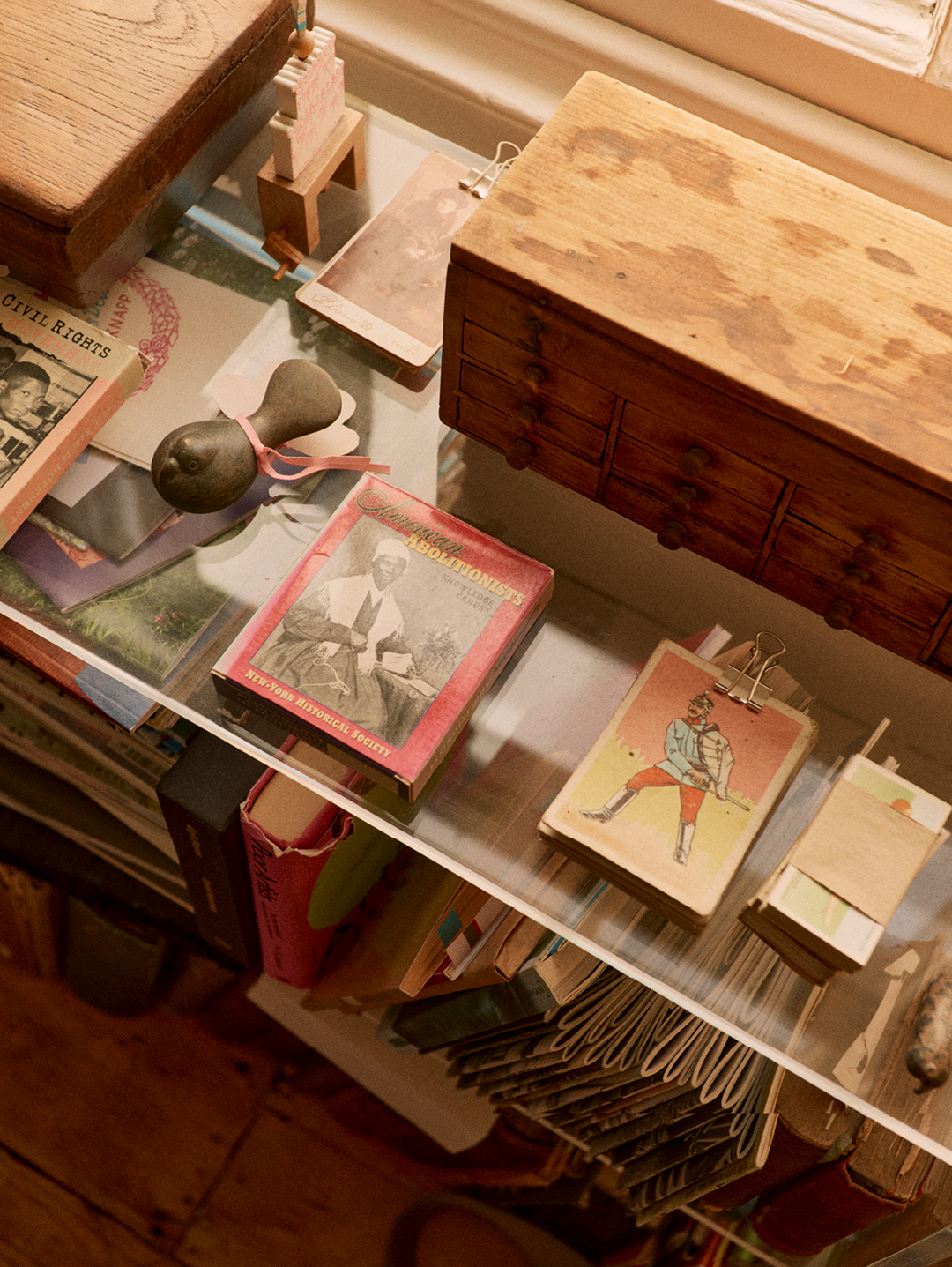
Himid was born in Zanzibar in 1954 and moved to England as a young child after her father’s death. She never fails to note that this early experience across cultures, raised by a mother who was a textile designer and taught her to properly look, deeply informs the work she makes. She first trained as a theater designer and later studied cultural history. Her visual repertoire continued to be broad and curious. I first came to know her work face-to-face during the commemorations for the abolition of the transatlantic slave trade in 2007, the subject of my first proper job within museums. The breathtaking scope, astute understanding and tender humanity of the 100-figure strong installation Naming the Money, which I first walked amongst at the V&A, has never left me. This was just part of her long consideration of cultural justice.
She often did not place her own art center stage. Through the 1980s, Himid was a curator platforming work by Black female artists, which institutions would not exhibit. She continues to describe herself as a ‘cultural activist.’ At the first Convention for Black Art in Wolverhampton, held in 1983, she was one of the women who left the main conversation for a landmark breakaway discussion with Claudette Johnson, Sonia Boyce and many other notable artists. In 1985, she curated The Thin Black Line at the ICA (recently marking 40 years with Connecting Thin Black Lines 1985-2025), showcasing work by young Black and Asian artists, and so titled because of the narrow length of corridor which she was given, as much as the implication of standing aligned against the denial of spaces to show their work. From the 1990s, she was a teacher and academic celebrating marginalized histories, people and cultural forms.
There has been no shortage of accolades for her ambitious installations, paintings and varied other work in the last decade. She won the Turner Prize in 2017 at the age of 63, the first year the prestigious prize for British artists reverted to nominations without age limit. Her work is held in the most significant collections nationally and globally; she was both elected a Royal Academician and awarded a CBE in 2018. Her Emeritus Professorship of Contemporary Art at the University of Central Lancashire is in recognition of her longstanding academic contribution to the art school (teaching responsibilities and affordable space for her art practice were among the reasons she first moved to Preston). Following a solo exhibition at Tate Modern in 2021, further major surveys in Beijing and Texas have followed as well as several international art prizes.
It should be unremarkable that three Black artists have consecutively received the honor of representing Britain. Not long ago, it was unremarkable that Jeremy Deller succeeded Mike Nelson in 2011 and 2013. The British Council, who commission the artist every two years, will be very conscious of the sequence they now select, taking responsibility for history, theirs intertwined with a national story. Sonia Boyce (who won the Golden Lion for her Venice exhibition in 2022), Sir John Akomfrah (who represented Britain in 2024) and Lubaina Himid each have very different art practices, only comparable in their deep commitment to their respective forms of making. But to leave the common activism they have engaged with unmentioned would suggest that the work might be done, when it is so clear that it is not.
Who would have imagined how years working with smaller, nimbler institutions outside London was in fact the very preparation for Venice? “The pavilion itself is a sort of layout that I’ve been used to since I was working when no galleries, only museums, showed my work — only regional museums. They had that layout when you go in and, in Britain, you turn to the left and you have that configuration of room, vista, room, vista, room, vista. So, it suits me beautifully.” I think of the Harris in Preston. Himid was curious about towns and cities that welcomed her work more easily than London. “It doesn’t matter whether it’s a famous gallery or a funny old museum. They’re repositories of history, of course, but also even of the air and the dust and the hair and the heat of people who have been in them, or people that paid for them, or people that built them.” She is visibly pleased that her Venice commission will tour across the United Kingdom after the Biennale.
“The thing about the pavilion is that originally it was the cafe. It wasn’t the British Pavilion. So it was in the best position, because when you go to a museum, we all know that the cafe and the shop are in places where the organization wants you to end up or wants you to go, to have an extra experience, and hand over some money. So, of course the British would decide to commandeer and alter that building, because it works. It works in Britain’s idea of itself.”
The beginning of her paintings is always intimate. “It’s a conversation between me and the paintings, if it’s working, well, I try to be in that space with them and feel the heat, or feel the wet, or feel the noise, feel the fabric, you know?” At the point in which we meet, anticipating the artworks traveling to Venice, her thinking opens out to an almost-social practice. People, visitors, audiences, are all vital to her, beginning in the theaters of her early training. “I climbed in and out of the paintings, but I’ll never know whether it works for people until some peculiar thing, in five years’ time, when somebody on a staircase says to me, ‘I really loved where such and such happens.’ They are important, people who’ve come, because they want to know more and they, without knowing it, give a load of energy and meaning and heat and breath to the work.” Lubaina Himid’s new work will be waiting to greet us at the top of the hill in Venice.
Lubaina Himid’s British Council commission for the British Pavilion at the 61st Biennale Arte runs from Saturday 9 May to Sunday 22 November 2026.
“I did the craziest thing I’ve ever done for a project”: How Rosebush Pruning landed Lukas Gage his most challenging role to date and a new therapist “I did the craziest thing I’ve ever done for a project”: How Rosebush Pruning landed Lukas Gage his most challenging role to date and a new therapist
“I did the craziest thing I’ve ever done for a project”: How Rosebush Pruning landed Lukas Gage his most challenging role to date and a new therapist
“I’m always interested in doing something I haven’t done before”: Gugu Mbatha-Raw on Possession and challenging the cultural zeitgeist “I’m always interested in doing something I haven’t done before”: Gugu Mbatha-Raw on Possession and challenging the cultural zeitgeist
“I’m always interested in doing something I haven’t done before”: Gugu Mbatha-Raw on Possession and challenging the cultural zeitgeist
“I love creating in chaos”: Odeal on his days as a fencing instructor and love of all things creative “I love creating in chaos”: Odeal on his days as a fencing instructor and love of all things creative
“I love creating in chaos”: Odeal on his days as a fencing instructor and love of all things creative
The HaloBraid is the new piece of beauty tech disrupting the braiding world The HaloBraid is the new piece of beauty tech disrupting the braiding world
The HaloBraid is the new piece of beauty tech disrupting the braiding world
Ama proves that it’s all in a name with her self-titled sophomore album Ama proves that it’s all in a name with her self-titled sophomore album
Ama proves that it’s all in a name with her self-titled sophomore album
“It’s camp, seductive, vulnerable and very razzy.” We’ve seen the future of comedy and it’s Grace Quigley’s surrealist high-femme fever dream, On Our Backs “It’s camp, seductive, vulnerable and very razzy.” We’ve seen the future of comedy and it’s Grace Quigley’s surrealist high-femme fever dream, On Our Backs
“It’s camp, seductive, vulnerable and very razzy.” We’ve seen the future of comedy and it’s Grace Quigley’s surrealist high-femme fever dream, On Our Backs
“I didn’t do what everyone expected me to”: Nia Archives on lessons in love and the jungle projects you should be listening to “I didn’t do what everyone expected me to”: Nia Archives on lessons in love and the jungle projects you should be listening to
“I didn’t do what everyone expected me to”: Nia Archives on lessons in love and the jungle projects you should be listening to
“Now I feel like I’m in an age where I can just be myself”: Jan de Villeneuve on embracing her authentic self and what it takes to be a model “Now I feel like I’m in an age where I can just be myself”: Jan de Villeneuve on embracing her authentic self and what it takes to be a model