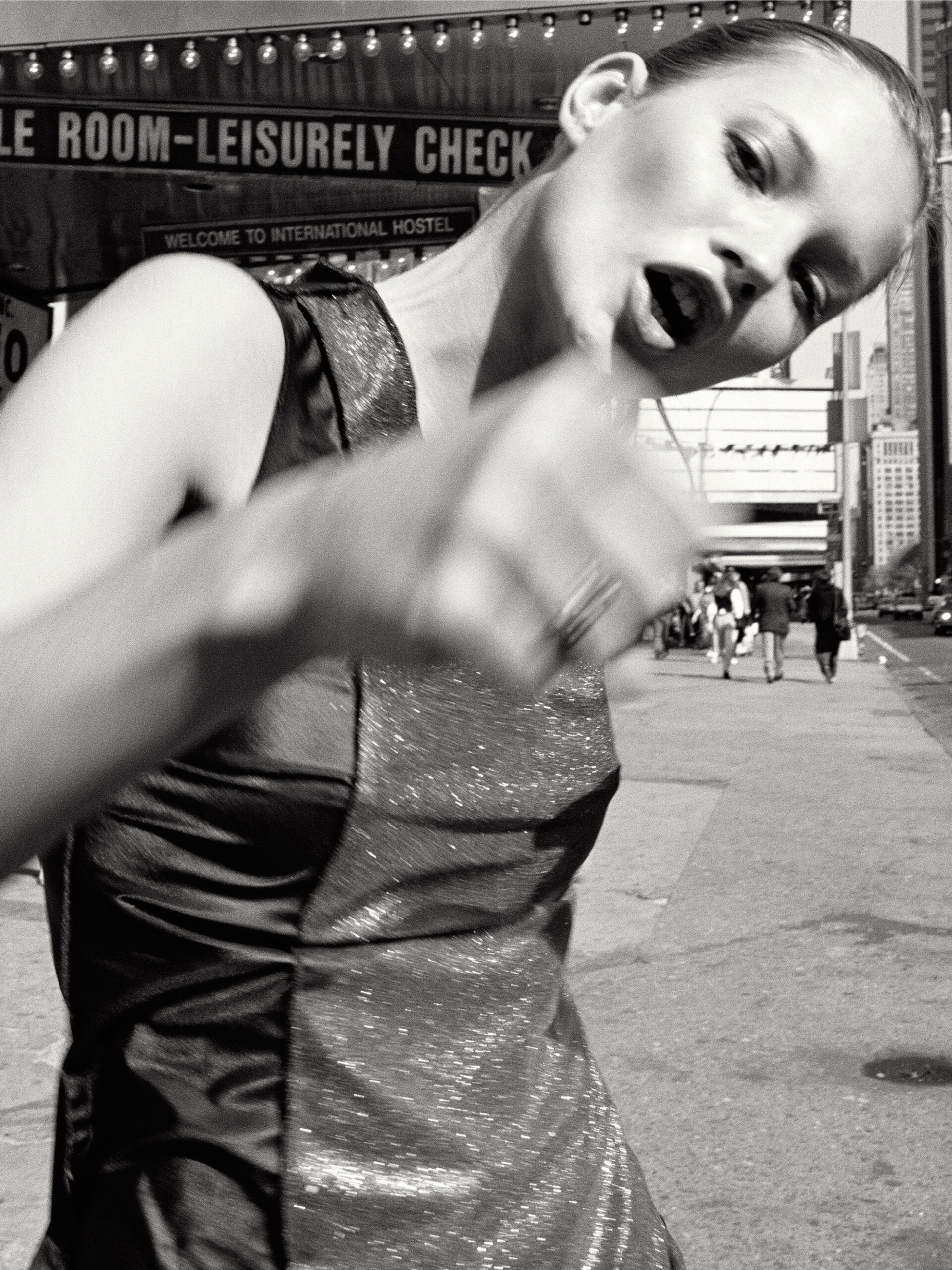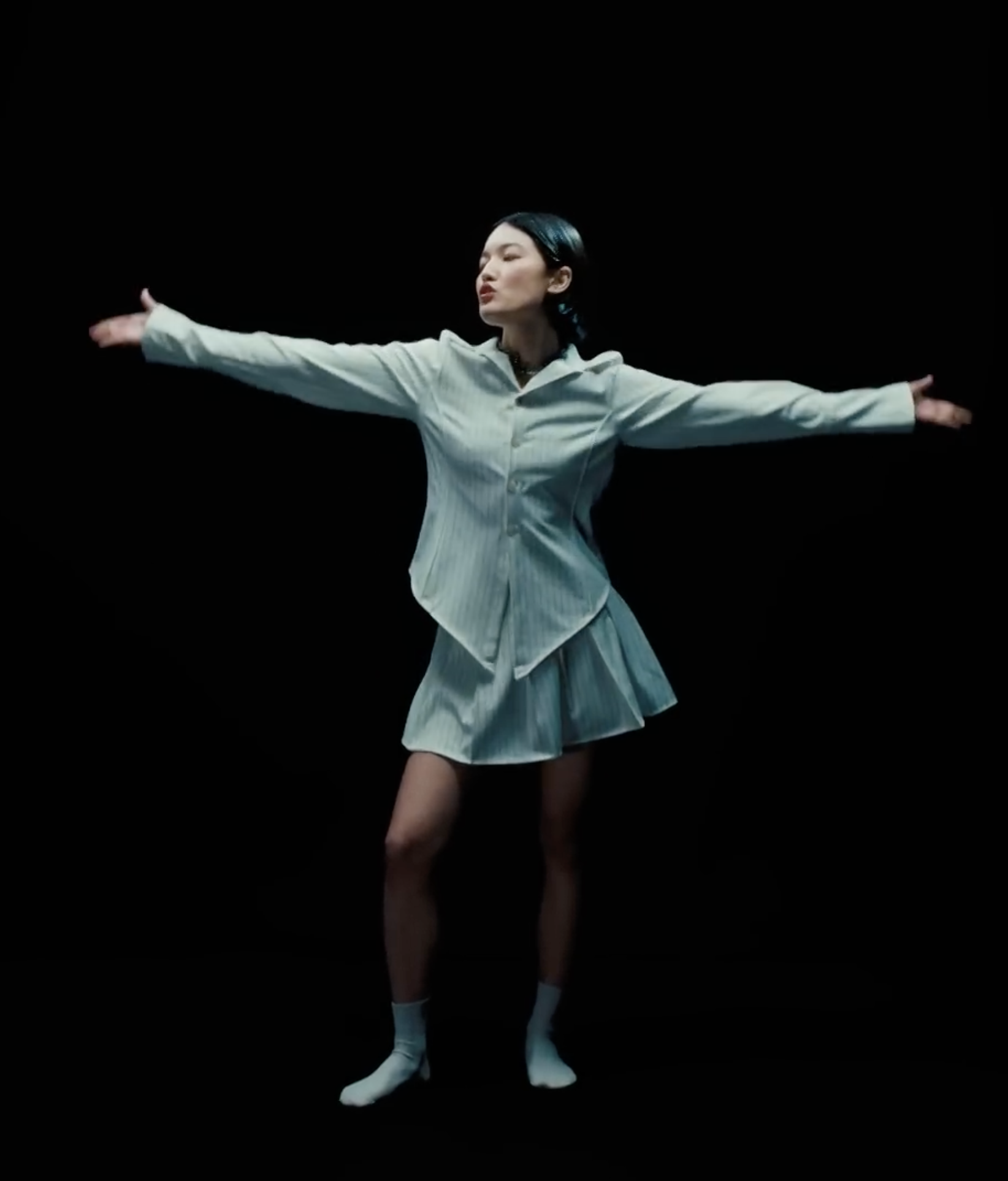
With sharp songwriting, sexually candid lyrics and a breakout hit that turned her into one of British pop’s most exciting new voices, Chloe Qisha is building her career with wit, humour and absolute creative control.
The pop landscape is littered with worn out artists trying desperately to grab people’s attention as millions of songs are chucked online every week. The wait for your chance to bask in the glory of sudden yet hard-won virality can feel endless. The disarmingly cool singer-songwriter Chloe Qisha, however, didn’t have to wait too long. Released in August 2024, her second single, the LCD Soundsystem-meets-Olivia Rodrigo mini drama I Lied, I’m Sorry, quickly took off and currently sits on 8m streams on Spotify alone.
Born in Malaysia, Qisha moved to the UK when she was 17, where she fell into music while finishing a psychology degree (the plan was to be a therapist). While the speed of her ascension has been quick – she’s currently finishing her forthcoming third EP with Swedish super-producer Max Martin’s team of banger merchants – there’s been a lot of work behind the scenes when it comes to finessing her slick, whip smart, often hot and heavy songs that channel everything from ABBA to Chappell Roan. “I’m a real perfectionist,” the 26-year-old tells me.
If we were to write a song together, where would we start?
Ooh. I would personally start with asking what you’ve been listening to recently.
Okay, I’ve been listening to Chloe Qisha.
Oh, gorge, we love her. Okay, then I would ask you what’s been going on in your life right now. Is there anything that you want to speak about, or do we want to write from scratch? I always think that’s a great experiment to do. And then we go from there. I do think some of the best songs are just written via having a good yap. That is how I start every session of mine.
Is there anything off limits in your songs?
No. I guess from the first EP onwards, I’ve always had this mantra that nothing’s off limits, be it sonic or lyrical references. There’s a lot of trust that I put in myself and my art and my voice particularly, and that acts as a good through line throughout all the music. I’m a big believer in throwing what the inspiration is out on the canvas and then you can always reel it back in and tailor it after the fact.
It’s been noted that a lot of your songs are quite horny. Why is that an interesting space for you to explore?
I just think it’s the most human experience. Even the word ‘horny’ is so interesting to me because when YDH [AKA Young Dumb Horny] came out [in February] we had everybody say ‘can you do a clean version?’, which is funny because it’s not even a swear word. To me it’s quite a PG word. So I’m just like, let’s unpack that. To me, that’s weird.
What did you change it to? Or did you not change it?
I refused to change it. I think we did a horn sound. I’m definitely not stopping the roll on the horny songs. Recently I’ve really loved writing with women. Writing songs about sex with women for women. I’ve been writing so many of them because it’s all born from laughter and feeling very empowered in that space. Sexual exploration is a very inward thing as well; it’s not just like how do I present to this man or woman or person, it’s feeling confident in yourself and feeling like you can express that. Last year was just a very sexual year for me.
Do people have expectations about you as a person because of your songs?
I do maybe have that as a slight fear. That’s actually a really interesting question. I’m going to ask that to my fans when I do a meet-up with them because it’s quite an interesting thing for me. I think ‘Chloe Qisha’ versus the at-home version of me are like two completely different sides of the same coin, which I love.
Also probably quite healthy.
Precisely. I think the Chappells of the world have set an example. It’s brilliant having that slight separation of the self, just to be able to do this longevity-wise. It’s really important. But I do look at other artists, particularly developing artists that are killing it right now, who literally live and embody that artist persona even more behind closed doors, and I have nothing but respect for them. But personally I couldn’t do it.
I read that when you’re songwriting you tend to start with a title and work from there.
I do, yeah. That’s the thing I think about first and foremost. Just even aesthetically, when I think of, like, my DSP page. It sounds so terrible and materialistic, but I do think about that. I really like a striking title. We’re at that level of pop now where everyone’s coming to the fore and you have to think about that stuff.
Do you remember the first song you wrote?
I don’t remember what the title was. I think it was about unrequited love, which has always been a running theme in my life. But I came to music incredibly late. I almost wish I had the sort of background of, you know, writing in my room age 14 on a guitar.
Let’s make that up.
I know. I should be like, ‘oh me? I’ve been doing it since I was nine’. But no, I taught myself guitar just like learning how to play covers, at maybe 16 or 17. Then I probably started dabbling in songwriting, even though I didn’t really know what it was, when I was 19.
So no teenage poetry?
There was an era where maybe I considered myself to be a writer. If Substack was a thing back then, I would have been all over that shit. I’m surprised I wasn’t more of a Tumblr girl.
Do you think it helped that you were slightly older when labels, etc, came knocking?
A hundred percent. It took me a lot longer as a human being to fully form, and you can blame that on the lack of prefrontal cortex development pre-age 25 or whatever but I truly would say it took me until my mid-20s to properly crystallize in terms of who I was, and what my identity is, and what I had to say in the world. And also just to have healthy boundaries between myself and work. So I think it is super important. Although now that I’m in [the industry], it’s still kind of the Wild West.
You were quite far down a specific career path when you veered off towards pop. So what did your parents, or the people around you, think when you said you were going to try music?
They were cautiously optimistic. I played it quite well, like unknowingly. Music arrived in the last year of my first degree. So I was already ticking that box for them, if that makes sense. I already sort of did the Asian parent request of getting into a good Uni and getting the Bachelors of Science. Once that was ticked, weirdly, they were like, ‘yeah, go on, do it. Just don’t come asking us for money’. But I also had a plan B, and a plan C, and a plan D, at any given point and that’s just how I operate now.
Would you have made a good therapist?
No. I’d feel too much. I’d also yap too much. I’d come back home and be like ‘you would never believe what I just heard’. Privacy and confidentiality would just go out the window, so thank god I didn’t do that.
I’ve always had this mantra that nothing’s off limits, be it sonic or lyrical references. There’s a lot of trust that I put in myself and my art and my voice particularly, and that acts as a good through line throughout all the music.
CHLOE QISHA
Does your psychology degree come in useful in the music industry?
I think your first degree is just to experience that melting pot of being amongst hundreds of people who also don’t know what they’re doing at the same time, and there’s a nice camaraderie in that. I’d love to say that, you know, my readings on Freud and whoever else informs my psyche of how I write, but the only thing that I kept from that is just my curiosity about people. I get to meet so many incredible creatives doing this job, like I work with a lot of dancers, I work with producers, writers, and even bandmates, that when I am interested in someone, it’s very clear that I’m interested. To a weird degree. I’m like, ‘we must go for coffee, and I must know about everything in your life. Tell me, do you have siblings? What is your star sign?’ I think it’s quite affronting for people, and I can come across as quite intense. But I just have this deep curiosity about humans and what makes them tick. That’s probably why subconsciously I did the psych degree.
As far as the public were concerned, you arrived fully formed with I Lied, I’m Sorry, which was your second ever release. Was that always the plan, to get everything sorted backstage before the big reveal?
I’m glad that it came across that way. It wasn’t necessarily intentional, it just kind of happened like that, but looking back I wouldn’t be surprised if subconsciously I did that because I’m a real perfectionist. I like to feel prepared. I’ve been writing for years, like probably at least four or five years now. There were so many points where I could have said, ‘okay, here’s five songs, let’s do this’. But there was always one thing that wasn’t quite right, whether that was the sonics at the time, or my previous management situation. There was just always something. So maybe in my brain, I just knew it wasn’t the right fit and I wanted to wait until it was the right fit.
Did you ever worry that I Lied, I’m Sorry was your best song?
At the time I didn’t think it was a great song! When we wrote that it was such a pivot from everything that we had just been writing that I assumed we were just experimenting. I didn’t have a manager at that point either. It wasn’t until weeks later, Rob [Milton, songwriter and producer] came back and was like, ‘no, my team absolutely love it. They think it’s a huge song.’ But I still wasn’t convinced. It didn’t feel like this was going to be the thing that made everyone turn their heads. So, yeah, weirdly that definitely took the pressure off.
The art of understatement: Jacqueline Rabun and the enduring appeal of minimalism The art of understatement: Jacqueline Rabun and the enduring appeal of minimalism
The art of understatement: Jacqueline Rabun and the enduring appeal of minimalism
A photographer’s love/hate relationship with Seoul A photographer’s love/hate relationship with Seoul
A photographer’s love/hate relationship with Seoul
Tems on why protecting her peace has become her greatest success Tems on why protecting her peace has become her greatest success
Tems on why protecting her peace has become her greatest success
“I’m obsessed with pop music and think I will be forever”: Troye Sivan on new album She’s the Best “I’m obsessed with pop music and think I will be forever”: Troye Sivan on new album She’s the Best
“I’m obsessed with pop music and think I will be forever”: Troye Sivan on new album She’s the Best
Edward Enninful on the enduring impact of the 90s Edward Enninful on the enduring impact of the 90s
Edward Enninful on the enduring impact of the 90s
Topjaw’s Jesse Burgess on Gordon Ramsay, Michelin stars and building a food empire online Topjaw’s Jesse Burgess on Gordon Ramsay, Michelin stars and building a food empire online
Topjaw’s Jesse Burgess on Gordon Ramsay, Michelin stars and building a food empire online
How Lima’s young creatives are using fashion as an act of resistance How Lima’s young creatives are using fashion as an act of resistance
How Lima’s young creatives are using fashion as an act of resistance
Glen Luchford revisits his photographs that captured the spirit of the 90s Glen Luchford revisits his photographs that captured the spirit of the 90s