Beyond the Tech Bro: The women building a different AI future
AI is synonymous with a certain kind of male dominance, but a new wave of women founders is pushing back. Afua Hirsh meets three pioneers reimagining AI with ethics, accountability and ambition at its core.
The AI leader has become a meme for our times — a grandiose, charismatic, occasionally messianic figure who, like it or loathe it, is rapidly changing the reality of our daily lives. He is also undeniably male. There are good reasons for the stereotype of leading AI figures to center so much on the “tech bros”. A handful of male-led giga companies have dominated the conversation about our AI future, while the tools they develop have disproportionately excluded women. The data shows that women are using AI at around a 25% lower rate than men, and that 44% of AI systems, across different industries, show gender bias. Tellingly, only 30% of the people currently working in AI are women. Women who do work in the sector are more likely to raise concerns about the ethics of tools and their impact. According to Karen Hao, whose book Empire of AI has highlighted inequalities at every level of the AI revolution, women who do rise to positions of leadership are more likely to find themselves drowned out of the conversation or pushed out of the industry altogether. AI bias and the exclusion of women from opportunities in AI has become, according to the Fawcett Society, a major feminist challenge. So what is life like for the women taking up that challenge — founding AI companies which unapologetically aim for exponential growth, while also centering a more humane perspective? We spoke to three exceptional women founders to find out.
JENNY SHAO, FOUNDER AND CEO, ROBYN
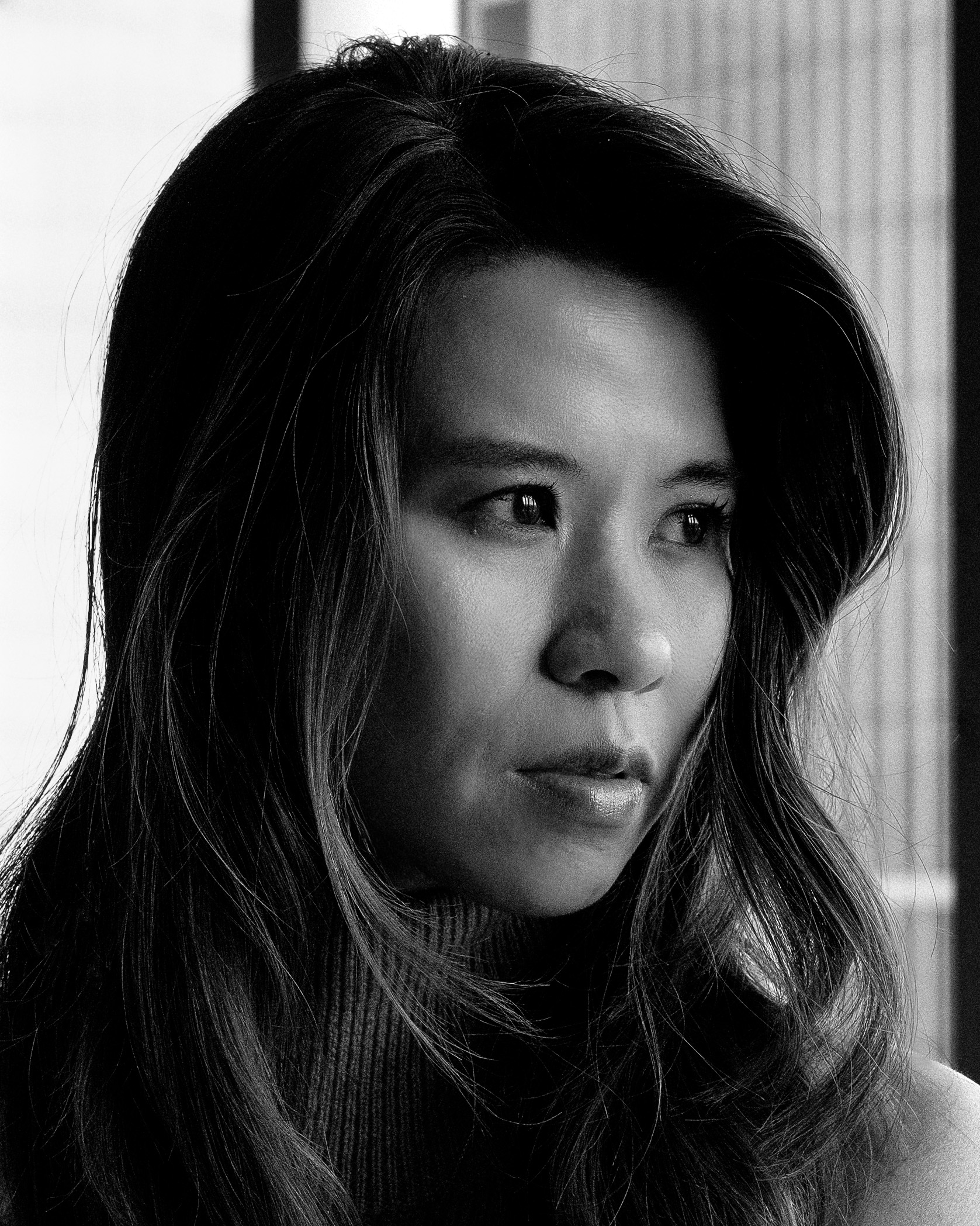
PHOTOGRAPHY CLAIRE GUARRY
Ever since she was a young girl, Jenny Shao was clear about her mission. She wanted to save lives and, as the daughter of hardworking and aspirational immigrants from China, becoming a doctor seemed the obvious way to do it. But then, having overcome every obstacle, graduating from Harvard and becoming a surgeon, COVID-19 hit.
“I was in surgery in New York City, at the height of the pandemic,” Shao says. “Bodies were being put in trucks. People were so disconnected. The one thing they would say to me was, ‘I don’t want to be alone’. It got to the point where I knew the system was broken. I felt it in my bones.”
Shao, 33, says she experienced the extremes of that time as a personal crisis, too. “I was in my shoebox Manhattan apartment. The rug had just been pulled [out from] underneath me, and I remember thinking, ‘I need something that is going to help me through this.’ And everyone was saying the same thing.”
The yearning for connection ultimately led Shao to come up with a radical suggestion; to leave her lifelong career in medicine and found her own company.“I don’t like to complain. I have this need to solve problems. And the problem was that as humans, we are biologically wired to connect, and to be held.”
Shao’s vision turned into Robyn, an emotionally intelligent AI. Robyn is perhaps best described as an anti-robotic AI — designed to lean into emotion and enhance human connections, rather than seeking to replace them. “The entire point is to empower connection,” Shao says. “It’s meant to be that place you can step into. An AI-powered partner that is able to help you feel truly seen.”
Unlike other chatbots, Robyn is focused on what humans need to thrive. “Robyn is not trained to just agree with you — that’s not really a true partner,” Shao insists. “We have already had feedback from users saying things like ‘this has made me a better husband and father,’ and ‘this helped me through a divorce.’ That’s why we exist.”
For Shao, who came to the US with her family aged just seven, taking the leap into entrepreneurialism and tech was a bold move. “Walking away from medicine was the hardest thing I’ve done,” she confesses. “It wasn’t the prestige — I already knew the realities of it. But being a surgeon was an identity. How do you walk away from yourself? It’s such a messy process.
“I’m very lucky that I have parents who are very supportive. They didn’t agree with this decision. When I told my dad I left Harvard and surgery, he was like, ‘No, you didn’t. Go back. We came here with nothing. We came with a box and two suitcases. Rewind!’ Props to them that they support me nonetheless.”
But, Shao says, the struggles of those years also gave her perspective. “As a child, I really saw my parents go through it,” she explains. “We came to the US with very little. We were as poor as you could be without being homeless. I remember watching my parents grind night and day to make that life for their daughter. No risk I could take could even be half as much as the risk they took. I thought to myself, ‘If I have to drive an Uber, I will. I will make sure my dogs are fed, and I will build something that, in a few years, will be a reason that people feel more alive.’ “It’s been the best decision of my life,” Shao adds. “I bet on myself. Not to lean into any fancy institution or fancy title. But I decided to bet on Jenny.”
Since founding Robyn in 2024, Shao has successfully raised more than $5 million in seed funding, making her one of very few women and even fewer women of color who found AI companies and successfully attract investment. “The reality is that about 0.2% of VC money goes to women of color,” Shao laments. “It’s very unfortunate and something we should actively work to change. Women are half the population — having women build technology that really impacts the way we live and connect is so important. It’s not a calling card; it’s the objective truth.”
Women are half the population — having women build technology that really impacts the way we live and connect is so important.
JENNY SHAO
“Our team hails from every part of the world,” Shao says. “We are a human-first company — a celebration of being human. So why should it be built for one specific group? We are building something for all humans.”
Shao’s ambition and success at fundraising is leading to rapid growth. “We took the team from three people to ten people in the past eight months,” Shao says. “We are growing very rapidly. But we want a very mission-aligned team, we are more emotionally connected and better off because of what we build. There’s a running joke that it’s easier to get a job at Google than at Robyn,” she laughs.
“When I tell people I used to be a surgeon, people in Silicon Valley said, what a weird jump. For me it made complete sense. My training in medicine, especially in surgery, has made [me] a much better founder. Radical ownership, placing humans first — that’s come from that training. If you’re on your shift, and someone is bleeding out, you can’t be like ‘just come back tomorrow’. As a surgeon you are the person who gets to stand in front of their family and say, ‘your person is alive today.’
Shao has been outspoken in her critique of some version of the tech future, which she acknowledges raise fear and anxiety in many people concerned about finding their work replaced and their opportunities for human connection limited. “My very ardent view is that AI and any tech should never replace humans,” she says.
It’s a perspective that challenges the presumption that the best ideas are always new. “I don’t think Robyn is innovative at all — it is as old as time,” she says. “This idea that we need connection.”
The entire point is to empower connection. An AI-powered partner that is able to help you feel truly seen.
SAMANTHA PAYNE MBE, CO-FOUNDER, OPEN BIONICS
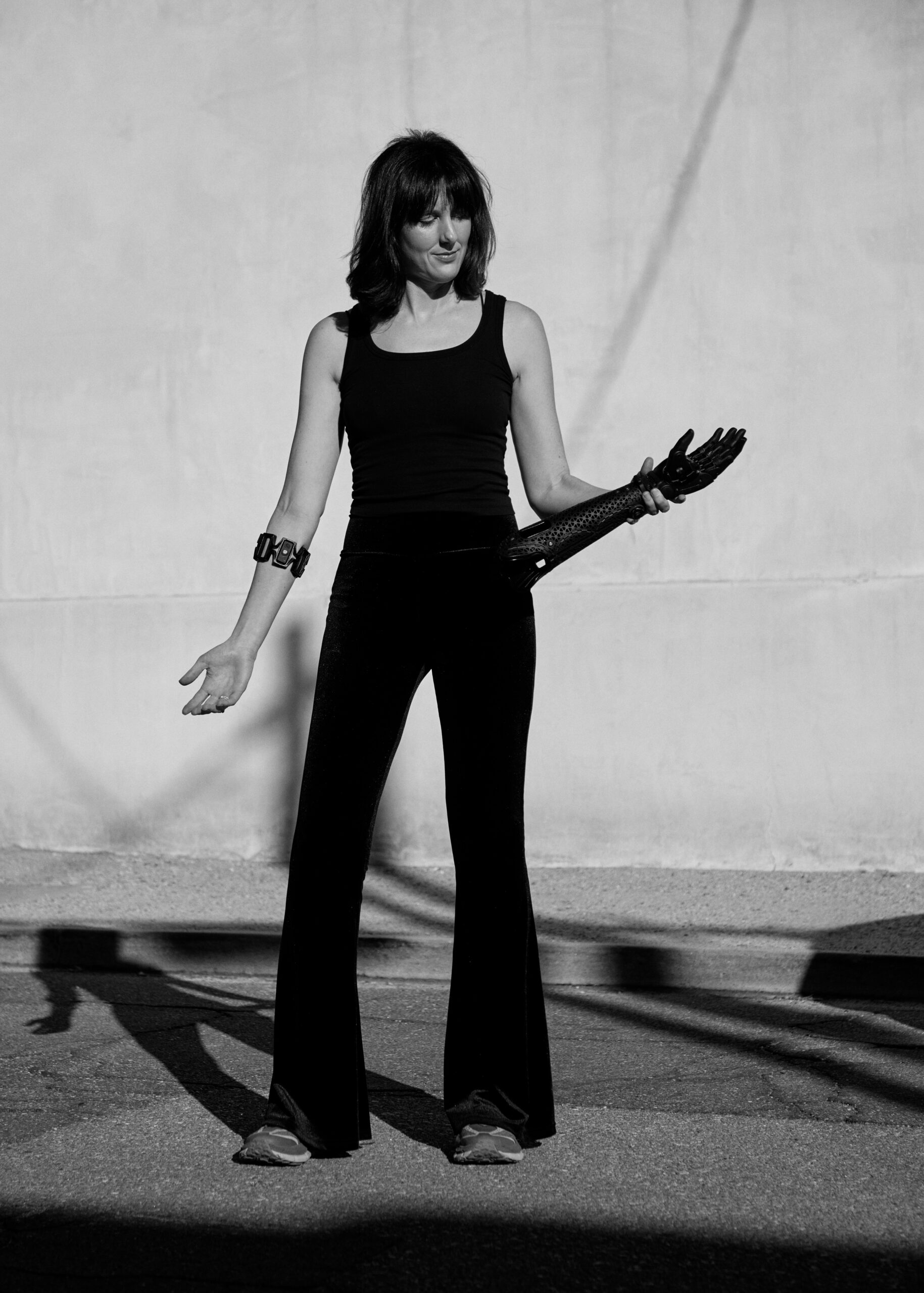
PHOTOGRAPHY THOMAS GIDDINGS
Our questions about the AI future often boil down to what it means for our jobs, for learning, our quality of life and social roles. But there are deeper themes too — whether we are divine, our bodies sacred, and which, if any, parts can be replicated by technology.
For most of us, these concerns — if we entertain them at all — are matters of philosophical and theological debate. But for Samantha Payne, they are just another part of her day job. “I have done a world tour of speaking, and presented on a few big stages,” Payne says. “When I’ve presented our work in countries with a higher religious identity, I have found people sometimes struggle with what we do, and the idea that we might be ‘changing’ something that is God’s will.’ As if engineering a human hand is interfering with God’s work.”
Payne, 34, is co-founder of Open Bionics, a company she and business partner Joel Gibbard created when she was just 23 years old. Its goal is simple — using 3D-printing technology to improve prosthetics available to people with limb differences.
The company, which has gone on to win numerous awards, raise more than £10m in investment funding and provide advanced bionic limbs to thousands of patients, now operates across the globe. Its designs have been widely adopted as significantly more affordable, as well as stylish and reflective of the wearer’s identity.
Payne’s journey into becoming one of the world’s most celebrated female AI founders started in an unlikely location — a large council estate in Bristol, in the south-west of England. “I went back to the Estate recently,” Payne says. “There are such huge social problems [and] basic resource questions. A lot of these kids don’t have enough to eat. They are hungry and they can’t concentrate. A lot of these homes don’t have the space to have anywhere to sit and do homework. Kids are told, ‘you’re never going to be anything’. I was told at school I would be lucky if I managed to get the opportunity to become a shelf stacker, or to make it to a call center,” Payne says. “Every child in Knowle West develops their own coping strategy with how tough life can be there. My escape from a very young age was reading. And I really loved running. I developed two healthy outlets that allowed me to stay focused.”
Payne studied journalism and initially started working as a reporter, when she met Gibbard, who had already had the idea for Open Bionics. The two founded the company together and, Payne says, had nothing to lose.
“When we first had the idea for Open Bionics we were pitching it around. We were in this flat that rained on the inside. There was no central heating, we were using space heaters. We won the pitch and they flew us out to Berkeley. The contrast between trying to build a company in rainy Bristol and trying to build a company in California!” Payne laughs. “Getting to America at a young age really helped. Everything got scaled up exponentially.”
Payne’s background in journalism continued to influence the company, which set about finding out what wearers of prosthetics really wanted from them.
“One thing that my background gave me was curiosity. I called 100 upper limb amputees and just spent hours talking to them and listening. That’s how I realized how previous designs were having such a negative effect on people’s confidence,” Payne explains. “It made them feel worse about their disability. It made them feel shame.
“We realized all these devices should be a vehicle for self-expression. All of our tech is about increasing the empowerment of the end user. They can exert their control and influence over every aspect of the device — changing the software or expressing their identity via the cover. We created magnetic covers; you can swap how the thing looks. We were the very first company to offer that. Our job as creators and builders is to build the best device for the patient.”
One of the areas Payne expresses most pride in is the impact of Open Bionics’ prosthetics on children. Disney granted Open Bionics royalty-free license agreements, so that they could produce prosthetics based on young people’s favorite characters like Black Panther, R2-D2, and Iron Man. But Payne says the benefits are unlimited.
“It’s literally for everyone and anyone. Our youngest patient is 5 years old, our oldest is 90,” she says. “Men and women, boys and girls. People born without hands. Who have lost hands in workplace or industrial accidents, agricultural, fireworks, trampolining, car crashes, kitchen accidents — lots of kitchen accidents. We just offer a really advanced solution to a serious functional problem.”
The company’s success has not sheltered Payne from the misogyny which she says is still too visible in AI. “I experience misogyny all the time!” she exclaims. “Within normal workday interactions, also at conferences. When I get off stage, the type of questions I’m asked, in boardrooms, in VC pitches. I’m really lucky to have a co-founder who has been on this journey with me. He was really shocked the first few times he was exposed to it. Now he makes it a game. When someone is being overtly misogynistic to me, he will make it really awkward for them,” she says. “I want to be able to say it’s getting better, to encourage women and girls that change is happening. But if you look at the investment data at the amount going to women-founded businesses and women co-founded businesses, it is so strikingly less than white, male-founded businesses.”
I want to be able to say it’s getting better, but the amount going to women-founded businesses… is so strikingly less than white, male-founded businesses.
SAMANTHA PAYNE
Payne has also been vocal about barriers for people from working class backgrounds like her own. “Seed round fundraising is often called a ‘friends and family’ raise,” Payne explains. “When we were at that stage, I remember people saying, ‘Just ask your friends and family, ask your network.’ I’m from a council estate that’s described as one of the top 1% to 2% in the UK for social deprivation. There’s no one there that has spare change!” Yet Payne says she is now, in her 30s, as comfortable taking up space on those global stages as anyone else. “My confidence in those rooms comes from the last 10 years of building the company. I can talk to anyone about the realities of doing the work.”
YINKA OGUNBIYU, CHEF AND BIOMECHANICAL ENGINEER
PHOTOGRAPHY CHRISTIAN CASSIEL
There is a big technological shift happening. I would love to see more women — minorities, Black women —benefit.
YINKA OGUNBIYU
Yinka Ogunbiyi’s first foray into founding a tech-forward company came from an unlikely place — a love of cooking, and specifically, smoking brisket. Struggling through Boston’s harsh winter as a British-Nigerian undergraduate at Harvard, Ogunbiyi found respite in her bioengineering class, in which her professor set an unusual challenge — building a better barbecue. “We smoked a brisket every week,” Ogunbiyi remembers. “But we couldn’t smoke enough of them to get the results we needed to test our appliance. So, I started making computer simulations and translating that into a computer so that we could smoke thousands of briskets a day.”
In the end, Ogunbiyi and her co-founders sold that innovation to a grill company, and she returned to college for an MBA. Studying at Harvard Business School, she had another idea. “I realized I was a biomechanical engineer who designed and started stuff from scratch, and who has worn braids all my life,” Ogunbiyi says. “Growing up, my mum braided my hair all my life. She had a butcher’s shop and a restaurant, and she would also spend six hours braiding my hair.
“I talked to a lot of people about their experiences of getting their hair braided. I wouldn’t even finish the question, before they said, ‘It takes so long!’” Braiding is an ancient technique for styling afro-textured hair and adorning people in African cultures, with millennia of tradition infused into the practice. It was researching this history that really convinced Ogunbiyi there was room for innovation, she says. “I looked into the history of braiding and found an image of ancient Egyptian drawings. It just struck me. This image was 3,000 years old, and yet I can walk into any hair salon today and see the exact same thing. Everything we practice in life has changed — apart from this!”
Together with her co-founder David Afolabi, a fellow Harvard graduate, Ogunbiyi, 32, created HaloBraid, a tool that automates the braiding process, building hundreds of prototypes until they engineered a machine complex enough to replicate the task. “We built 600 different versions of this product to get to the finish line,” she recalls. “We started with looking at industrial machines, rope braiding for ships or climbing, toy machines… we just kept following the engineering innovation process.
Launching this summer, HaloBraid began attracting growing attention, which escalated when a video circulated on social media of Ogunbiyi making a pitch that ultimately won her company a prestigious Harvard President’s prize in 2025. The video attracted praise, but also backlash, with some commentators questioning whether it was desirable to automate an ancient and sometimes ritualistic beauty tradition using AI. “Some people are asking, why change it?” Ogunbiyi admits. “But that represents thousands of hours of Black women’s time. That represents so much potential business!”
Ogunbiyi also interviewed braid stylists who described the health impact of long hours of repetitive braiding, which is usually done standing on one’s feet while the client sits in a chair. “Arthritis is a huge problem for people who do braids,” Ogunbiyi explains. “They are using their arms and hands for repetitive motions for twelve hours a day. They experience carpal tunnel syndrome, or they are leaving the business because they can no longer do it or have to put their hands in ice. They are on their feet all day. Their backs. It’s really hard manual labour.”
Ogunbiyi is careful to emphasize that HaloBraid does not replace the human expression and connection involved in braiding. “Creativity and humanity will always have value,” she insists. “The way this works, the stylist is an integral part of the process, still responsible for the creativity and artistry.” HaloBraid could in fact, Ogunbiyi suggests, create more profit for braid stylists, the majority of whom are Black women. “There’s an interesting concept called Jevons Paradox,” she explains. “When something is made more efficient, you generate more business. I 100% think HaloBraid will create more jobs in the braiding salon economy. People who were put off doing it because they don’t have time will now be able to get braids. Our intention is that people can get the hairstyle of their dreams without time being a barrier.”
As a Black woman herself, Ogunbiyi is intensely aware of the scarcity of good news stories about founders like her in AI. “At the time I came up with HaloBraid, only [very few] Black women had raised more than a million dollars from VC,” she explains. “And so, few had done it from hardware. I knew going into it that we have to do twice as much with half the resources, by every metric,” she adds. “Build more prototypes, build them with less. Money is not usually given. When I am talking to investors, most investors have not had the experience of getting their hair braided.”
The lack of representation has, Ogunbiyi reflects, made some Black women even more cynical about AI. But she insists rejecting the technology is not the solution. “What we can’t do is just avoid it. There is a big technological shift happening. I would love to see more women — minorities, Black women — benefit.”
Omah Lay talks his sophomore album Clarity of Mind and his journey to self-forgiveness. Omah Lay talks his sophomore album Clarity of Mind and his journey to self-forgiveness.
Omah Lay talks his sophomore album Clarity of Mind and his journey to self-forgiveness.
The R&B renaissance is underway The R&B renaissance is underway
The R&B renaissance is underway
Lindsay Perryman celebrates Trans Day Of Visibility with powerful portraits of some of their favourite creatives Lindsay Perryman celebrates Trans Day Of Visibility with powerful portraits of some of their favourite creatives
Lindsay Perryman celebrates Trans Day Of Visibility with powerful portraits of some of their favourite creatives
Photographer Ezekiel honours Trans Day Of Visibility with intimate portraits of UK creatives Photographer Ezekiel honours Trans Day Of Visibility with intimate portraits of UK creatives
Photographer Ezekiel honours Trans Day Of Visibility with intimate portraits of UK creatives
“The song is kind of a f*ck you to just… everything”: Julia Cumming on going solo “The song is kind of a f*ck you to just… everything”: Julia Cumming on going solo
“The song is kind of a f*ck you to just… everything”: Julia Cumming on going solo
Love looks good on Niall Horan Love looks good on Niall Horan

Love looks good on Niall Horan
The myth of the Antwerp Six, explained at last The myth of the Antwerp Six, explained at last
The myth of the Antwerp Six, explained at last
“Legacy? I don’t get it. It’s all about painting.” Hurvin Anderson “Legacy? I don’t get it. It’s all about painting.” Hurvin Anderson