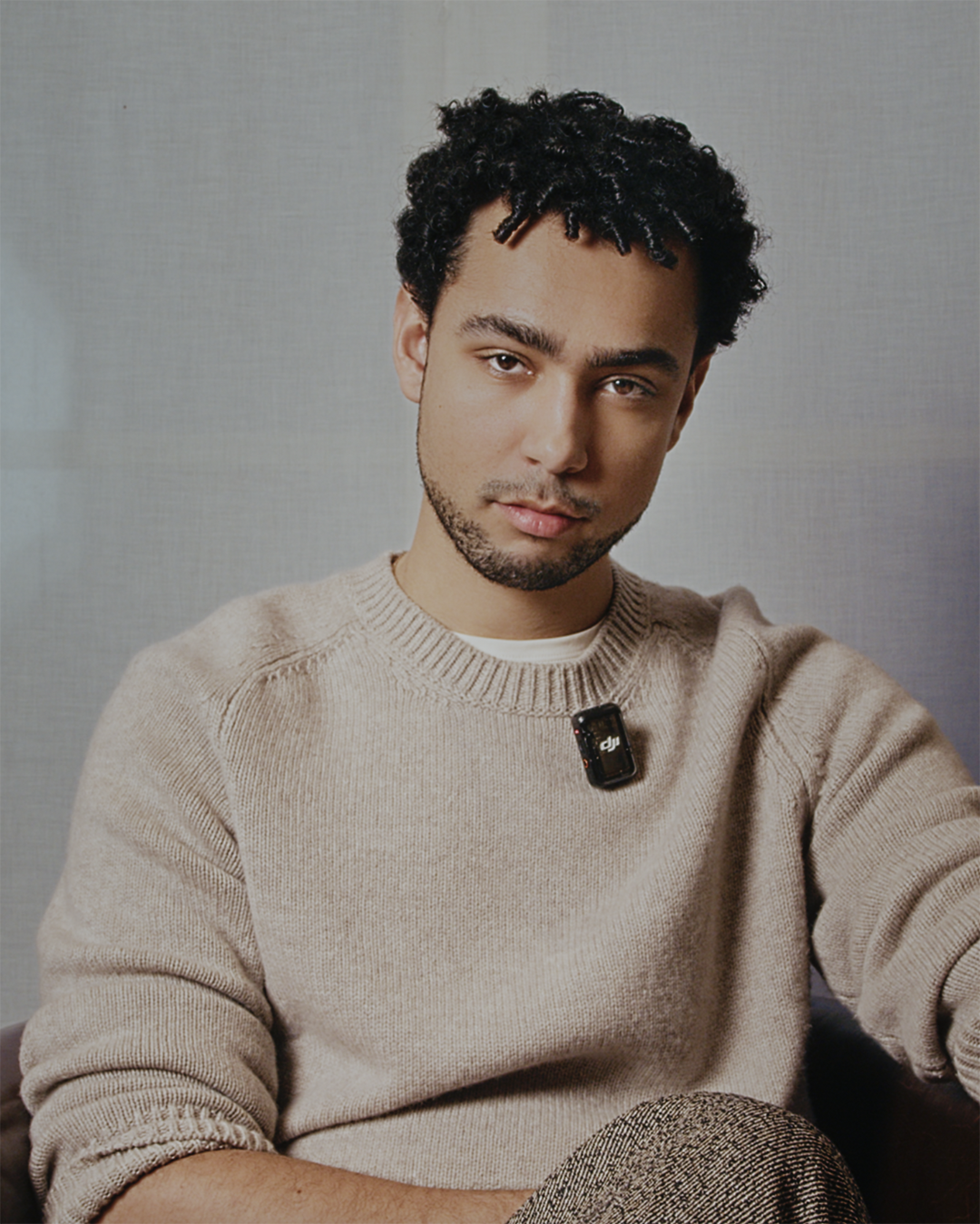
From playing the outsider in Saltburn to stepping into the spotlight in Alex Russell’s Lurker, Archie Madekwe talks to Tish Weinstock about fame, friendship, creative freedom and his BAFTA rising star nomination.
31-year-old British actor Archie Madekwe knows what it feels like to be an outsider. Growing up in south London, a mixed-race theatre kid at a predominantly white, all-boys rugby school, and standing tall at 6ft 5, it’s a feeling he’s encountered often. It’s what makes his portrayal of Farleigh, in Emerald Fennell’s 2023 grave-defiling thriller Saltburn, so textured and real. In another actor’s hands, Farleigh could have been just another snivelling posho snob. But Madekwe was keen to articulate the character’s feelings of otherness and insecurity, exposing him as a foil to Barry Keoghan’s Oliver, and making him one of the most relatable characters in the film as a result.
Madekwe had auditioned to play another outcast, Matthew, in Alex Russell’s 2025 directorial debut, Lurker, when the director came back to him with an alternative proposition: to play the lead role of Oliver instead, a charismatic popstar navigating the politics of fame. This time, the boot was on the other foot, with Madekwe playing someone on the inside, the object of another’s obsession.
This journey from the outside in mirrors Madekwe’s own arc. Despite being repeatedly told as an actor of color that the only roles available to him were essentially fringe characters or racial stereotypes, Madekwe’s back catalogue is varied and rich. In 2017, he starred opposite Damien Lewis in a West End production of Edward Albee’s The Goat, or Who Is Sylvia?, which led to roles in projects including Apple TV+’s See, Ari Aster’s thrilling chiller Midsommar, and race car movie Gran Turismo in 2023.
For Madekwe, choosing roles that shatter conventional depictions of race is paramount. “I’m trying to very specifically challenge the way audiences view and perceive people of colour,” he says. It’s a strategy that seems to be working, with the actor recently nominated for this year’s EE Rising Star Award. Currently starring opposite Sophie Turner in the British crime TV series Steal, we sat down with him to discuss his journey so far.
I watched Saltburn for the first time this weekend.
No way!
Yes, it was always just a bit too close to home for me…
That’s why I’m surprised.
Too much childhood trauma. But it was brilliant. You were brilliant. Tell me about your character Farleigh. What experiences did you draw from to flesh the character out?
I share the experience with Farleigh of being in predominantly white spaces and sharing a sensibility of feeling other, of physically not fitting in with the majority in the room. There is this weird push-pull; this feeling sometimes of wanting to prove that you do deserve to be there, and then also resenting the idea that you feel like you have to prove it. You’re constantly battling with these micro-aggressions. Which ones do you respond to? Which ones do you let roll off your back? Then being angry at yourself when you get home later, because you let that one slip by and didn’t say something in the moment.
The parallels between Lurker and Saltburn are really interesting. What was it like playing the one on the inside this time, the object of someone’s obsession?
It took me a second to get my head around. I had this real anxiety moment of like, ‘How am I supposed to convince Alex [Russell] that I can be the cool one, the alpha?’ There are so many people that I know like Oliver. It exists a lot in male friendship dynamics where someone at least perceives themselves to be the alpha. There’s always this push and pull of affection with them, where they’ll give a lot and they’ll take away a little, and leave you wondering how you fucked up. I’ve had versions of that relationship. It’s very school playground. I guess the common thread is that they’re both feeling deeply insecure. But they’re very different characters and that insecurity manifests in very different ways for both of them.
What was something you took away from playing Oliver?
I’m 6ft 5” and I’m often trying to make myself smaller or hide away from that. But there’s something about when you walk in the room and take up space, how that changes the way that people perceive you. I think that was a very interesting thing to borrow from Oliver.
I was one of two people of color in the school. Suddenly, you’re being told that you wouldn’t be able to appear in a period drama because you’re not white… You’re hearing this really archaic language, and you’re thinking, wait, ‘What is this industry that I’m moving into?!’ It puts you through this weird crisis of self.
Archie Madekwe
I wanted to ask you about your upbringing and expand on your experience of otherness that you touched on. How did you come to navigate it?
To be a boy and want to do performing arts, you have to really want it. I went to an all-boys rugby school, and there were probably only five of us who did performing arts, and so it was hell. But there was something in me that was really sure I wanted to do it and I persisted with it. At 14, I auditioned for the Brit school and going to that school completely changed my experience. For the very first time, I was liberated to trust that my creative voice was important and that what I was doing was worthwhile.
As a British actor, there’s so much emphasis on going to drama school and training classically. There’s also this real idea that if you’re a person of color, the only parts you’ll play are in Top Boy. I mean Top Boy is amazing, but it’s limiting. You go to drama school and there’s this stamp of legitimacy, where you’re like, ‘I can do Shakespeare or Chekhov or Brecht.’ When I got into LAMDA, there was this ‘I’ve made it’ feeling. But then it was a completely different experience. I was one of two people of color in the school. Suddenly, you’re being told that you wouldn’t be able to appear in a period drama because you’re not white. My dark-skinned friend is being told that he is going to look like a chocolate blancmange, all teeth and eyes, on stage. You’re hearing this really archaic language, and you’re thinking, wait, ‘What is this industry that I’m moving into?!’ It puts you through this weird crisis of self. I’ve been told that I have a perfect example of a multicultural London urban ethnic accent. And I’m thinking, ‘Really? Is that true? Is that the way that I sound? How am I perceived in this industry?’ And all of a sudden, I was experiencing this otherness, this outsider-ness, where you’re like, ‘What is the space for me in this industry? And how do I navigate that?’ I only had that experience at Brit to remind me that there are people who believed in what I was doing.
It’s interesting to experience a crisis of self in a career that’s all about inhabiting the roles of others. As an actor, how do you maintain a strong sense of self?
Your sense of self infuses everything, all your choices, the things you want to say about the world. This job is about telling stories that you think are important and can potentially change, in the grandest idea, the world. I’m choosing parts that I’ve never seen somebody who looks like myself in before. I’m trying to very specifically challenge the way audiences view and perceive people of colour and trying to play human beings in all the vast and challenging ways that human beings show up and exist in the world, outside of the lens of race, which is sometimes the only context in which we think we’re allowed to exist in film or TV.
I’m choosing parts that I’ve never seen somebody who looks like myself in before. I’m trying to very specifically challenge the way audiences view and perceive people of colour and trying to play human beings in all the vast and challenging ways that human beings show up and exist in the world, outside of the lens of race.
Archie Madekwe
What else do you look for in a role?
I often find that I’m most moved when I’m completely surprised by something. Good writing that makes you not want to stop reading. Where you immediately go into the other place and start imagining yourself in the part. Writing that makes you tear up and gives you butterflies. I pass on a lot. I’m challenging myself and trying not to play the same thing twice.
What about other creative avenues like writing, directing and producing?
I’m very much doing all of those things. I had a producer credit on Lurker, and I’ve been developing a few projects. I have one with Ari Aster’s Square Peg that we’ve been doing over a few years that is now feeling very real, and I’ve been working for the last year or so on my feature debut, which is very crazy to say out loud, but now, again, that feels really real.
We also need to talk about your BAFTA nomination. Where were you when you got the call?
I was sitting on the street. I just finished a therapy session and my publicist kept calling me. I was like, ‘What is this about?’ And she told me the news and I was so shocked to hear that my name was in the running. I weirdly had thought that I’d missed that window. We’re obsessed with the idea of a sudden catapulting to fame, but I think the idea that the brightest star burns fastest is true. I love the idea that it’s over ten years into my career and I have this incredible recognition, especially by people in the industry. It’s kind of a surreal, humbling thing.
What are your thoughts about fame?
It feels very separate to me. You have slight reminders day-to-day when someone stops you in the street. But then you continue with your day. I think if you put too much energy into that, it exhausts you. I’m very lucky to have had this incremental build. The overnight thing is really damaging and really scary, and hard to navigate. I mean it obviously comes with really amazing perks, but it’s a huge price to pay for your private life and anonymity.
Ok, last question, what are you most excited about for the future?
The incredible thing about this job is that you’re constantly moving from surprise to surprise. I’m excited for whatever it has to offer.
Out with the Snake, in with the Fire Horse Out with the Snake, in with the Fire Horse
Out with the Snake, in with the Fire Horse
Inside The Perfect Neighbor, how Geeta Gandbhir turned documentary into a catalyst for change Inside The Perfect Neighbor, how Geeta Gandbhir turned documentary into a catalyst for change
Inside The Perfect Neighbor, how Geeta Gandbhir turned documentary into a catalyst for change
‘Girl, I’m chillin!’ Eve on her overdue Grammy win, enduring legacy and embracing all things ‘woo woo’ ‘Girl, I’m chillin!’ Eve on her overdue Grammy win, enduring legacy and embracing all things ‘woo woo’
‘Girl, I’m chillin!’ Eve on her overdue Grammy win, enduring legacy and embracing all things ‘woo woo’
From South Korea to London, Antwerp, and beyond, these are the must-see exhibitions of 2026 From South Korea to London, Antwerp, and beyond, these are the must-see exhibitions of 2026
From South Korea to London, Antwerp, and beyond, these are the must-see exhibitions of 2026
Holiday Club’s Bisoye Babalola is opening doors for the next generation of creative talent Holiday Club’s Bisoye Babalola is opening doors for the next generation of creative talent
Holiday Club’s Bisoye Babalola is opening doors for the next generation of creative talent
On representation and morality: what do we want from Black women on screen? On representation and morality: what do we want from Black women on screen?
On representation and morality: what do we want from Black women on screen?
“A child should never be put in a position where they have to beg for survival.” Saja Kilani on The Voice of Hind Rajab “A child should never be put in a position where they have to beg for survival.” Saja Kilani on The Voice of Hind Rajab
“A child should never be put in a position where they have to beg for survival.” Saja Kilani on The Voice of Hind Rajab
The Rise of the Spectrum: Afua Hirsch dissects the rising rates of ADHD and autism in women and girls The Rise of the Spectrum: Afua Hirsch dissects the rising rates of ADHD and autism in women and girls